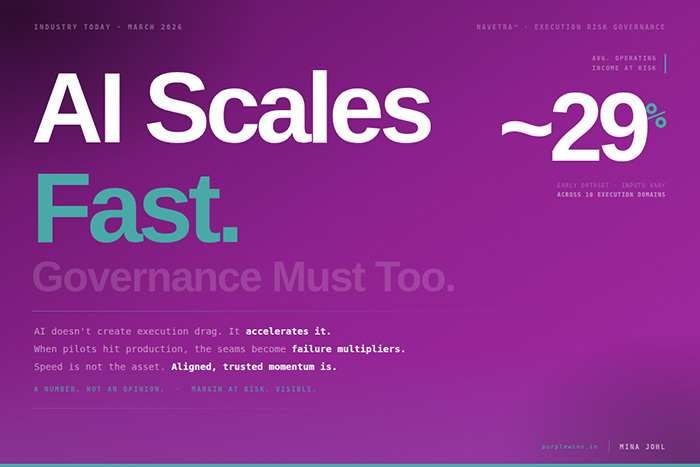
AI is entering production. If execution governance doesn’t scale with it, you’re not gaining margin — you’re accelerating failure.
The pilot-to-production transition is where the economics get real. In pilot mode, you’re optimizing a model. In production, you’re stress-testing an operating system: people, handoffs, decision rights, constraints, capital sequencing, exception handling, compliance.
The pattern repeating across manufacturing, logistics, energy, and regulated operators is this:
Acceleration without governance doesn’t reduce risk. It increases failure velocity.
If any of these are true, you’re not in a warning zone. You’re already bleeding:
If you nodded at even one of those, it’s not a data problem. It’s an execution system problem.
Most enterprises already run layered stacks: ERP, WMS/TMS, HRIS, CRM, plus dashboards on dashboards. AI gets added on top as routing logic, predictive maintenance, quality detection, compliance triage, or planning optimization.
The executive complaint doesn’t change: “We have visibility. We still can’t isolate the drag.”
That’s because execution risk lives in the seams — the places no single system owns:
AI doesn’t resolve those conditions. It moves decisions faster through the same broken seams.
If your operating system is coherent, AI compounds margin. If it’s misaligned, AI compounds exposure.
Last week in Cannes, I sat in rooms with manufacturers, logistics operators, energy leaders, and public-sector delegations all comparing notes on the same inflection point: AI has moved from “interesting pilot” to production infrastructure.
The questions weren’t about capability anymore. They were about deployment into real systems — production lines, dispatch networks, maintenance planning, compliance-heavy environments.
One operator put it plainly:
“We made decisions faster — and discovered we were wrong faster.”
That sounds like progress until you price it: expedited freight, scrap, late deliveries, safety exceptions, overtime, churned customers, board credibility burned.
Speed is not the asset. Aligned, trusted momentum is.
A regulated logistics operator was preparing a ~$40M modernization program. Their AI routing pilot looked strong. Integrations in place. Dashboards clean. Then delivery variance started climbing.
When we traced it end-to-end, the model wasn’t the issue. The operating system was. Three seams were doing the damage:
In NAVETRA terms, what looked like a routing problem decomposed into priced execution drag: cross-functional alignment failure, leadership bandwidth collapse, and capital missequencing. That translation matters — it turns “AI issues” into ranked operational causes with a dollar figure attached.
Two initiatives were paused. The investment sequence was re-ranked. Funding moved to the constraint.
That is execution governance. Not another dashboard. Not a bigger data lake.
When leaders feel uncertainty, the reflex is to add visibility: more reporting, more instrumentation, more KPIs, more executive dashboards.
In complex operating environments, that reflex backfires. More dashboards:
Execution governance is not about seeing everything. It’s about isolating what materially drives outcomes — and forcing decision discipline around it.
Most operators can describe these issues. Almost none can price them.
NAVETRA is built to change that. We quantify the unmeasured drivers of execution — the things that don’t show up cleanly in ERP or dashboards — and translate them into Operating Income at Risk across nine execution domains:
The output isn’t a new set of KPIs. It’s a ranked, board-ready financial view of Operating Income at Risk — so investment sequencing becomes a financial decision, not a debate.
For a $100M industrial operator, “small” leakage is never small:
No exotic assumptions required. That’s arithmetic.
Margin leakage shows up in familiar categories: expedite and premium freight, scrap/rework and quality escapes, overtime and labor instability, penalties and service failures, downtime and missed throughput.
AI doesn’t create the leakage. It increases the speed at which leakage materializes — because AI moves decisions faster through the same seams.
If “governance” makes you think of committees and slide decks, you’re thinking of the wrong thing. Execution governance is a decision architecture with four practical outputs:
4. A constraint-first view of the system. Identify what actually governs throughput, service level, quality, or cost — and stop funding around it. Fund through it.
5. A seam-risk map across the value stream. Where do handoffs fail because of ownership ambiguity, KPI conflict, or approval latency? These are failure multipliers under AI velocity.
6. Decision rights and cadence that match operational reality. When variance appears, who decides, how fast, and with what inputs? If decision cycles are slower than the system, AI amplifies drift.
7. A ranked investment sequence tied to margin protection. Stabilize the operating model before scaling automation. Otherwise, you’re automating instability.
A quarter is enough to materially de-risk the pilot-to-production transition — if the work is structured around outputs, not meetings.
Only then should you scale AI.
When the operating system is coherent, AI becomes a margin amplifier. When it isn’t, AI becomes a risk multiplier.
The technical capability is no longer the bottleneck.
The differentiator is governance discipline — the ability to align process, people, technology, and capital under acceleration.
AI is scaling across enterprise systems. The question is whether execution governance is scaling with it.
That is the conversation that matters now.

About the Author
Mina Johl is the founder of Purple Wins and the creator of NAVETRA™, an execution risk governance platform that quantifies the unmeasured drivers of execution — leadership bandwidth, cross-functional alignment, hiring friction, training ROI, knowledge transfer gaps, upskilling/AI readiness, and risk exposure — and converts them into Operating Income at Risk so operators can protect margin before scaling AI.
Read more from the author:
2026 CEO Diaries: RISK5 — The Execution Risk Checklist That Prevents Margin Leakage | Purple Wins, Jan 21, 2026
2026 CEO Diaries: How Boards Will Interrogate Execution Risk in 2026 | Purple Wins, Jan 1, 2026

Industry in Transition: The Forces Reshaping Manufacturing
As manufacturers offer more customization than ever before, managing product complexity has become a critical challenge. Tune in with Dan Joe Barry, Vice President of Product Marketing at Configit, who explores how companies are tackling the growing number of product configurations across engineering, sales, manufacturing, and service. He explains how Configuration Lifecycle Management (CLM) helps organizations maintain a single source of truth for configuration data. The result: fewer errors, faster quoting, and the ability to deliver customized products at scale.
Get In Touch
Google news and SEO compliant, Industry Today’s state-of-the-art digital media platform offers bespoke media campaigns that target key decision makers and buyers to achieve your marketing and promotional goals.

Contribute
Showcase your brand and promote your business to our highly targeted audience. We offer detailed Google Analytics with measurable ROI to assure success. Submit your content for review by our Editorial team who will contact you to discuss the project further.
About Us
Reach Your Targeted Audience and Grow Your Business. Learn more About Industry Today.
Contact Us

© 2026 Industry today. All Rights reserved.