The Dignity Act of 2025 would unlock a long-stalled talent pipeline without increasing immigration caps.
By John Dorer, CEO of EB3.Work
For much of the last decade, manufacturers across the United States have faced a deepening workforce crisis. From welders and machine operators to assembly workers and production line staff, the sector has struggled to fill positions even as demand surged post-pandemic.
About a half-million manufacturing jobs are vacant thanks to a nationwide labor shortfall that stretches over multiple industries. For decades, baby boomers powered American industry. But now, thousands retire each day. While far fewer young workers line up to replace them. With birth rates declining and preferences shifting toward remote, white-collar roles, manufacturing struggles to compete for talent in a workforce that’s both shrinking and changing.
Visa workers are one of the few reliable sources of ready-to-train labor in today’s tightening workforce, filling some of the gaps left behind. But a broken immigration system means being able to plan for them as part of a comprehensive workforce strategy is nearly impossible.
A new proposal gaining traction in Congress could offer part of the solution. The Dignity Act of 2025, a bipartisan immigration reform bill, includes a simple but powerful fix to ease legal hiring through the EB-3 visa program, without raising the overall immigration ceiling. For manufacturers open to sponsoring foreign workers, this bill could open long-blocked pathways and speed up access to the labor they desperately need.
The EB-3 visa program is designed to help U.S. employers fill full-time, permanent jobs that aren’t being met by the domestic workforce. It includes three subcategories including “skilled workers,” “professionals,” and “other workers.” The other workers category covers many common manufacturing roles that are critical to plant operations like assemblers, material handlers, forklift operators, and machinists.
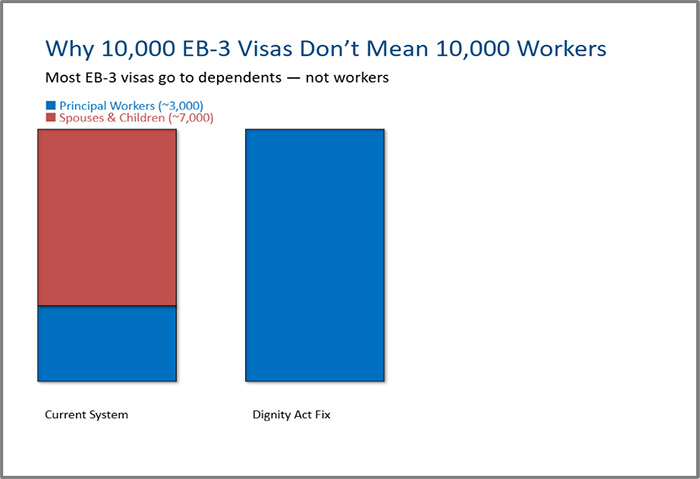
The problem? The system is backlogged and outdated. Although the law allows up to 10,000 EB-3 “Other Worker” visas per year, far fewer than that go to actual workers. About 3,000 EB-3 visas in this category are estimated to go to workers while the rest are taken up by their spouses and children, who count against the same annual quota, even though they aren’t working.
This inefficient accounting has created massive backlogs leading to retrogression, a bureaucratic term that essentially means, “get in line and wait years.” For many employers, these long waits make the EB-3 program unworkable, even when they’re eager to sponsor legal workers.
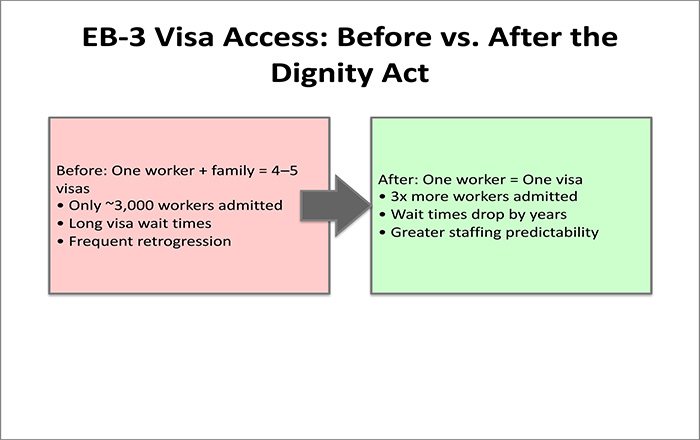
This is where the Dignity Act shines. Rather than increasing the number of available green cards, it simply changes how they’re counted. Only the principal EB-3 worker would count against the visa cap, not their spouse or children. Those family members would still need to go through the proper vetting and receive their visas, but they wouldn’t be counted against the 10,000 annual slots reserved for the “Other Workers” category.
If enacted, this change could more than triple the number of EB-3 workers entering the U.S. each year, without raising the cap or creating new categories. For manufacturers, that means access to more reliable labor without waiting years or gambling on temporary seasonal programs like H-2B.
At a time when many industries are experimenting with automation to fill labor gaps, manufacturers know that human workers remain essential. Certain tasks still require precision, judgment, or coordination that machines can’t match. This rings especially true in those small and mid-sized operations where every employee wears multiple hats.
The EB-3 visa offers a path for manufacturers to fill these roles legally and sustainably. Workers arrive with the proper documentation, they receive long-term green cards, and they often stay with the same employer for years. Unlike gig work or high-turnover entry-level hiring, EB-3 recruitment is an investment in workforce stability.
The Dignity Act would remove one of the biggest barriers to making that investment worthwhile which is the glacial pace of processing visa applications.
In addition to fixing the visa cap formula, the Dignity Act provides major funding increases to the three government agencies responsible for EB-3 processing:
Together, the steps can take two to three years to complete under the current system. The bill earmarks nearly $3.7 billion in new funding across these agencies, designed to shorten timelines and modernize outdated systems. It also establishes an Immigration Coordinator role to streamline communication and reduce bottlenecks between the agencies.
Unlike other industries with high employee churn or seasonal staffing models, manufacturing thrives on workforce consistency. A single trained machine operator or production worker can dramatically impact output, safety, and quality control.
By restoring access to a steady pipeline of legal, full-time workers, the Dignity Act gives manufacturers a recruiting tool they can actually rely on. It also allows employers to plan staffing around real timelines instead of regulatory guesswork.
Of course, the Dignity Act won’t resolve every hiring challenge. It won’t rebuild the country’s vocational education system, change perceptions of industrial work, or replace investments in training and automation. But it does offer a smart, focused fix to a problem that has hampered legal hiring for years. And it does so without opening floodgates or creating untested programs. It’s a practical update to a policy that hasn’t kept pace with the modern economy.
The Dignity Act has gained bipartisan support and growing momentum in Congress. But it hasn’t yet become law. That makes this the ideal time for manufacturers to prepare.
Employers should:
If passed, the Dignity Act could offer a predictable and efficient way to meet workforce needs while supporting workers who want to contribute and build a life in the U.S. For manufacturers staring down a decade of labor shortages, that’s not just welcome news, it’s long overdue.

About the Author:
John Dorer is CEO of EB3.Work, a workforce solutions company that helps U.S. employers address labor shortages through lawful and compliant staffing strategies

Industry in Transition: The Forces Reshaping Manufacturing
As manufacturers offer more customization than ever before, managing product complexity has become a critical challenge. Tune in with Dan Joe Barry, Vice President of Product Marketing at Configit, who explores how companies are tackling the growing number of product configurations across engineering, sales, manufacturing, and service. He explains how Configuration Lifecycle Management (CLM) helps organizations maintain a single source of truth for configuration data. The result: fewer errors, faster quoting, and the ability to deliver customized products at scale.
Get In Touch
Google news and SEO compliant, Industry Today’s state-of-the-art digital media platform offers bespoke media campaigns that target key decision makers and buyers to achieve your marketing and promotional goals.

Contribute
Showcase your brand and promote your business to our highly targeted audience. We offer detailed Google Analytics with measurable ROI to assure success. Submit your content for review by our Editorial team who will contact you to discuss the project further.
About Us
Reach Your Targeted Audience and Grow Your Business. Learn more About Industry Today.
Contact Us

© 2026 Industry today. All Rights reserved.