Hyundai’s Hormuz detour isn’t a one-company problem—it’s a signal that just-in-time supply chains need a fundamental rethink.
By David Eyes, Vice President of Automotive at TrueCommerce
When Hyundai CEO José Muñoz announced in early April that the company had diverted its ships around the Cape of Good Hope to avoid the blocked Strait of Hormuz, he didn’t mince words. “Globalization is over. It is completely over.” For supply chain professionals, that declaration shouldn’t come as a shock. It should sound like a long-overdue reckoning.
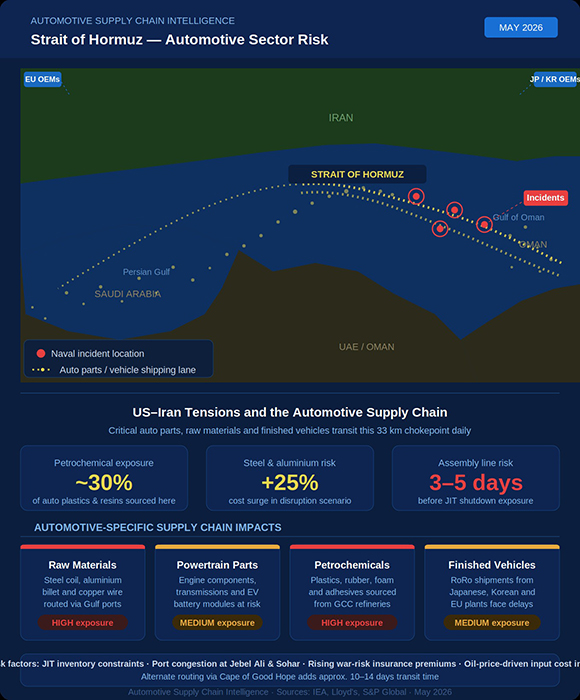
Hyundai rerouted ships around Africa via the Cape of Good Hope to avoid the Strait of Hormuz, extending delivery times and straining its global supply chain as conflict involving Iran disrupted a critical trade route. But here’s the harder truth: for most manufacturers, Hyundai’s position is enviable. They at least knew they had a problem and the operational flexibility to respond. Most companies won’t be so fortunate.
Ask supply chain leaders whether they know exactly where their critical components are at any given moment, and many will hesitate. Ask whether they know which of their tier-2 or tier-3 suppliers are exposed to routes through the Strait of Hormuz, and the hesitation grows longer. This isn’t a technology failure. It’s a structural one, built into decades of optimizing for efficiency rather than resilience.
Just-in-time manufacturing was a brilliant invention for a stable world. It reduced inventory carrying costs, minimized waste, and streamlined production. But it was designed for predictability with predictable routes, predictable lead times, predictable geopolitics. None of those conditions reliably exist anymore. The pandemic proved it. The Red Sea disruptions proved it again. The Hormuz situation is simply the latest proof point.
That pivot from annual planning cycles to near-real-time operational thinking is something every complex manufacturer needs to consider. Supply chain strategy can no longer be a once-a-year exercise.
There’s a nuance here that often gets lost in the conversation about tariffs and trade disruption: a fixed cost increase, however painful, is manageable. Companies can model it, price around it, and make investment decisions accordingly. What they cannot plan around is constant uncertainty.
When tariff policy changes week to week, or when a critical shipping strait could close tomorrow and reopen next month, businesses are paralyzed. Capital expenditures get delayed. Supplier contracts become harder to negotiate. Long-term manufacturing footprint decisions stall because the inputs keep shifting. The economic damage from that uncertainty often exceeds the damage from whatever the policy actually lands on.
This is the environment manufacturers are operating in right now. And it demands a different posture from supply chain leadership: not just contingency planning for known risks but building structural flexibility that can absorb shocks that aren’t yet on anyone’s radar.
Hyundai responded by sourcing more components locally in Europe rather than shipping them from South Korea and is expanding its U.S. footprint as part of a broader localization strategy.
That’s an extraordinary commitment and it reflects a broader industry truth. Regionalization is no longer a hedge. It’s becoming a baseline operating requirement for any manufacturer with global ambitions. The economics of long, globally optimized supply chains look very different when you factor in the real and growing costs of route disruption, border friction, and geopolitical risk.
For automotive suppliers in particular, the calculus is shifting fast. Customers like Hyundai are making decade-long footprint decisions right now, and suppliers that can demonstrate regional manufacturing capability, or at minimum, regional inventory positioning, will be far better positioned to remain on preferred supplier lists.
The companies that will navigate this environment best share a few characteristics. They have invested in supplier visibility tools that extend beyond their direct relationships giving them a real picture of tier-2 and tier-3 exposure before a crisis hits. They have diversified their logistics options so that no single route, port, or carrier represents a single point of failure. And they have built stronger data infrastructure so that when disruption does occur, they can model alternatives quickly rather than reacting from a standing start.
Hyundai has largely been able to maintain production due to its built-in flexibility. It was built incrementally, beginning with hard lessons from the pandemic. Other manufacturers are still in the early stages of building that same kind of resilience.
The Hormuz disruption will eventually resolve. But the underlying forces driving it like geopolitical fragmentation, shifting trade alliances, and the weaponization of critical chokepoints, are not going away. The question every supply chain leader should be asking is not “what do we do about this specific disruption?” It’s “how do we build a supply chain that can absorb the next five disruptions we haven’t anticipated yet?”
Like Hyundai, companies must move away from siloed, bespoke processes built solely around their own needs. Instead, they should adopt a modern, collaborative approach that spans multiple supply chain disciplines like demand management, transportation, logistics tracking, and beyond. This shift enables suppliers and logistics partners to support not just one customer, but to apply a single agile framework across all their supply chain commitments. The result is improved resilience and reduced risk, achieved in a controlled way that minimizes investment and eliminates process duplication.

About the Author:
David Eyes has long been an influential figure in supply chain management and digitalization markets. With over 25 years of supply chain business development expertise, David has helped hundreds of businesses leverage integration and automation for greater success. In addition to his position at TrueCommerce, he also serves on the advisory boards for the Alabama Automotive Manufacturers Association (AAMA) and Georgia Automotive Manufacturers Association (GAMA), acting as Chairman of the GAMA Supply Chain Committee. When he isn’t helping business owners, David uses his knowledge and passion to support supply chain education in younger generations, regularly visiting and speaking at schools, colleges and universities about opportunities in the field.
Forging the Next 250 Years: Powering the Next Era of American Manufacturing
As manufacturers offer more customization than ever before, managing product complexity has become a critical challenge. Tune in with Dan Joe Barry, Vice President of Product Marketing at Configit, who explores how companies are tackling the growing number of product configurations across engineering, sales, manufacturing, and service. He explains how Configuration Lifecycle Management (CLM) helps organizations maintain a single source of truth for configuration data. The result: fewer errors, faster quoting, and the ability to deliver customized products at scale.
Get In Touch
Google news and SEO compliant, Industry Today’s state-of-the-art digital media platform offers bespoke media campaigns that target key decision makers and buyers to achieve your marketing and promotional goals.

Contribute
Showcase your brand and promote your business to our highly targeted audience. We offer detailed Google Analytics with measurable ROI to assure success. Submit your content for review by our Editorial team who will contact you to discuss the project further.
About Us
Reach Your Targeted Audience and Grow Your Business. Learn more About Industry Today.
Contact Us

© 2026 Industry today. All Rights reserved.