Disconnected cyber and physical security leaves manufacturers vulnerable. Integrated operations can reduce downtime and strengthen resilience.
By Tony Dozier, Sr. Director of Solutions Consulting, Trackforce
Manufacturers have spent the past decade wiring their operations with new layers of connectivity: cloud-managed machines, remote diagnostics, automated material handling, and fleets of sensors feeding performance data into enterprise systems. These upgrades strengthen output, but they also bind together assets that once behaved independently. The result is a new kind of operational exposure, one where a digital disruption can stop physical production just as surely as a mechanical failure.
When something goes wrong, it no longer stays in one domain. A digital event can trigger a physical disruption, and a physical anomaly can expose a digital weakness. That is the defining challenge for today’s plants. The boundary between cyber and physical security hasn’t blurred; it has effectively dissolved.
That shift is no longer hypothetical, and it’s already playing out. Across the industry, analysts continue to report a steady rise in attacks that affect operational technology. In some cases, the attacker’s target is data. In many others, the target is activity stopping a conveyor, locking an operator out of a workstation, or interrupting a critical interface that coordinates production.
Studies show that 55% of organizations have experienced an operational outage caused by a cyber intrusion. In manufacturing, where uptime defines profitability, those outages increasingly trace back to ransomware, which now accounts for nearly half of reported breaches.
And separate report highlights an 89% jump in confirmed data compromises within the sector. As these events accumulate, more manufacturers are beginning to see cybersecurity as an extended part of physical security rather than a parallel concern.
What these incidents have in common is that they complicate how teams detect and diagnose a problem. A door not opening, a network segment misbehaving, or a machine pausing mid-cycle are no longer isolated events. They are fragments of a much larger picture, and plants built for continuous movement cannot afford to interpret those fragments slowly.
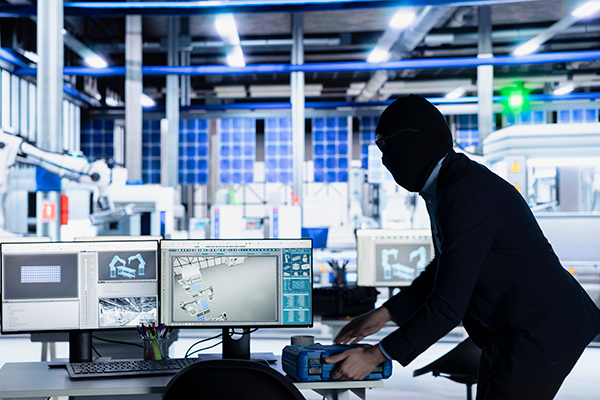
Historically, the plant floor was governed by clear divisions. IT focused on identity, network activity, and business systems. OT teams looked after equipment behavior and production continuity. Physical security managed access, cameras, and incident logs. These roles still matter, but the underlying risk has changed, and most issues now involve signals from more than one domain. Each team may be doing its job correctly, but the delay between them is where downtime compounds.
A network failure might explain badge denials. An access anomaly might precede a controller irregularity. An operator’s report of an equipment slowdown may correlate directly to a digital compromise. When these findings are collected separately, it takes longer to understand what is happening and whether the event is spreading. As incidents grow harder to interpret in real time, manufacturers are being forced to rethink where visibility actually resides. Leaders are accelerating OT investments because IT-only visibility is not sufficient. Eight in ten manufacturers now report more OT-related incidents, yet fewer than half feel prepared to manage them effectively.
The solution is not another standalone system, but changing in how incidents are seen, shared, and resolved. Instead of treating physical, cyber, and operational issues as unrelated, manufacturers are beginning to bring them together into a single operational model. This is not a major transformation, simply just a shift in the flow of information.
It starts with combining the signals. When access control, cameras, line sensors, and network monitoring feed into the same incident record, teams waste less time reconciling conflicting reports. A single alert pattern, occurring in one area within a short timeframe, becomes a clear indicator of where to intervene before disruption spreads downstream.
The next layer is coordination. The first minutes of an event often determine whether downtime lasts an hour or a day. Establishing shared procedures for badge failures, abnormal line stoppage, or network interruptions helps teams move together instead of sequentially. Each group knows exactly what to check, what to escalate, and when to shift to manual processes.
Plants also benefit from equipping frontline staff with structured reporting tools. Operators and guards often witness the first signs of an issue, but their observations are lost when they must be transcribed, re-entered, or relayed verbally. Prompt reporting that captures photos, timestamps, and machine state gives technical teams more accurate starting points.
Finally, the most resilient operations measure their progress. Tracking detection time, handoff delays, and total recovery time creates a baseline that plants can improve against. It also surfaces recurring weak points, whether they involve a particular integration, a partner connection, or a gap in how incidents are handled.
Even with better workflows, people must remain the first and last line of defense. In a connected plant, small human errors do not stay small for long. They propagate quickly across systems that are designed for speed and efficiency.
In manufacturing environments, many security incidents can be traced back to routine actions such as skipped steps or devices connected without proper validation. Role-based instruction, rooted in real examples from the plant, helps prevent those missteps. Teaching teams how to recognize tampered access points, unusual login activity, or out-of-band equipment behavior builds confidence and reduces the chance of an escalation.
The manufacturing sector is modernizing rapidly, but the pace of connectivity means attackers no longer need to breach a deeply guarded system to cause a disruption. They only need to find the point where a digital weakness touches a physical process.
When manufacturers connect cyber and physical security, through shared visibility, coordinated response, and workforce readiness, they do more than reduce downtime. They create operations that can absorb disruption, adapt faster, and keep production moving even as threats evolve.

About the Author:
As the Senior Director of Solutions Consulting for Trackforce, I’m often described as an “undercover geek” someone who thrives at the intersection of technology, teamwork, and real-world problem-solving. Throughout my career, whether working with electrical systems, electronics, IoT, analytics, video, networks, or software, I’ve found energy and purpose in collaborating with great professionals, great clients, and innovative technologies. I’ve been fortunate to build a career in spaces I truly enjoy, staying connected to the fast-paced, ever-evolving world of tech. One of my greatest joys is bringing teams together to achieve what others might call impossible. To me, “impossible” isn’t a limitation; it’s an opportunity to innovate.

Forging the Next 250 Years: Powering the Next Era of American Manufacturing
As manufacturers offer more customization than ever before, managing product complexity has become a critical challenge. Tune in with Dan Joe Barry, Vice President of Product Marketing at Configit, who explores how companies are tackling the growing number of product configurations across engineering, sales, manufacturing, and service. He explains how Configuration Lifecycle Management (CLM) helps organizations maintain a single source of truth for configuration data. The result: fewer errors, faster quoting, and the ability to deliver customized products at scale.
Get In Touch
Google news and SEO compliant, Industry Today’s state-of-the-art digital media platform offers bespoke media campaigns that target key decision makers and buyers to achieve your marketing and promotional goals.

Contribute
Showcase your brand and promote your business to our highly targeted audience. We offer detailed Google Analytics with measurable ROI to assure success. Submit your content for review by our Editorial team who will contact you to discuss the project further.
About Us
Reach Your Targeted Audience and Grow Your Business. Learn more About Industry Today.
Contact Us

© 2026 Industry today. All Rights reserved.