Manufacturing leaders are built for execution. But the changes reshaping the industry demand a fundamentally different set of skills.
By Kevin Tamanini
Manufacturing leaders are among the most execution-driven in any industry. They hit production targets, maintain safety standards, and optimize processes with remarkable discipline.
So why are they among the least prepared to lead through the very changes that will determine their organizations’ futures?
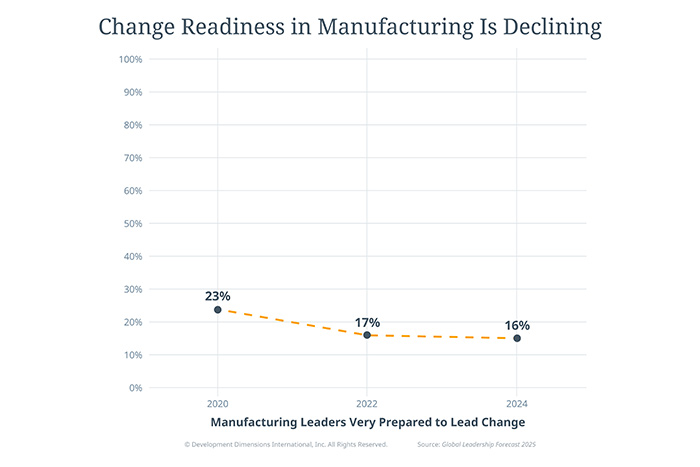
According to DDI’s Global Leadership Forecast, only 16% of manufacturing leaders say they are very prepared to lead through change. Even more concerning, that figure has declined over time — down from 17% in 2022 and 23% in 2020 — suggesting the industry’s change confidence is eroding even as disruption intensifies.
Few industries are navigating a more sweeping transformation. Tariff uncertainty requires rapid sourcing pivots and pricing adjustments. Reshoring initiatives demand workforce expansion and new capabilities. Automation and AI investments are reshaping job roles and accelerating the need for upskilling.
For many manufacturing leaders, change is no longer episodic but continuous. The pace of disruption is accelerating, but leaders’ readiness to guide their organizations through it is moving in the wrong direction. And that gap creates real operational risk.
Manufacturing leaders are exceptional at what they’ve been trained to do: drive output, reduce scrap, improve safety, and protect margins. These skills are built for environments that reward precision, predictability, and operational discipline, and they’re essential.
Manufacturing systems are intentionally designed to reinforce technical excellence. Organizations invest heavily in Lean certifications, Six Sigma training, safety compliance, and equipment capability. In these areas, the connection between skill and production KPIs is immediate and visible.
Leadership capability, however, is not always developed with the same structure or rigor. While operational discipline remains foundational, it’s an essential yet insufficient benchmark to lead during times of change. Leading through change requires a structured manufacturing leadership development program that builds new and enhanced leadership capabilities alongside technical expertise.
That distinction becomes especially important when organizations are responding to sourcing pivots, scaling workforces to support reshoring efforts, or introducing automation that reshapes daily responsibilities. In those moments, employees look to their leaders for clarity and direction.
When leaders communicate clearly, address resistance directly, and reinforce new behaviors, teams adapt faster, and performance stabilizes more quickly. The impact is immediate, even if it is less visible than a process improvement initiative.
Development gains traction when it reflects the realities leaders face every day. When leadership development is grounded in real operational challenges, such as implementing automation or restructuring shifts, leaders see the connection to performance and KPIs they are held accountable to more quickly, enabling faster and deeper adoption of the change.
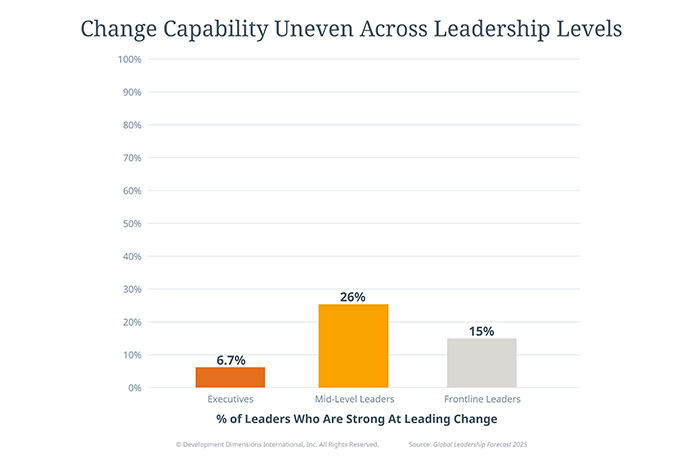
The result of this systemic underinvestment shows up at every level of leadership. DDI’s assessments of more than 100,000 leaders highlight how uneven change capability is across levels:
Operational skill drives consistent performance. During change, that operational strength must be reinforced by leadership capabilities that help teams understand, align, adapt, and execute effectively.

Transformation demands do not sit at a single level of the organization but permeate the entire leadership pipeline.
Frontline supervisors manage the most immediate pressures: attendance issues, quality concerns, safety standards, and daily production targets. Many were promoted because of their technical expertise, not because their leadership capability had been assessed or developed.
Mid-level leaders and plant managers operate in constant turbulence, balancing shifting priorities, supply chain variability, workforce constraints, and executive directives. They often absorb resistance from frontline supervisors while being expected to deliver results without disruption.
And at the executive level, leaders must set direction amid tariff volatility, reshoring decisions, and automation investments. But the data suggests most are not equipped to do so effectively. When executives struggle to model change behaviors themselves, the impact cascades. Messaging defaults to what must change and how it will change, without clearly articulating why, and alignment erodes as it moves downward through the organization.
This dynamic creates a cultural challenge. As change accelerates, communication often defaults to what will happen and how, without clearly reinforcing why it is necessary. When development and expectations differ across levels, inconsistencies multiply. A frontline supervisor trained to engage and explain the “why” cannot sustain that behavior if their plant manager defaults to “just execute.”
Sustainable transformation requires aligned capability across every level. As volatility accelerates, employees experience change as daily uncertainty, and leadership clarity determines whether it creates momentum or friction.
Manufacturing leaders are not failing to communicate or drive results. In most cases, they are working hard to maintain execution under enormous pressure. The gap isn’t in effort or intent. It’s in how they lead through change.
Manufacturing leaders are accustomed to communicating what needs to change and how it will be executed. That approach can drive short-term compliance, but effective change leadership goes one step further by clearly articulating why the change is necessary and how it connects to operational priorities.
When leaders consistently reinforce the rationale behind sourcing pivots, automation investments, or process redesigns, alignment improves across levels. Execution becomes more durable when grounded in shared understanding rather than authority alone. Addressing concerns instead of pushing past them turns resistance into buy-in that strengthens execution.
Change breaks down when leaders at different levels send different signals. A frontline supervisor who engages employees and explains the “why” cannot sustain that behavior if their plant manager communicates in a purely directive style.
That alignment doesn’t happen by accident. It requires developing leaders at every level around the same expectations and behaviors — and ensuring that what’s reinforced at the top is consistent with what’s expected on the floor.
Manufacturing leaders operate in KPI-driven environments. Use that. Effective change leadership starts by identifying which operational metrics are lagging and working backward to the leadership behaviors that influence them.
If productivity drops during automation rollout, the issue may not be technical capability alone but unclear expectations or inconsistent communication. If retention declines during workforce expansion, leaders may need to reinforce stability and purpose, not just staffing plans.
For HR and talent teams, this means staying close enough to plant-level realities to know which KPIs matter right now. And that may look different plant-to-plant. Design manufacturing leadership training around the specific metrics that each facility is trying to move.
Break large transformation goals into measurable weekly targets, so progress is tangible for leaders and teams alike. When leadership behaviors are tied directly to floor-level performance indicators, they move from abstract concepts to operational habits.
Manufacturers know how to build systems, enforce standards, and drive consistent performance under pressure. That operational discipline is a genuine competitive strength, and it’s exactly what makes this problem solvable.
The opportunity now is to apply that same rigor to selecting, developing, and supporting leaders. Organizations that embed leadership capability into their operating model will not only navigate change more effectively but also convert it into measurable performance improvement. In today’s environment, the true differentiator is not just what you build, but how effectively your leaders mobilize people to build it differently.

About the Author
Kevin Tamanini is an I/O psychologist and Vice President of Professional Services at DDI. He oversees the post-sales teams responsible for designing and implementing innovative solutions for executive succession, leadership development, coaching, and development planning. He also has nearly 20 years of experience working with large-scale global customers across industries to implement talent development and selection programs for all levels of leaders.
Read more from the author:
AI and Leadership: The 5 Capabilities Every Leader Needs Now | DDI, December 2025
Developing High-Potential Talent: 7 Challenges in Identifying Emerging Leaders | DDI, February 2025
Forging the Next 250 Years: Powering the Next Era of American Manufacturing
As manufacturers offer more customization than ever before, managing product complexity has become a critical challenge. Tune in with Dan Joe Barry, Vice President of Product Marketing at Configit, who explores how companies are tackling the growing number of product configurations across engineering, sales, manufacturing, and service. He explains how Configuration Lifecycle Management (CLM) helps organizations maintain a single source of truth for configuration data. The result: fewer errors, faster quoting, and the ability to deliver customized products at scale.
Get In Touch
Google news and SEO compliant, Industry Today’s state-of-the-art digital media platform offers bespoke media campaigns that target key decision makers and buyers to achieve your marketing and promotional goals.

Contribute
Showcase your brand and promote your business to our highly targeted audience. We offer detailed Google Analytics with measurable ROI to assure success. Submit your content for review by our Editorial team who will contact you to discuss the project further.
About Us
Reach Your Targeted Audience and Grow Your Business. Learn more About Industry Today.
Contact Us

© 2026 Industry today. All Rights reserved.