Consumer expectations are growing faster than legacy fulfillment systems can manage. Supply chains must modernize to keep pace.
By Dr. Ashfaque Chowdhury, CEO at Exol
Consumers no longer view fast fulfillment as a premium experience; it’s an expectation. Today, shoppers evaluate when a product will be fulfilled and what delivery options are available as core factors in their purchasing decisions, alongside price, quality, and availability. What began with just a few categories, such as books and apparel, has expanded into every category, with consumers expecting expedited delivery from home goods and groceries to beauty products.
Five years ago, fast delivery and fulfillment were differentiators. Now it’s the reason a buyer does not abandon their cart. Speed has shifted from a differentiator to the baseline cost of staying in the game. However, speed alone is not enough. Fast, but inconsistent service, is inferior to slow and reliable, especially as trust is broken if a speed expectation is set and missed.
The largest retailers have set the bar for speed, and they are not done pushing the limits. Today, consumers compare every fulfillment experience to the fastest delivery experience they’ve had, regardless of company size. Unfortunately, many supply chains are still operating on infrastructure designed for a vastly different era – meaning retailers are at risk of disappointing consumers and losing market share and loyalty.
Most conversations around fulfillment focus on the visible part of delivery, the package arriving at the customer’s door. In reality, delivery performance is determined much earlier in the process.
Delivery is only as strong as the fulfillment operation behind it. Last-mile delivery is the most visible, but this is only one piece of a much larger equation. The work that enables speed is upstream; tasks like inventory positioning, dock-to-stock speed, and picking accuracy are critical for final delivery.
But most operators are trying to deliver tomorrow’s speed leveraging yesterday’s infrastructure. Legacy systems, which make up most of the fulfillment infrastructure in operation today, were designed for a slower and more predictable supply chain: bulk shipments to retail distribution centers, batch processing, and heavy labor workflows. In today’s fast-changing world, where the requirements have shifted, the original systems and foundations that remain in place create growing operational strain across the supply chain.
Rising complexity and expectations are highlighting the limits of traditional fulfillment.
Labor constraints are a major pressure point. Labor shortages, increasing wages, and consistent turnover compound operational strain. In the first quarter of 2026, the U.S. manufacturing sector saw a 6.1% increase in hourly compensation. Focusing on hiring to solve a speed problem is not feasible and tends to be an expensive patch to a larger issue.
In addition, real estate has become a major limiting factor. Industrial rent in the markets relevant for fulfillment have continued to climb. Brands need to hold inventory closer to demand to meet modern customer expectations, but the cost of proximity is increasing.
Further, in recent years, there has been an explosion of channels. Rather than just retail or a company website, servicing channels like TikTok Shop, Amazon, Walmart Marketplace, dropship programs, and B2B portals have become commonplace. Customers expect a seamless experience across all of them. Most companies originally built their fulfillment strategy around one or two channels and bolted additional channels onto infrastructure that was not designed to support it.
Rising operational costs and consumer expectations are making modernization difficult to avoid. And, with global fulfillment and logistics costs increasing by over 20% in the last three years, companies are no longer asking whether it is necessary, but how quickly they can implement it without disrupting the business.
For decades, automation and modern technology were available only to companies large enough to fund the investment themselves. Now, mid-market companies can access the capabilities that used to be largely limited to enterprise-scale organizations. Modular automation systems, cloud-based platforms, and infrastructure-as-a-service models are lowering the barrier to entry for mid-market companies, and brands that previously lacked access can now compete on speed, consistency, and accuracy.
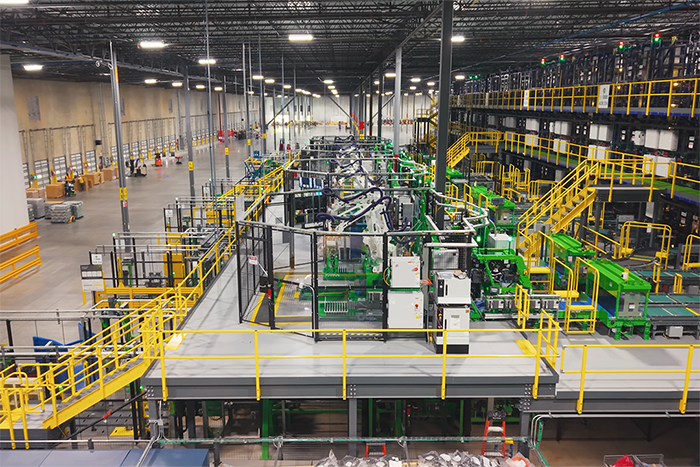
The biggest role automation and technology play is driving higher service levels and consistency. Manual operations are inherently variable, with accuracy varying by shift, worker, season, or labor market. Automated systems, including robotics, do not make errors that humans might, and they are reliable. This consistency enables all downstream activities, like retail compliance, customer experience, and predictable cost-to-serve.
Speed and throughput are the second piece. Automated systems can pick faster, more accurately, and at a higher density than manual operations. They also do not slow down as volume scales, enabling companies to absorb volume spikes without breaking service levels. This predictability and consistency help meet customer expectations and deliver as promised.
While hardware systems like robots receive most of the attention, software is just as critical. A modern data platform that sits on top of hardware can provide real-time visibility, predictive intelligence, and artificial intelligence (AI)-driven decision-making across the network. Robotics without solid software creates fast errors. Software without solid hardware simply provides good visibility into inefficient operations. A combination of both is necessary for success.
Technology and automation can also make operations channel-agnostic. The same automation, software, and inventory pool can serve across retail, direct-to-consumer, marketplace, and dropship without requiring dedicated infrastructure for each. This flexibility allows companies to scale inventory and fulfillment capacity as demand changes rather than operating in siloes.
Automation provides opportunities to upskill workers and remove repetitive, physically demanding tasks. Human operators are able to instead focus on tasks related to judgment, problem-solving, and customer relationships. The goal is stronger, more resilient operations supported by higher-value work.
Transformation does not require a complete operational overhaul. Start with the channel or operation that’s causing the most pain — the most chargebacks, customer complaints, or strain on the team — not the largest one.
Finding partners that have made the investments in automation, modern technology, and operating models can lower the barrier to entry significantly. Instead of funding the build, businesses may look to access infrastructure that is already built.
Additionally, businesses should focus on the modular automation that delivers the greatest value. Rather than treating automation as an all-or-nothing investment, modular systems allow companies to add targeted capabilities into existing operations without building new facilities or starting from scratch. They enable companies to prioritize the highest-impact parts of the operation first, whether that is throughput, pick accuracy, or storage density, without a full overhaul.
The baseline keeps moving; wherever the bar is today, it will be reset again tomorrow. Operators must treat speed as an ongoing effort, not a one-off task. Without the right infrastructure in place, speed quickly becomes expensive, driven by expedited shipping, higher labor costs, or excess inventory in too many places.
The companies that succeed will be the ones focused on fulfillment infrastructure capable of adapting as customer expectations continue to evolve. Speed is no longer the differentiator; it is the price of admission. Competitive advantage comes from delivering speed alongside consistency and flexibility, meeting the baseline as it continues to rise.

About the Author:
Ashfaque Chowdhury, Ph.D. is the Chief Executive Officer of Exol, bringing over two decades of experience in scaling global supply chain operations. His leadership is defined by driving transformative growth and innovation for some of the world’s most recognized brands. Previously, Dr. Chowdhury was the CEO of North America for CEVA Logistics. Before that, as President of XPO Logistics’ supply chain business in the Americas and Asia Pacific, he spearheaded the integration of multiple acquisitions, transforming the business into the world’s second-largest contract logistics provider. At XPO, he oversaw a network of over 400 locations and 32,000 employees, achieving industry-leading growth while cultivating an award-winning, employee-centric culture. An innovator in the field, he holds several patents in supply chain technology.

Forging the Next 250 Years: Powering the Next Era of American Manufacturing
As manufacturers offer more customization than ever before, managing product complexity has become a critical challenge. Tune in with Dan Joe Barry, Vice President of Product Marketing at Configit, who explores how companies are tackling the growing number of product configurations across engineering, sales, manufacturing, and service. He explains how Configuration Lifecycle Management (CLM) helps organizations maintain a single source of truth for configuration data. The result: fewer errors, faster quoting, and the ability to deliver customized products at scale.
Get In Touch
Google news and SEO compliant, Industry Today’s state-of-the-art digital media platform offers bespoke media campaigns that target key decision makers and buyers to achieve your marketing and promotional goals.

Contribute
Showcase your brand and promote your business to our highly targeted audience. We offer detailed Google Analytics with measurable ROI to assure success. Submit your content for review by our Editorial team who will contact you to discuss the project further.
About Us
Reach Your Targeted Audience and Grow Your Business. Learn more About Industry Today.
Contact Us

© 2026 Industry today. All Rights reserved.