AI data centers are changing how waste and carbon are measured—reshaping construction and operations across industrial sectors.
By Todd Thomas
Across the country, massive AI data centers are rising at record speed. These facilities are not only expanding digital capacity—they are reshaping expectations around how industrial projects are built and evaluated. Energy use remains a headline issue, but a quieter shift is happening on the ground: scrutiny of materials, construction waste, and embodied carbon is intensifying long before servers ever come online.
Developers, contractors, investors, and local communities are asking tougher questions. What materials are coming onto the site? How much waste leaves each week? Where does it go? What is the verified carbon impact of those decisions?
For executive teams, this marks a structural change. Sustainability is no longer a report compiled at project closeout. It is becoming a real-time operational discipline tied directly to cost control, performance, and long-term competitiveness.
Hyperscale AI facilities are among the most complex construction projects underway today. Their size, compressed timelines, and public visibility create pressures that did not exist even a few years ago.
Communities want clarity on local impact. Investors expect credible carbon data. Corporate stakeholders require alignment with climate commitments that are already on the record.
That scrutiny is raising the baseline for performance.
On major AI projects, sustainability requirements are being embedded into procurement standards and contract terms. Contractors are expected to provide transparency into sourcing, waste handling, and downstream material outcomes. Generalized diversion claims are no longer sufficient.
These expectations will not stay confined to data centers. As hyperscale operators refine their standards, manufacturing plants, logistics hubs, semiconductor fabs, and other advanced facilities will face similar demands—particularly when backed by global brands or institutional capital.
AI infrastructure is effectively serving as a proving ground for what industrial sustainability will look like over the next decade.
One of the most meaningful changes underway is the shift from estimated waste reporting to measurable waste intelligence.
Historically, construction waste data relied on haul tickets, invoices, and industry averages. Mixed loads obscured contamination. Final material outcomes were rarely verified. Diversion percentages offered a simplified snapshot but little operational insight.
New tools are altering that reality. Image recognition systems, sensor-based monitoring, and real-time tracking technologies now allow large job sites to see material flows as they happen. Project teams can measure volumes, flag contamination, and verify end-use pathways.
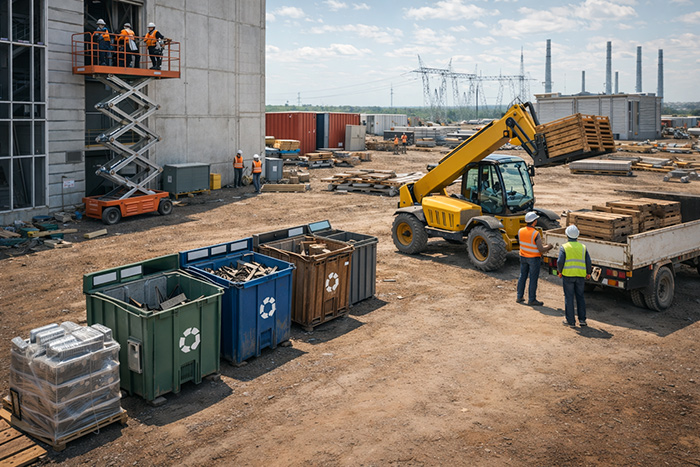
When waste becomes visible, behavior follows. Crews sort more accurately. Containers are placed with intention. Hauls are consolidated. Materials that once went to landfill retain value.
For AI data center projects—where speed and precision matter—this visibility reduces friction and supports more predictable delivery.
It also changes accountability. With verified data, sustainability moves from aspiration to measurable performance.
As data improves, sustainability is increasingly connected to operational outcomes.
Better material management reduces hauling frequency and landfill fees. Fewer truck trips cut fuel use and ease congestion on busy job sites. Cleaner sorting minimizes rework and supports safer working conditions.
Those improvements translate into financial impact. Waste hauling and disposal represent significant line items on large industrial builds. When materials are separated effectively and routed to higher-value uses, costs decline.
This reframes sustainability. It is not a parallel initiative managed outside of core operations. It becomes part of how projects are executed.
On the most advanced sites, sustainability metrics are reviewed alongside schedule, budget, and safety performance. Reporting cycles shrink from months to days. Site managers see waste data as a management tool rather than a marketing artifact.
That integration reflects a broader cultural shift. Sustainability performance is being evaluated through the same operational lens as any other business metric.
Diversion rates have long served as the primary measure of construction sustainability. While useful, they offer limited context.
An 80 percent diversion rate may still conceal inefficiencies. High-value materials might be downcycled into low-impact uses. Loads may travel multiple times before final processing. Without verified end-use data, environmental outcomes remain uncertain.
Stakeholders are now asking for more precise information.
New indicators are gaining traction:
These metrics connect construction decisions to measurable carbon outcomes. They allow investors and corporate sustainability leaders to compare projects more accurately. They also help operators identify where process improvements generate real savings.
The shift from percentage-based reporting to outcome-based measurement strengthens credibility and supports better strategic decisions.
Wood is one of the most common materials on industrial construction sites, particularly in large data center builds where crating, pallets, and temporary structures generate significant scrap.
For years, inconsistent sorting and contamination sent substantial volumes of recoverable wood to landfills. The limitation was rarely technical—it was informational. Without reliable tracking and verification, recovery efforts lacked consistency.
Improved sorting systems and transparent reporting are changing that equation. Clean wood can serve as renewable energy feedstock or industrial input when managed correctly.
Public commitments to zero wood waste are beginning to appear on major projects. Achieving those goals requires upstream planning—container placement, crew training, contamination prevention, and consistent verification of outcomes.
More importantly, zero wood waste commitments reflect a mindset shift. Waste is no longer treated as an inevitable byproduct of construction. It is approached as a system challenge that can be addressed through design and discipline.
When recovery is planned from the outset, economics improve. Wood transitions from disposal expense to managed output with measurable value.
As hyperscale operators normalize these commitments, zero wood waste may become an operational expectation rather than a headline pledge.
Much of this transition is being led by the private sector.
Hyperscale technology companies operate under intense public scrutiny and long-term capital commitments. Their procurement standards increasingly require verified sustainability performance from contractors and suppliers.
Transparency is being written into scoring criteria and bid evaluations. Data quality influences access to future work.
This is reshaping competitive dynamics across the industrial supply chain. Organizations that provide real-time visibility and documented outcomes are better positioned to participate in high-growth projects. Those relying on manual reporting face mounting pressure.
Sustainability capability is becoming an operational credential.
For executives overseeing manufacturing and industrial operations, the implications are immediate.
Real-time sustainability data will become standard. Customers and partners will expect current, verifiable insight into material flows and carbon impact during active projects.
Material efficiency will remain tightly connected to economics. Hauling costs, congestion, schedule delays, and safety performance all intersect with how materials are managed.
Technology adoption will influence market access. AI-enabled tracking and integrated reporting tools are increasingly common on large builds.
Community expectations will continue to matter. Reduced truck traffic, cleaner job sites, and transparent communication strengthen relationships and can accelerate approvals.
Organizations that embed sustainability into daily operations—rather than isolating it within reporting functions—will be positioned to compete as expectations rise.
AI data centers are offering a preview of industrial sustainability’s next chapter.
The standards emerging today around waste visibility, carbon accountability, and outcome-based measurement are unlikely to remain confined to digital infrastructure. As data improves and scrutiny intensifies, similar expectations will extend across construction, manufacturing, and advanced industry.
Leaders who invest early in transparency, disciplined material management, and measurable performance will gain more than environmental credibility. They will strengthen efficiency, reduce cost volatility, and build resilience in a market where sustainability performance increasingly shapes competitive standing.

About the Author:
Todd Thomas is the CEO of Woodchuck, a climate technology company turning construction wood waste into renewable energy using AI. He is the author of the Abundant Energy trilogy and Hyperscale, which examine the future of global power systems, infrastructure, and decarbonization. Todd also hosts Abundant Energy, a television series spotlighting the technologies and leaders reshaping energy, climate, and industrial systems worldwide.
Read more from the author:
Agentic AI’s biggest consumer moment is almost here | Fast Company, 1/6/2026
AI for the real world | Fast Company, 11/26/2025

Industry in Transition: The Forces Reshaping Manufacturing
As manufacturers offer more customization than ever before, managing product complexity has become a critical challenge. Tune in with Dan Joe Barry, Vice President of Product Marketing at Configit, who explores how companies are tackling the growing number of product configurations across engineering, sales, manufacturing, and service. He explains how Configuration Lifecycle Management (CLM) helps organizations maintain a single source of truth for configuration data. The result: fewer errors, faster quoting, and the ability to deliver customized products at scale.
Get In Touch
Google news and SEO compliant, Industry Today’s state-of-the-art digital media platform offers bespoke media campaigns that target key decision makers and buyers to achieve your marketing and promotional goals.

Contribute
Showcase your brand and promote your business to our highly targeted audience. We offer detailed Google Analytics with measurable ROI to assure success. Submit your content for review by our Editorial team who will contact you to discuss the project further.
About Us
Reach Your Targeted Audience and Grow Your Business. Learn more About Industry Today.
Contact Us

© 2026 Industry today. All Rights reserved.