AI lets enterprises deliver the attentive, empowered service of small businesses at scale—turning cost centers into loyalty engines.
By Eric Buesing
Over the past twenty years, large corporations have relentlessly pursued scale, optimizing global supply chains, centralizing services, digitizing customer journeys, and engineering cost structures. In this pursuit, many have overlooked a critical element: the art and heart of customer service.
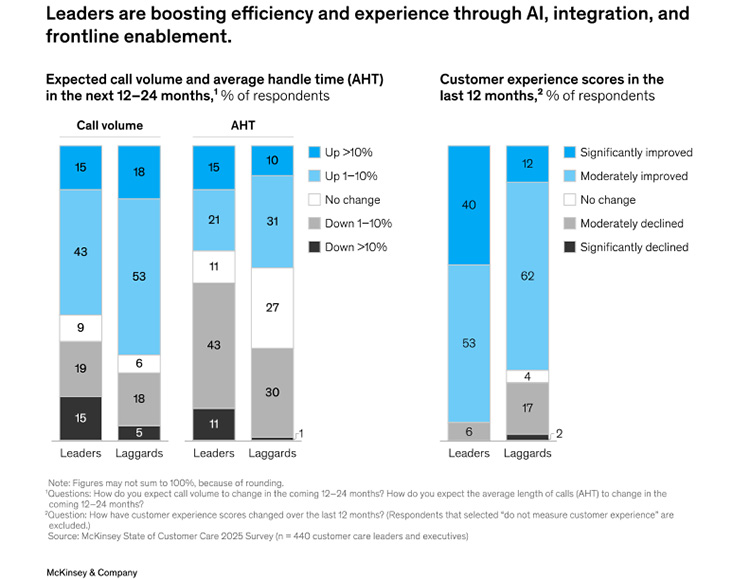
Customers across sectors are expressing dissatisfaction. The American Customer Satisfaction Index (ACSI) indicates stagnation or decline in many industries. Meanwhile, McKinsey research highlights that companies excelling in customer service and experience deepen customer loyalty, achieve revenue growth rates achieve more than double the revenue growth of laggards, delivering higher shareholder returns.
This presents a paradox. Despite substantial investments in automation and AI, customers often encounter longer wait times, fragmented digital experiences, repetitive authentication, and frontline agents restricted by rigid scripts. Service representatives, often evaluated on average handle time (AHT) and adherence metrics, struggle to convey genuine gratitude and empathy. What was once a loyalty engine has, in many organizations, become purely a cost center.
In contrast, exceptional service thrives in smaller, less resourced environments. Consider a neighborhood hardware store, a local insurance broker, or a family-owned restaurant. The difference in the service experience, and even speed to resolution from many large organizations, is palpable.
The owner of an independent hardware store remembers your last renovation project. When you return, he asks how it turned out. If a tool fails, he replaces it without debate and quietly reevaluates his supplier. He personally absorbs the friction.
A neighborhood insurance broker answers calls directly. When a claim stalls, she contacts the carrier herself, follows up diligently, and updates the customer proactively, often making additional recommendations for enhancements to the policy that better protects her customer in the future. Her reputation is inseparable from the outcome.
At a local café, the owner notices when a regular customer hasn’t visited in weeks. If an order is incorrect, he rectifies it immediately, often with a complimentary gesture. He understands that a single negative experience can resonate throughout a close-knit community.
These businesses operate under conditions demanding proximity, accountability, and empathy. Small businesses cannot afford poor service. They frequently interact with customers in the community, where a negative experience threatens not just a transaction but a network.
In contrast, large corporations often diffuse responsibility across layers of people, systems, vendors, and performance dashboards, creating a structural gap between decision-making and customer impact.
Customers perceive this misalignment. Complaints on review platforms and social media consistently highlight long wait times, limited authority to resolve issues, lack of empathy, and repetitive explanations. The experience feels transactional rather than relational.
Today’s leaders, face a provocative question: How can enterprises with hundreds or thousands of agents adopt a five-and-dime mindset at scale?
The five-and-dime service model, inspired by small business operating principles, is based on five enduring principles:
Historically, large enterprises have struggled to operationalize these principles at scale. Advances in agentic AI could enable the combination of scale with intimacy in unprecedented ways.

In a small shop, the owner immediately knows when something goes wrong. In a multinational organization, friction signals are buried across channels.
Agentic AI can aggregate structured and unstructured data across calls, chats, emails, surveys, and social channels, identifying emerging patterns in near real-time. Agentic Voice Agents can incorporate this context during customer conversations in real-time. More importantly, they can trigger coordinated action across the service organization:
Customers then experience visible change in their next interaction. Responsiveness becomes tangible rather than theoretical.
One defining advantage of small businesses is authority at the edge. Decisions are made where the customer stands.
In large enterprises, frontline agents often lack comprehensive context and discretionary authority. Agentic AI can synthesize full customer histories in seconds, surface risk and loyalty indicators, and recommend actions grounded in lifetime value rather than transaction cost alone. This enables representatives to express authentic appreciation and empathy.
McKinsey research shows that AI-enabled customer care models are shifting work toward higher-value interactions, freeing human agents to focus on complex, relationship-driven issues. When agents are empowered rather than constrained, first contact resolution improves, driving both satisfaction and efficiency.
Perhaps the most significant advantage small businesses possess is awareness of absence. When a small business customer stops visiting, someone notices. Large enterprises often identify dissatisfaction only when churn data materializes. Yet many dissatisfied customers never complain; they simply leave.
Agentic AI can detect subtle signals of disengagement such as:
Proactive outreach informed by these signals transforms service from reactive problem-solving to preventive stewardship. In effect, it extends the attentiveness of a local proprietor across millions of customers.
Language shapes culture. When service is described or implied primarily in terms of budget containment, employees internalize constraint. When it is framed as loyalty creation, they internalize purpose.
Rather than focusing exclusively on:
Executives might emphasize:
AI investments should not be positioned internally or externally as purely cost-cutting initiatives. Customers should experience them as faster answers, fewer repetitions, proactive outreach, and more empathetic and personalized interactions. Efficiency gains will follow from better design.
The ultimate transformation is cultural. Technology provides the mechanism; leadership provides the mandate.
Three questions can guide executive teams:
Organizations aligning operating models around customer journeys tend to outperform peers. Assigning clear ownership of journeys, redesigning metrics to balance efficiency and emotional outcomes, and rewarding empathy alongside productivity are foundational steps.
For leaders, the question is not whether AI can only reduce cost. It is whether they will use it to restore the art and heart of delightful service, and, in doing so, rebuild the loyalty that drives satisfaction and growth.
Organizations that embrace this mentality, amplified by intelligent systems, will not merely reverse declining customer satisfaction trends. They will redefine what scale feels like. And in that redefinition lies competitive advantage.
Agentic AI makes it feasible for enterprises with thousands of agents to operate as though the owner is standing behind every interaction.

About the Author:
Eric Buesing is a Partner based in McKinsey’s Charlotte office. He has more than 17 years of experience working with executives to transform sales and service operations into a source of sustained competitive advantage. In this role, he advises clients from a variety of industries as they seek to enhance the capacity and efficiency of their sales channels, customer-facing networks, and back-office functions. Eric would like to thank Kourosh Houshmand for contributions to this article.

Industry in Transition: The Forces Reshaping Manufacturing
As manufacturers offer more customization than ever before, managing product complexity has become a critical challenge. Tune in with Dan Joe Barry, Vice President of Product Marketing at Configit, who explores how companies are tackling the growing number of product configurations across engineering, sales, manufacturing, and service. He explains how Configuration Lifecycle Management (CLM) helps organizations maintain a single source of truth for configuration data. The result: fewer errors, faster quoting, and the ability to deliver customized products at scale.
Get In Touch
Google news and SEO compliant, Industry Today’s state-of-the-art digital media platform offers bespoke media campaigns that target key decision makers and buyers to achieve your marketing and promotional goals.

Contribute
Showcase your brand and promote your business to our highly targeted audience. We offer detailed Google Analytics with measurable ROI to assure success. Submit your content for review by our Editorial team who will contact you to discuss the project further.
About Us
Reach Your Targeted Audience and Grow Your Business. Learn more About Industry Today.
Contact Us

© 2026 Industry today. All Rights reserved.