A look at economic and operational advantages for companies with flexible industrial spaces.
Industrial companies face several structural and operational hurdles. Disrupted supply chains and seasonal demand peaks adding to the generally prevailing skilled labor shortage make reliable production and capacity planning increasingly difficult. At the same time, available space at many sites is decreasing, even as new requirements for storage and production arise. Traditional construction projects to expand company capacities often cannot keep pace with these dynamic developments. That is why flexible industrial spaces are coming into focus for many businesses. They make it possible to respond quickly to changing conditions and efficiently expand capacities according to actual needs.
The introduction of new product lines and the expansion of existing business areas push the capacities of industrial and logistics companies to their limits. Added to this are temporary projects within the framework of maintenance work or restructuring, which require short-term additional space for machinery and materials.
Storage bottlenecks caused by fluctuating delivery times or increased safety stocks further increase the pressure on existing space structures. Traditional industrial buildings frequently prove impractical, as long planning and approval processes as well as high costs make them a solution that does not always match actual needs. In addition, there is the risk that permanently constructed buildings are only partially utilized after a high-demand period.
Companies therefore require alternatives that can be implemented faster and adapted easily to changing requirements.
Prefabricated modular construction allows temporary industrial spaces to be deployed flexibly, assembled quickly, and expanded or reduced as needed. Another advantage is the possibility to relocate or reuse the structures after a project is completed, allowing companies to make their space strategy significantly more agile and cost-effective.
Depending on the specific need, companies can use different structures, from lightweight industrial tents for short-term storage to modular production halls and weather-protected temporary solutions for assembly or maintenance.
For short-term production increases or new projects, suitable modular spaces provide additional production and assembly areas. Companies then integrate machinery, workstations, and material storage flexibly without interrupting ongoing operations.
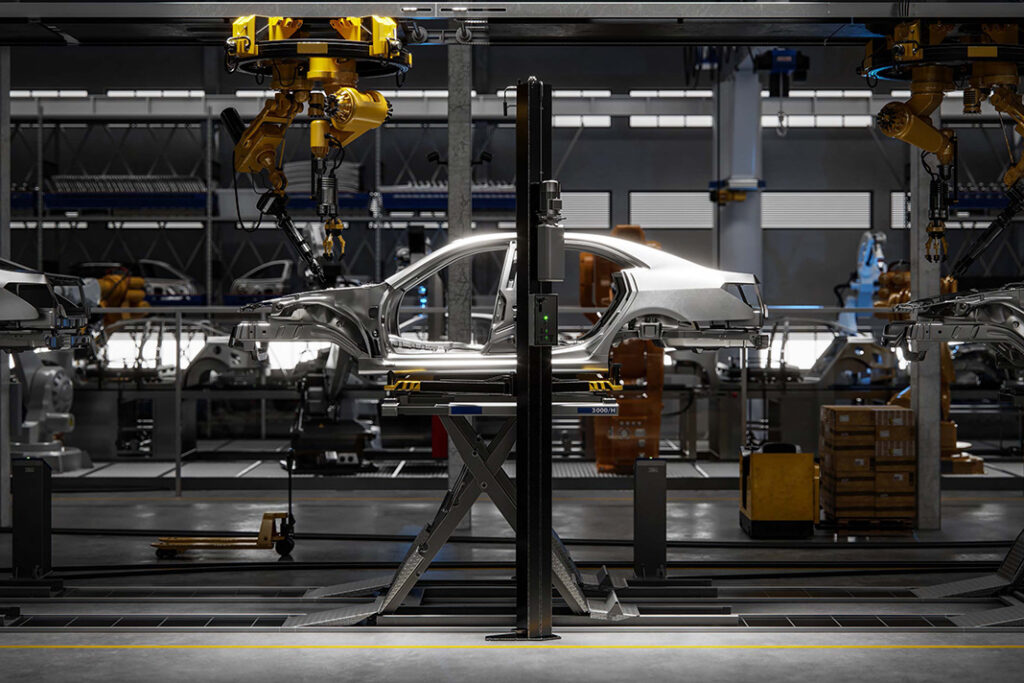
Automotive suppliers, for example, use modular halls to quickly set up assembly lines for new vehicle models. Food manufacturers, on the other hand, create temporary production areas for seasonal products. An industrial tent serves in these cases as a robust and rapidly deployable solution that is easily adapted to the specific need.
In the logistics sector, flexible solutions are used
For example, an e-commerce company creates additional storage capacity during seasonal peaks such as Christmas. A machinery manufacturer uses weather-protected areas to store spare parts.
With an industrial tent, these spaces can be quickly expanded or reduced, allowing companies to respond flexibly to fluctuations in demand and to changes in the supply chain.
With flexible industrial spaces, investment costs are lower, as extensive foundations or long-term construction projects are not required. Planning and approval processes are also significantly shortened, allowing the spaces to be deployed within a matter of weeks. This reduces financial risk and enables capacity scaling according to actual needs, without incurring long-term costs for unused space.
Beyond financial aspects, there are operational advantages because flexible spaces increase responsiveness to market changes and production peaks. Companies can use their existing halls more efficiently, optimize processes, and deploy temporary structures such as industrial tents specifically for certain tasks without disrupting ongoing operations.
At the same time, modular solutions support lean production concepts, therefore allowing rapid adjustments to changing workflows or product requirements.
The Rise of American Manufacturing: A New Industrial Era
Scott Ellyson, CEO of East West Manufacturing, brings decades of global manufacturing and supply chain leadership to the conversation. In this episode, he shares practical insights on scaling operations, navigating complexity, and building resilient manufacturing networks in an increasingly connected world.
Get In Touch
Google news and SEO compliant, Industry Today’s state-of-the-art digital media platform offers bespoke media campaigns that target key decision makers and buyers to achieve your marketing and promotional goals.

Contribute
Showcase your brand and promote your business to our highly targeted audience. We offer detailed Google Analytics with measurable ROI to assure success. Submit your content for review by our Editorial team who will contact you to discuss the project further.
About Us
Reach Your Targeted Audience and Grow Your Business. Learn more About Industry Today.
Contact Us

© 2026 Industry today. All Rights reserved.