Volume 28 | Issue 4
Click here to read the complete illustrated article or continue below to read the text article.
By Thomas Lamb, CEO, Myriad Uranium Corp.
The U.S. uranium gap and why it matters Nuclear power is the largest source of carbon-free, around-the-clock electricity in America. Yet nearly all of the uranium fueling those reactors comes from outside the country. In 2023, U.S. plants relied on about 32 million pounds of imported uranium and only around 50,000 pounds produced domestically. That means about 99 percent of the fuel supply was imported, leaving the country exposed when it comes to energy security and climate goals.
The market is responding. Uranium contract prices have climbed to their highest levels since 2008 as utilities look for stability. Spot prices have strengthened from the 30s to above 80 dollars, while long-term contracts are holding around 80 dollars per pound. This reflects a tighter market and a clear push from utilities to lock in secure supply.
The federal government is also stepping up. Programs like the Department of Energy’s HALEU initiative are designed to rebuild a domestic fuel cycle for next-generation reactors. Efforts to speed up licensing for nuclear projects are also underway. These moves come as artificial intelligence data centers and advanced manufacturing drive a surge in electricity demand.
Globally, uranium demand is expected to rise about 28 percent by 2030 and more than double by 2040. Meanwhile, there are no easy or rapid ways to increase global supply. For the United States, therefore, bringing reliable domestic production online is about more than energy. It is also about national security, grid reliability, and industrial competitiveness.
One of the best examples of this opportunity is in Wyoming’s Copper Mountain district. In the 1970s, Union Pacific drilled roughly 2,000 boreholes, found seven deposits, and even created a six-pit mine plan. When uranium prices collapsed after 1979’s Three Mile Island incident, the project was shelved. What was left behind was a rich archive of drill logs, engineering work, and mine plans, data that today can be re-analyzed with far better tools.
Myriad Uranium, with its partner Rush Rare Metals, is doing exactly that. We are digitizing these historical records, applying modern geophysics, and most importantly, running laboratory chemical assays to check the accuracy of probe results (gamma and neutron probes are the first-line instruments used to assess uranium deposits). Our early work has focused on the Canning deposit, which was at the center of Union Pacific’s original mine plan.
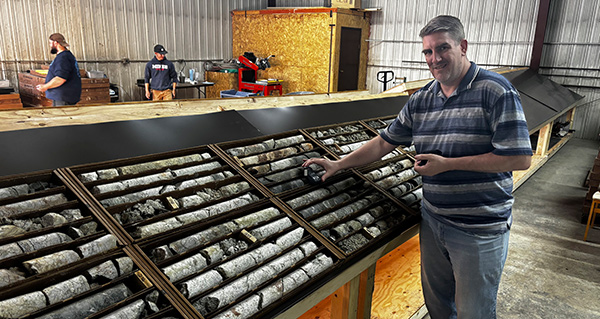
Why is this so important? The probes used in the 1970s and even today often undercount uranium in certain geological settings. When we recently compared probe readings to new chemical assays, the differences are striking. In some cases, assays are showing grades 50 to 60 percent higher than the probe data suggested. Entire zones that looked unremarkable before now appear to host significant mineralization.
This is what we mean when we talk about “invisible uranium.” It is mineralization that was always there but simply not captured by the default tools.
In 2024 and 2025, our work program has combined the application of advanced new methods and innovative thinking with confirmation drilling at Canning. The goal is to validate the historical results, refine targets, and build a clearer picture of the opportunity.
The opportunity appears to be one of America’s largest in the uranium space. In 1982, the U.S. Department of Energy released a report that assessed Copper Mountain’s uranium endowment could be 246 million pounds. Myriad and its partner Rush hold roughly 70 percent of the acreage relevant to this. The Department of Energy assessed that an even broader area around Copper Mountain could contain 656 million pounds. It is important to note that Copper Mountain’s historic estimates and the Department of Energy’s assessments are not current resources or reserves under NI 43-101 standards. They must be verified through modern work. Myriad continues to advance the project through verification drilling and ongoing scientific work.
Wyoming remains America’s leading uranium jurisdiction. It has active production, existing processing facilities, and regulators who are familiar with uranium projects. That combination makes it an attractive place to invest in new exploration.
Copper Mountain benefits from decades of past work, road access, and a district-scale land package. A Plan of Operations submitted in 2025 outlines a multi-year drilling program that will allow us to confirm mineralization and bring the data into compliance with modern standards.
For years, utilities expected electricity demand to remain flat. That is no longer the case. AI data centers, electric vehicles, and new manufacturing facilities are creating a surge in demand for reliable, clean power. Nuclear energy is one of the few options that can provide this at scale.
That shift is showing up in the market. Utilities are signing longer-term contracts at stronger prices. Federal programs are encouraging investment in the fuel cycle. There is also renewed interest in restarting reactors and extending the lives of existing plants. All of this underscores the value of securing a domestic supply of uranium.
For projects like Copper Mountain, the potential impact of the new chemical assays cannot be overstated. If grades consistently come in higher than what probes suggest, or if missed zones add meaningful pounds, it can completely change the economics of a project.
This could support a larger-scale conventional mining and milling operation or open the door to in-situ recovery opportunities depending on the geology. Early results from 2025 are pointing to stronger grades and more mineralization, which is why we are confident in scaling up exploration.
It is still early. Verification drilling, metallurgy, hydrology, and environmental studies will all play a role in determining the best development path. But the bottom line is clear: by re-analyzing historical data with modern tools, forgotten U.S. uranium projects can be transformed into valuable, strategic assets at exactly the time they are most needed.

About the author
Thomas Lamb is the Chief Executive Officer of Myriad Uranium Corp., a U.S.- focused exploration company consolidating and advancing historic uranium districts, including Copper Mountain in Wyoming and Red Basin in New Mexico. With a background in capital markets and resource development, he leads Myriad’s strategy to apply modern science and technology to legacy data in order to strengthen North America’s nuclear fuel supply chain.


The Rise of American Manufacturing: A New Industrial Era
Scott Ellyson, CEO of East West Manufacturing, brings decades of global manufacturing and supply chain leadership to the conversation. In this episode, he shares practical insights on scaling operations, navigating complexity, and building resilient manufacturing networks in an increasingly connected world.
Get In Touch
Google news and SEO compliant, Industry Today’s state-of-the-art digital media platform offers bespoke media campaigns that target key decision makers and buyers to achieve your marketing and promotional goals.

Contribute
Showcase your brand and promote your business to our highly targeted audience. We offer detailed Google Analytics with measurable ROI to assure success. Submit your content for review by our Editorial team who will contact you to discuss the project further.
About Us
Reach Your Targeted Audience and Grow Your Business. Learn more About Industry Today.
Contact Us

© 2026 Industry today. All Rights reserved.