As industrial AI moves from pilots to scaled deployments, connectivity emerges as a critical factor for success.
By Rajeev Shah
For decades, industrial automation has progressed in steady, incremental steps — more sensors, more software, and more connected workflows. What’s changed is the level and placement of intelligence. We’ve entered the era of physical AI, where intelligence no longer just analyzes operations, but increasingly makes decisions and acts on them in real time.
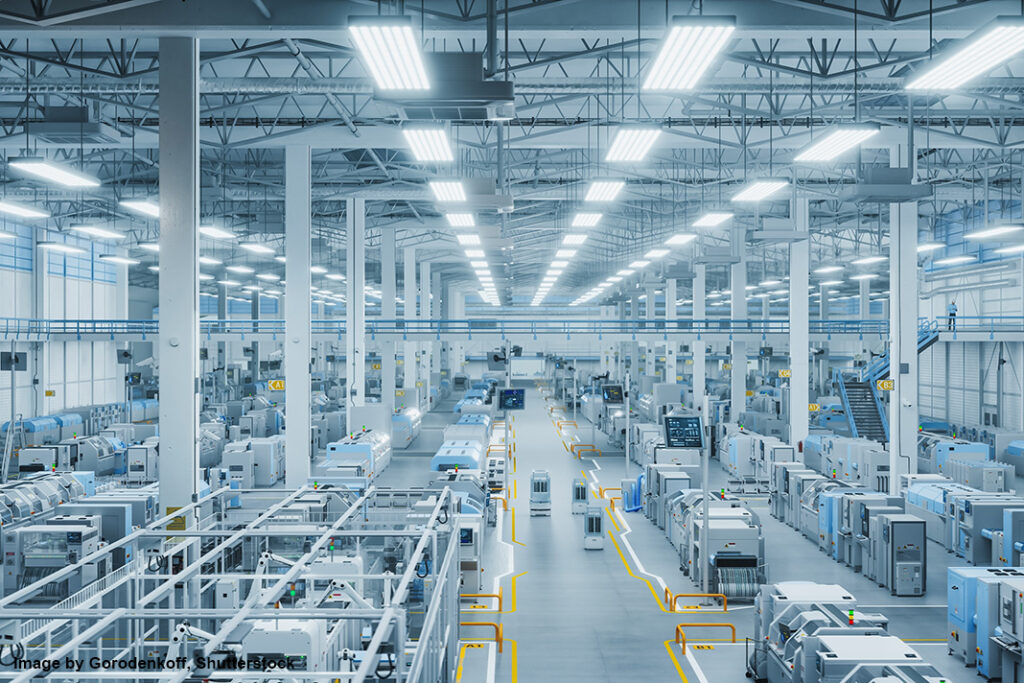
In this new phase, machines communicate, coordinate, and make decisions on the factory floor. Autonomous systems adapt continuously to changing conditions without human intervention. The implications extend far beyond robotics, redefining how industrial operations are designed, managed, and scaled.
The story of industrial transformation is no longer about whether autonomous systems can deliver value. It’s whether the digital foundations beneath them are ready for scale. In my view, this is the defining challenge industrial leaders now face.
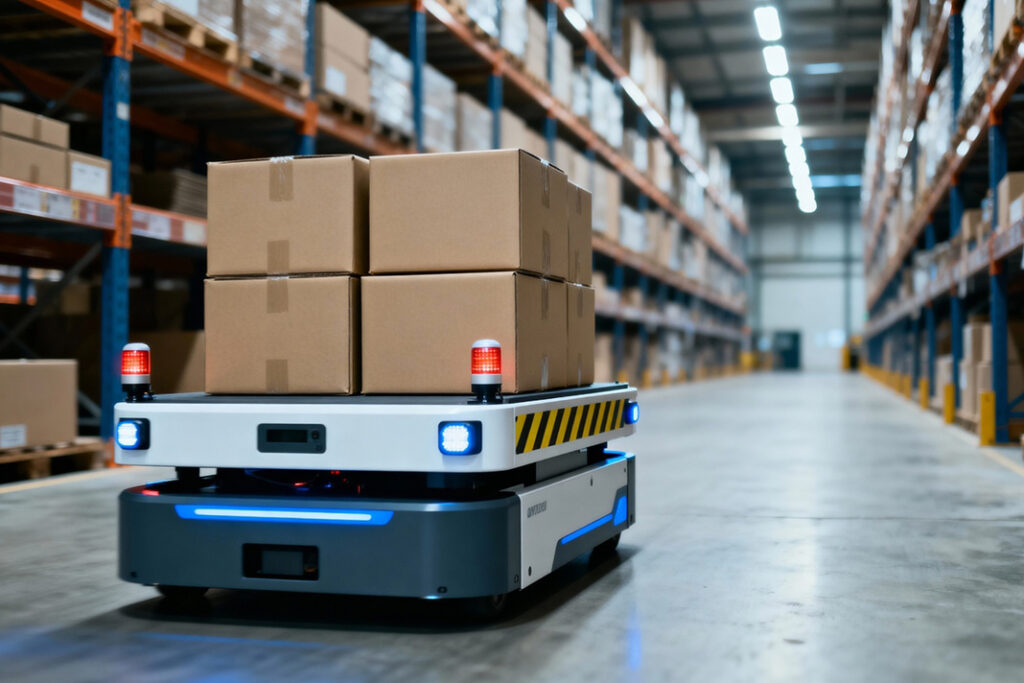
Autonomous Mobile Robots (AMRs) once operated primarily as pilot projects — confined to repetitive tasks and dedicated zones. Those experiments served their purpose: testing navigation, fine-tuning workflows, and validating ROI models.
What’s changed now is the scope. Leading industrial organizations are scaling AMRs across live production environments, expanding from dozens of robots to hundreds operating across entire facilities. These systems aren’t just moving materials. They’re interpreting sensor data, dynamically adapting to their surroundings, and collaborating with other machines in real time.
That transition — from pilots to large-scale deployments — exposes a hard reality: intelligence only works at scale if machines and robots can communicate consistently and predictably.
Every physical AI deployment — whether it involves AMRs, autonomous inspection drones, or computer vision-based quality systems — depends on continuous machine-to-machine communication. Yet, many manufacturers still rely on networks designed for office IT, not mobile, real-time industrial systems.
These legacy networks struggle in environments with radio interference, large-scale factory floors, metal-dense infrastructure, and constant motion. The impact ripples through production: stalled robots, dropped video feeds, delayed dispatch instructions, disconnected frontline workers, delayed safety signals, and costly downtime.
This isn’t a minor inconvenience. It’s an operational risk with real cost and safety consequences. Uptime Institute data shows that more than half of enterprises reported outages exceeding $100,000 in direct costs. In manufacturing, those losses multiply quickly when an entire production line grinds to a halt.
No surprises then that most Operational Technology still relies on wired networks – requiring expensive cabling and creating the most inflexible systems.
Private 5G can provide the reliability of wired cabling without the wires, allowing industries to connect equipment that was cost-prohibitive in the past
Industrial AI increasingly runs at the edge, close to where data is generated and decisions are made.
According to data from J Gold and Associates, more than two-thirds of all AI workloads will involve inferencing at the edge by the end of the decade. This means decisions will no longer be deferred to centralized systems — they will be made in real time, within the operating environment itself.
This fundamentally changes the role of the network. It’s no longer just a data transport layer — it’s part of the control loop, determining how quickly systems respond, how reliably machines coordinate, and how safely operations run.
A delayed packet is no longer just lost data. It’s a delayed safety response, a missed production target, or a breakdown in workflow.
Industrial AI is not a single product or platform but a full stack from the new edge to the cloud. This edge layer is of particular interest – it’s a system composed of three interdependent layers.
The ability to move data seamlessly between these layers is essential. Without robust connectivity, data becomes siloed, latency increases, and the value of industrial AI is diminished.
Unlike legacy infrastructure, private 5G is designed for challenging industrial environments. It delivers deterministic, ultra-reliable performance with seamless mobility across vast industrial spaces — both indoors and out. This matters when fleets of robots and drones continuously move between zones, and connected workers depend on access to real-time data wherever they are.

Private 5G, unlike public 5G networks, also gives industrial enterprises control over their own networks — enabling data segregation, ensuring local data sovereignty, and reducing latency by processing AI workloads on-site.
In one Celona deployment, a 1.4-square-mile U.S. manufacturing facility replaced legacy Wi-Fi with private 5G — reducing annual connectivity disruptions by 70% and cutting downtime losses by more than $2 million.
Connectivity is no longer a supporting system. It directly determines how operations are run.
Forward-looking industrial enterprises are already treating network performance as an operational KPI, tracking uptime and latency just as closely as throughput and yield. As AI-driven systems scale, connectivity becomes embedded in coordination, safety, and performance.
For industrial leaders planning their next phase of automation, a few principles stand out:
Industrial AI isn’t just about smarter machines — it’s about infrastructure that allows them to operate in real time.
As physical AI scales across sectors, connectivity defines the boundary between what’s possible and what can be executed at scale.
In the age of industrial AI, the reliability of your wireless network is the reliability of your operations.

About the Author:
Rajeev is the co-founder and CEO of Celona with the passion to bring new generation of connectivity solution to its customers in the enterprise. He brings nearly 2 decades of product management/marketing experience in enterprise Wi-Fi and service provider markets. Before founding Celona, Rajeev was the VP of product management and marketing for Federated Wireless – a leader in the shared spectrum/CBRS space. In this role, Rajeev launched the industry’s first and leading Spectrum Access System, enabled the CBRS ecosystem while negotiating multiple major Tier 1 operator contracts. Prior to Federated, Rajeev held multiple product management leadership positions at Aruba Networks, including creating its Cloud Wi-Fi business. He holds a M.S. degree in Computer Science from the University of Southern California. www.celona.io

Industry in Transition: The Forces Reshaping Manufacturing
As manufacturers offer more customization than ever before, managing product complexity has become a critical challenge. Tune in with Dan Joe Barry, Vice President of Product Marketing at Configit, who explores how companies are tackling the growing number of product configurations across engineering, sales, manufacturing, and service. He explains how Configuration Lifecycle Management (CLM) helps organizations maintain a single source of truth for configuration data. The result: fewer errors, faster quoting, and the ability to deliver customized products at scale.
Get In Touch
Google news and SEO compliant, Industry Today’s state-of-the-art digital media platform offers bespoke media campaigns that target key decision makers and buyers to achieve your marketing and promotional goals.

Contribute
Showcase your brand and promote your business to our highly targeted audience. We offer detailed Google Analytics with measurable ROI to assure success. Submit your content for review by our Editorial team who will contact you to discuss the project further.
About Us
Reach Your Targeted Audience and Grow Your Business. Learn more About Industry Today.
Contact Us

© 2026 Industry today. All Rights reserved.