Volume 28 | Issue 4
Click here to read the complete illustrated article or continue below to read the text article.
By Norman Smith, Chief Technology Officer at DEEP
For as long as I can remember, I’ve been drawn to the challenge of sustaining human life in places we weren’t adapted to survive. I engineered hardware for NASA’s human spaceflight programs, but the work I lead today at DEEP – designing, building, and testing subsea human habitats – is the realization of the dreams that set me on the path to becoming an engineer.
Jacques Cousteau was one of my childhood heroes, and his pioneering spirit shaped my imagination. Yet the ocean, despite covering most of our planet, remains an overlooked frontier. Vast regions are unexplored, full of mysteries waiting to be uncovered.
At DEEP, I see an opportunity to pick up where Cousteau (and others) left off. An opportunity to give humans sustained access to the ocean on a scale we’ve never achieved before.
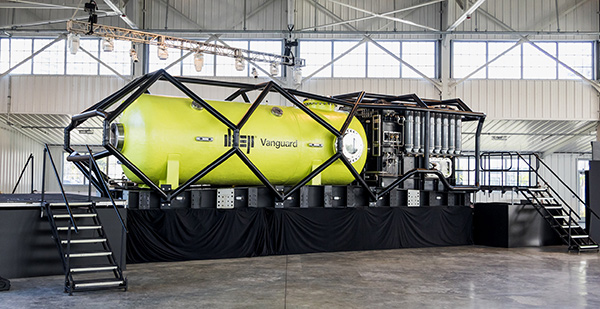
That’s why recently unveiling Vanguard in Miami, Florida, meant so much to me. It’s our pilot subsea human habitat and the first new one of its kind to be built in nearly 40 years. We designed it for a crew of four to live and work underwater for seven days or more, and it represents a major step forward in how we explore and understand the marine environment.
With Vanguard, with have created a comfortable, functional living space for ocean scientists, conservationists, and explorers. By allowing teams to live and work submerged in the ocean realm for extended periods, we can dramatically expand what’s possible. That means more comprehensive research and real-time observation of marine ecosystems. This capability has the potential to transform everything from coral reef restoration and climate monitoring to astronaut training for future space missions.
Vanguard is also a cornerstone of DEEP’s expansion into the United States. It reflects our $100 million commitment to establishing a permanent engineering and development hub in Florida and a manufacturing facility in Houston, Texas.
And if, like me, you grew up watching Jacques Cousteau and imagining what it would be like to live beneath the waves, this is a meaningful milestone – because that dream is now one step closer to becoming reality.
DEEP is on a mission to make humans aquatic. In practice, that means enabling people to live for days, weeks, or even months at the bottom of the ocean, giving researchers and divers more time to explore, make new discoveries, and carry out conservation work.
The first stage of the journey is Vanguard, which has been built in Sebastian, Florida. Not only will this be DEEP’s first underwater living space, it will also be the biggest development in subsea habitation in 40 years.
Vanguard is the beginning of a roadmap that will include many habitats and a long-term vision of habitats in installed in oceans all over the world. We can bring in technologies that are available now that were never available in Jacques Cousteau’s day.
The 1960s were the heyday of underwater habitats. That decade saw Cousteau’s Conshelf missions in the Mediterranean and the Red Sea, as well others including the US Navy’s Sealab experiments, overseen by pioneering physician and navy diver Captain George Bond, and Germany’s Helgoland habitat.
These projects demonstrated the concept of saturation diving. This is where a diver stays at depth until their body’s tissues adjust to all the gases, like nitrogen, that they are capable of absorbing at that pressure. At this point the diver is said to be ‘saturated’. Although they will still need to go through a period of decompression to avoid the bends on their way back to the surface, once a diver reaches saturation, they can stay at depth indefinitely without adding to that decompression time.
Projects like Conshelf, Sealab, and Helgoland proved that humans can live indefinitely on the ocean floor in practice, not just in theory. They were followed by other habitat missions in the 1970s. Some of these extended the underwater habitat concept to Arctic waters, while others expanded the scope of research.
Then, in 1986, the Aquarius habitat was built in Texas, later being deployed in the Florida Keys in 1993. And for the next 30 years, Aquarius flew the flag for subsea habitat missions, being used by scientists to further our knowledge of the ocean, as well as by NASA for its astronauts’ extreme environment training.
But the appetite to build laboratories under the sea has been relatively quiet to non-existent in recent decades.
DEEP’s U.S. expansion has allowed us to team up with other specialists in subsea engineering, like Florida-based Triton Submarines.
DEEP is also working with aerospace and subsea engineering experts Bastion Technologies, based in Houston, Texas, and Unique Group, a global leader in diving and marine services.
We’re really excited to expand DEEP into the U.S. We’ve been able to tap into the engineering capabilities and development opportunities that are in the U.S., as well as deepen our relationships with the scientific community, defense community, and the space industry.
Vanguard is roughly the size of a shipping container. It has been designed for a crew of four people to undertake medium-duration missions of seven or more days, at depths of up to 50 meters.
Vanguard comprises a pressurized living chamber, where the crew will work, eat, and sleep, a dive center, where divers will change in and out of dive gear, and a moon pool, which is basically an unobstructed opening in the floor that gives free access to the ocean. The pressure inside Vanguard will be the same as that of the ocean outside (a.k.a. ambient pressure), preventing any water from coming in. Vanguard is capable of being deployed to ocean depths of 50 meters configured with heliox as the breathing gas, and 20 meters with air.
The living chamber and dive center will be attached to a foundation, securely mounted to the ocean floor, while a buoy on the surface will be tethered to the habitat to provide compressed air, power, and a communications link.
Vanguard is set to be the first underwater habitat to be classed by DNV, a leading international certification and classification agency for underwater technology. This will mark a new global standard in subsea safety.
Vanguard differs from previous subsea habitats in other ways. Whereas earlier habitats were functional and basic accommodations, DEEP is paying much more attention to human comfort.
As a team of engineers, we’re used to regularly working with astronauts, aquanauts, manufacturers and subject matter experts. Now we’re also working with architects and designers detailing the interior spaces, outfitting, and even choosing upholstery fabrics.
The Vanguard project is a chance to get feedback from the crew and make improvements to everything from how the bathrooms are designed to what food is available (living in denser, pressurized air affects divers’ sense of taste).
Once installed on location (to be announced in the coming weeks) and acceptance testing is complete, our mission operations team will run through a series of training and proficiency drills on Vanguard and then (big celebration!) we will be ready for our first missions.
But building the first new underwater habitat in four decades is just the start of the story. As the name suggests, Vanguard is planned to be the first of many subsea habitats built by DEEP. The learnings from Vanguard will inform the design of Sentinel, a much larger, modular habitat architecture that’s next on the drawing board.
We’re building an entire ecosystem for subsea habitation.
Find out more at deep.com or follow on social @deepengineered.
About the Author:
Norman Smith has more than 35 years of experience launching complex technology products. Before joining DEEP, these products were for manned space flights with NASA and for deep-water equipment at Oceaneering International. He was previously Executive Vice President of Engineering at a microgrid power company providing low-emission backup power to hyperscale data centers.

Forging the Next 250 Years: Powering the Next Era of American Manufacturing
As manufacturers offer more customization than ever before, managing product complexity has become a critical challenge. Tune in with Dan Joe Barry, Vice President of Product Marketing at Configit, who explores how companies are tackling the growing number of product configurations across engineering, sales, manufacturing, and service. He explains how Configuration Lifecycle Management (CLM) helps organizations maintain a single source of truth for configuration data. The result: fewer errors, faster quoting, and the ability to deliver customized products at scale.
Get In Touch
Google news and SEO compliant, Industry Today’s state-of-the-art digital media platform offers bespoke media campaigns that target key decision makers and buyers to achieve your marketing and promotional goals.

Contribute
Showcase your brand and promote your business to our highly targeted audience. We offer detailed Google Analytics with measurable ROI to assure success. Submit your content for review by our Editorial team who will contact you to discuss the project further.
About Us
Reach Your Targeted Audience and Grow Your Business. Learn more About Industry Today.
Contact Us

© 2026 Industry today. All Rights reserved.