ACCA Pumps announces the expansion of its aftermarket parts program engineered to fit Moyno® 2000 Series progressing cavity pumps.
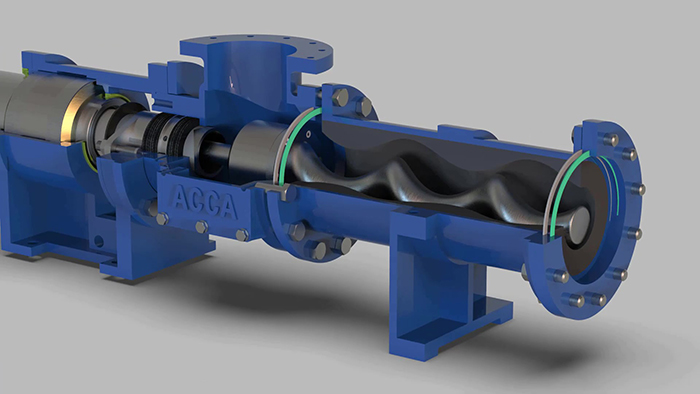
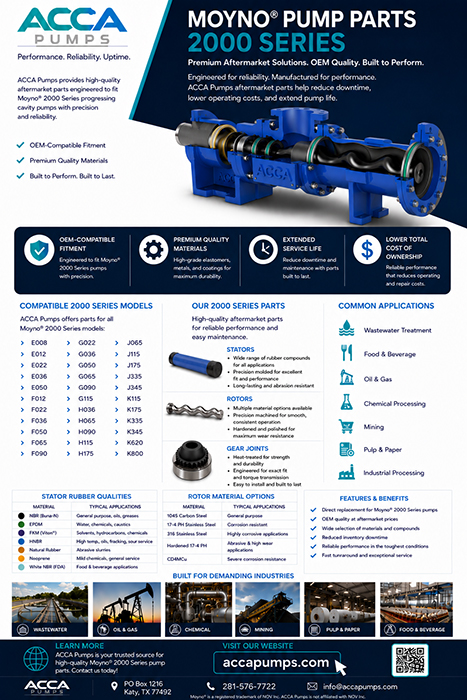
KATY, TEXAS — ACCA Pumps, a supplier of aftermarket progressive cavity pump solutions, announces the expansion of its replacement parts offering engineered to fit Moyno® 2000 Series progressing cavity pumps. The product line includes stators, rotors, gear joints, and related replacement components manufactured for industrial reliability and OEM-compatible fitment.
Designed for demanding industrial applications, ACCA Pumps aftermarket components are utilized in wastewater treatment plants, oil & gas operations, chemical processing facilities, mining operations, food and beverage manufacturing, and pulp & paper processing. The company offers replacement parts for a wide range of Moyno® 2000 Series models including E, F, G, H, J, and K frame sizes commonly used across industrial pumping systems.
ACCA Pumps provides multiple elastomer and material options to support various operating conditions and fluid types. Available stator elastomers include NBR, HNBR, EPDM, FKM (Viton®), Natural Rubber, and FDA-grade compounds. Rotor material options include stainless steels, hardened alloys, and corrosion-resistant coatings designed to improve wear resistance and operational longevity.
“Our goal is to provide dependable aftermarket pump parts that help facilities reduce downtime and maintenance costs while maintaining reliable pump performance,” said Nelson Bort of ACCA Pumps. “We continue expanding our product offerings to support industrial users operating Moyno® 2000 Series progressing cavity pumps in demanding environments.”
Moyno® is a registered trademark of NOV Inc. ACCA Pumps is not affiliated with NOV Inc.

Forging the Next 250 Years: Powering the Next Era of American Manufacturing
As manufacturers offer more customization than ever before, managing product complexity has become a critical challenge. Tune in with Dan Joe Barry, Vice President of Product Marketing at Configit, who explores how companies are tackling the growing number of product configurations across engineering, sales, manufacturing, and service. He explains how Configuration Lifecycle Management (CLM) helps organizations maintain a single source of truth for configuration data. The result: fewer errors, faster quoting, and the ability to deliver customized products at scale.
Get In Touch
Google news and SEO compliant, Industry Today’s state-of-the-art digital media platform offers bespoke media campaigns that target key decision makers and buyers to achieve your marketing and promotional goals.

Contribute
Showcase your brand and promote your business to our highly targeted audience. We offer detailed Google Analytics with measurable ROI to assure success. Submit your content for review by our Editorial team who will contact you to discuss the project further.
About Us
Reach Your Targeted Audience and Grow Your Business. Learn more About Industry Today.
Contact Us

© 2026 Industry today. All Rights reserved.