From voltage sags to harmonics, dirty power kills uptime. See how BESS and real-time controls restore stability.
By Matthew Ward
Dirty power quietly undermines industrial efficiency, but manufacturers now have the ability to detect and correct it in real time.
Industrial facilities rely on continuous, high-quality power to keep machines running, automation synchronized, and processes stable. But power can be “on” without being clean.
Dirty power includes voltage sags, harmonic distortion, surges, and frequency instability that disrupt operations without warning. These conditions trip drives, disrupt PLC timing, and damage sensitive equipment.
Common warning signs include flickering lights, nuisance breaker trips, overheating panels, and erratic motor behavior. In modern plants running robotics, variable frequency drives, and sensor-driven systems, dirty power directly impacts uptime, throughput, and equipment life.
As manufacturing becomes more electrified and digitally integrated, power quality is essential to operational reliability.
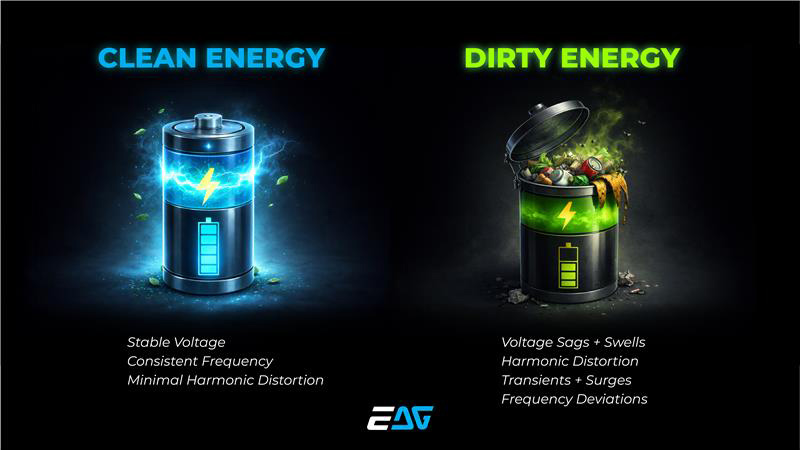
“Clean” electricity sounds simple. It delivers stable voltage, consistent frequency, and minimal harmonic distortion. That’s the gold standard.
Dirty power, on the other hand, shows up in many forms:
These effects are often symptoms of deeper electrical problems. Common causes of dirty power include:
Even tiny irregularities can cause major headaches. Modern control systems, drives, and PLCs don’t tolerate fluctuations well. This results in intermittent faults, unexplained shutdowns, and premature wear that quietly erode productivity.
In industrial settings, poor power quality is a silent cost driver. It leads to unplanned downtime, component failure, excessive maintenance, and rising energy waste.
Here’s how it shows up on the plant floor:
Recent research suggests that many power quality problems originate inside the facility rather than from the utility grid. Common contributors include improper grounding, aging components, and operating equipment beyond its design parameters. In high-throughput manufacturing environments, even brief disruptions tied to internal conditions can result in significant financial losses, often measured in thousands of dollars per minute.
Beyond immediate disruptions, dirty power reduces the value of automation, degrades overall equipment effectiveness (OEE), and drives ongoing margin loss.
As we move toward a cleaner, more decentralized energy future, grid complexity is growing. Renewable generation and distributed energy resources (DERs) bring sustainability benefits but also introduce variability.
Bidirectional power flows, once rare, are now routine. Solar inverters, EV chargers, and microgrids inject and draw power dynamically. Each interface creates a potential source of distortion. The grid that once flowed neatly in one direction now behaves more like a living, breathing network that is constantly shifting.
EV charging infrastructure adds a new challenge. Fast chargers draw immense bursts of power, creating localized sags and harmonics that ripple upstream. Utilities are working hard to manage these impacts, but stability is harder to maintain when thousands of distributed assets turn on and off throughout the day.
In short, the grid is smarter and greener, but also more volatile. Managing power quality has never been more important.
You can’t fix what you can’t measure. Power quality is tracked through indicators like THD (Total Harmonic Distortion), flicker, and frequency deviation.
Several standards define acceptable limits:
Modern monitoring tools can record waveform anomalies, log transient events, and even predict failures before they occur. Facilities that implemented simple power quality logging often discovered that recurring machine faults were caused not by mechanical issues but by distorted voltage profiles at specific times of day.
Data visibility is the first defense. Once you can see your power quality, patterns emerge, and targeted fixes become possible.
Manufacturers do not have to accept power quality issues as a cost of doing business. Proven technologies exist to stabilize power, protect equipment, and enhance facility resilience.
Surge protectors, line reactors, and isolation transformers can dampen transients and protect critical loads from incoming disruptions. These are often the first line of defense.
Power conditioners, voltage regulators, and UPS systems dynamically correct sags, swells, and waveform distortion. These are especially valuable for sensitive production equipment, IT rooms, or automated systems.
Industrial plants often face penalties and capacity constraints due to poor power factor and reactive power imbalance. These issues reduce energy efficiency, increase system losses, and place unnecessary stress on transformers and switchgear.
Modern systems can address both challenges simultaneously. By dynamically correcting power factor and managing reactive power in real time, facilities can reduce utility costs, improve voltage stability, and ensure smoother operation of motor-driven loads and automated systems.
Battery Energy Storage Systems are rapidly becoming the backbone of industrial power quality strategy. Far beyond backup power, advanced BESS platforms actively monitor and regulate power conditions in real time.
When properly integrated, BESS can:
At EticaAG, our BESS solutions feature patented LiquidShield immersion cooling technology that maintains thermal uniformity and enhances inverter performance under demanding load conditions. This cooling method minimizes thermal stress, prevents fire propagation, and improves system responsiveness during transient events. It makes our systems uniquely equipped to handle the volatility of modern industrial loads.
Combined with advanced monitoring, controls, and grid coordination, BESS becomes a precision instrument for power quality. They help plants improve uptime, reduce maintenance, and protect high-value automation from power-related disruptions.
These technologies are foundational for performance. A well-deployed BESS is a must-have for resilient, cost-efficient, and future-ready manufacturing operations.
Electrification is reshaping industrial operations. EV fleets, smart manufacturing, and digital controls demand power that stays stable, predictable, and resilient.
Dirty power is a technical and financial risk hiding in plain sight. Left unchecked, it triggers downtime, accelerates equipment failure, and erodes efficiency. The tools to stop it already exist. Real-time monitoring, advanced controls, and energy storage systems eliminate power quality issues before they disrupt operations.
Clean power is a competitive advantage. It delivers higher uptime, lower maintenance costs, longer equipment life, and safer operations. The future of industry depends not just on how much power we generate, but on how cleanly we deliver it.

About the Author:
Matthew Ward is President of EticaAG, responsible for leading company strategy, market expansion, and the deployment of its non-flammable energy storage systems across critical infrastructure sectors.
He brings more than 20 years of experience in energy resilience, distributed energy, and infrastructure modernization, with a proven track record of launching and scaling solutions in highly regulated markets.
Prior to EticaAG, Ward founded Solmicrogrid, a Morgan Stanley portfolio company, delivering turnkey microgrid solutions to the C&I industries nationwide.
His early career as a civilian nuclear engineer for the U.S. Navy underpins his deep focus on system safety, reliability, and technical rigor.
At EticaAG, he is applying that expertise to commercialize immersion-cooled battery systems that eliminate fire risk while advancing grid stability. Ward’s leadership is central to EticaAG’s mission to redefine energy storage safety standards in both public and private sector deployments.
Read more from the author:
From server racks to battery racks: Why immersion cooling is the future of safe energy storage in data centers | Data Center Dynamics, 8/14/2025
The New Energy Landscape Under OBBBA: From Disruption to Opportunity | Battery Technology, 8/26/2025

The Rise of American Manufacturing: A New Industrial Era
As manufacturers offer more customization than ever before, managing product complexity has become a critical challenge. Tune in with Dan Joe Barry, Vice President of Product Marketing at Configit, who explores how companies are tackling the growing number of product configurations across engineering, sales, manufacturing, and service. He explains how Configuration Lifecycle Management (CLM) helps organizations maintain a single source of truth for configuration data. The result: fewer errors, faster quoting, and the ability to deliver customized products at scale.
Get In Touch
Google news and SEO compliant, Industry Today’s state-of-the-art digital media platform offers bespoke media campaigns that target key decision makers and buyers to achieve your marketing and promotional goals.

Contribute
Showcase your brand and promote your business to our highly targeted audience. We offer detailed Google Analytics with measurable ROI to assure success. Submit your content for review by our Editorial team who will contact you to discuss the project further.
About Us
Reach Your Targeted Audience and Grow Your Business. Learn more About Industry Today.
Contact Us

© 2026 Industry today. All Rights reserved.