Procurement guide to choosing a commercial outdoor furniture manufacturer: materials, OEM/ODM, quality, and buying pitfalls.
If you’ve ever managed a hotel refurbishment or opened a new resort property, you already know that outdoor furniture procurement is rarely as simple as picking something attractive from a catalog. What looks good in a showroom doesn’t always survive a monsoon season, a salt-heavy coastline, or eighteen months of daily guest use.
I’ve spent over fifteen years advising hotels, resorts, restaurant groups, and furniture distributors on sourcing decisions—reviewing factories, negotiating OEM contracts, and occasionally cleaning up after procurement mistakes that cost clients tens of thousands of dollars in premature replacements. This guide distills what actually matters when selecting a commercial outdoor furniture manufacturer, based on real project experience rather than marketing claims.
Here’s something many first-time commercial buyers don’t realize: residential-grade outdoor furniture and commercial-grade outdoor furniture are built to entirely different standards, even when they look nearly identical in photographs.
A homeowner’s patio set might see light use—a few hours a week, moved indoors before winter, cleaned occasionally. A hotel pool deck chair, by contrast, might be sat in, dragged across concrete, rained on, and left in direct sun for twelve hours a day, every day, for years. The frame, the joinery, the coatings, and even the fabric webbing all need to perform under a completely different load.
This mismatch is the single most common cause of procurement regret I see in hospitality projects. Buyers select furniture based on appearance and price, only to discover within a year that frames are corroding, cushions are fading, or joints are loosening under repeated use. Replacing furniture early doesn’t just cost money—it disrupts operations, creates inconsistent aesthetics across a property, and damages guest experience during the replacement period.
There’s no single universal certification that defines “commercial-grade” outdoor furniture, which is part of why the term gets used loosely in marketing. In practice, experienced buyers evaluate commercial suitability across a few concrete dimensions:
For properties in tropical, coastal, or high-UV climates, ask manufacturers directly about their fabric and coating testing standards. Reputable factories can share fade-resistance and salt-spray test data rather than just verbal assurances. This is a fair question to ask during supplier evaluation, and any manufacturer serious about commercial work should have this documentation ready.
Commercial furniture needs to withstand repeated stacking, moving, and heavier average usage than residential pieces. Reinforced joints, welded (rather than screwed) aluminum frames, and thicker wall tubing are details worth inspecting on sample pieces before committing to a large order.
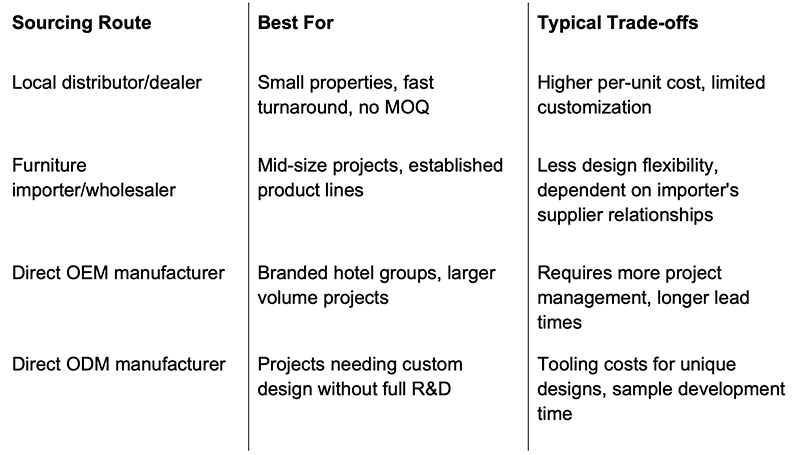
For furniture importers, distributors, and larger hospitality groups, working directly with a manufacturer through OEM or ODM arrangements is often more cost-effective than buying through intermediaries—but only if you understand how these processes work.
OEM (Original Equipment Manufacturing) means the factory produces furniture to your specifications—your designs, your branding, sometimes your proprietary materials. This is common for hotel groups and furniture brands that already have design teams and want manufacturing capacity without owning a factory.
ODM (Original Design Manufacturing) means the factory offers its own design and engineering input, often starting from an existing product line that gets customized to your project’s needs—colors, dimensions, fabric selections, branding. This route suits buyers who need a faster path to market or lack in-house design resources.
Manufacturers with established global export experience and dedicated project teams tend to handle these transitions more smoothly than smaller workshops that primarily serve domestic markets.
After reviewing dozens of hospitality furniture orders, the same mistakes tend to recur:
When advising clients on manufacturer selection, I typically walk them through the following framework rather than relying on a single factor like price or design appeal.
Manufacturers worth shortlisting typically check most, though rarely all, of these boxes. No supplier is perfect for every project, which is why matching manufacturer strengths to your specific project scope matters more than finding a single “best” option.
When evaluating manufacturers for commercial hospitality projects, it’s useful to look at companies that combine hospitality-specific experience with real manufacturing infrastructure rather than trading-company resale models. Kingmake Outdoor Furniture is one example of a factory-direct commercial outdoor furniture manufacturer that works across aluminum, teak, and rope product lines and offers both OEM and ODM services for hotel, resort, and restaurant projects.
That doesn’t mean every manufacturer with these capabilities is automatically the right fit for every project—buyers should still verify lead times, minimum order quantities, and material certifications against their specific requirements, the same due diligence outlined above applies regardless of which factory you’re considering. But it illustrates the kind of manufacturing profile hospitality buyers should be screening for: commercial-grade production experience, in-house engineering support, and export logistics capability suited to international hotel and resort projects.
Commercial-grade furniture is engineered for higher usage frequency, heavier average loads, and continuous outdoor exposure, typically using reinforced frames, marine-grade coatings, and higher-spec fabrics compared to residential lines.
With proper material selection and maintenance, well-made aluminum or teak commercial furniture can reasonably last seven to ten years in coastal or high-UV environments, though upholstery and cushions often need replacement sooner.
OEM production follows the buyer’s own designs and specifications, while ODM production is based on the manufacturer’s existing designs, customized to the buyer’s requirements such as color, size, or branding.
Request physical samples, ask for material test documentation, and where feasible, arrange a factory audit or third-party inspection before mass production begins.
Sample development typically takes two to four weeks, with mass production adding another four to eight weeks depending on order size, followed by shipping time that varies by destination.
Neither is universally better—teak offers a natural aesthetic and ages well with maintenance, while aluminum offers lower maintenance and more consistent performance in humid or coastal climates. The right choice depends on design intent and maintenance capacity.
Look for clear terms distinguishing frame defects, fabric or cushion coverage, and normal wear exclusions, along with a defined claims process and response timeline.
Smaller boutique properties should clarify MOQs early in supplier discussions, since some manufacturers are structured primarily around large resort or hotel-chain volume and may not accommodate small custom runs cost-effectively.
Choosing a commercial outdoor furniture manufacturer is ultimately a risk-management decision as much as a design one. The right partner reduces your exposure to premature replacement costs, supply chain delays, and inconsistent quality across a property—while the wrong one can quietly erode a project’s budget and guest experience over several years.
Take the time to verify materials, understand your sourcing model options, and ask manufacturers the harder questions about testing, lead times, and warranty terms before committing to a large order. That diligence upfront is almost always cheaper than the alternative.

Forging the Next 250 Years: Powering the Next Era of American Manufacturing
As manufacturers offer more customization than ever before, managing product complexity has become a critical challenge. Tune in with Dan Joe Barry, Vice President of Product Marketing at Configit, who explores how companies are tackling the growing number of product configurations across engineering, sales, manufacturing, and service. He explains how Configuration Lifecycle Management (CLM) helps organizations maintain a single source of truth for configuration data. The result: fewer errors, faster quoting, and the ability to deliver customized products at scale.
Get In Touch
Google news and SEO compliant, Industry Today’s state-of-the-art digital media platform offers bespoke media campaigns that target key decision makers and buyers to achieve your marketing and promotional goals.

Contribute
Showcase your brand and promote your business to our highly targeted audience. We offer detailed Google Analytics with measurable ROI to assure success. Submit your content for review by our Editorial team who will contact you to discuss the project further.
About Us
Reach Your Targeted Audience and Grow Your Business. Learn more About Industry Today.
Contact Us

© 2026 Industry today. All Rights reserved.