Industrial manufacturing’s new strategic role: Where AI, electrification and resilience converge.
By Michael Fiore
Industrial manufacturing is no longer simply responding to global investment trends; it’s enabling them. AI infrastructure, grid modernization and electrification, and defense and resilience investments, such as strengthening supply chains and reshoring, increasingly rely on the same industrial capabilities, concentrating capital around the manufacturers best positioned to support all three.
That shift is changing how companies compete and how investors deploy capital. Manufacturers with capabilities that serve multiple infrastructure markets are commanding greater attention, while acquisitions, divestitures, and portfolio repositioning have become strategic tools for strengthening long-term competitive advantage. These trends are reshaping the industry, and the question for manufacturing leaders is now how quickly can they position their businesses to benefit.
Industrial manufacturing sits at the intersection of three powerful investment cycles. AI infrastructure requires power distribution, thermal management, automation and controls, and advanced engineered components. Grid modernization depends on many of those same capabilities, while investments in domestic manufacturing, supply chain resilience, and defense continue to reinforce demand across the same industrial supply base. That convergence is changing how investors evaluate the sector. Rather than viewing these as separate growth opportunities, they’re increasingly seeking out the manufacturers that enable all three.
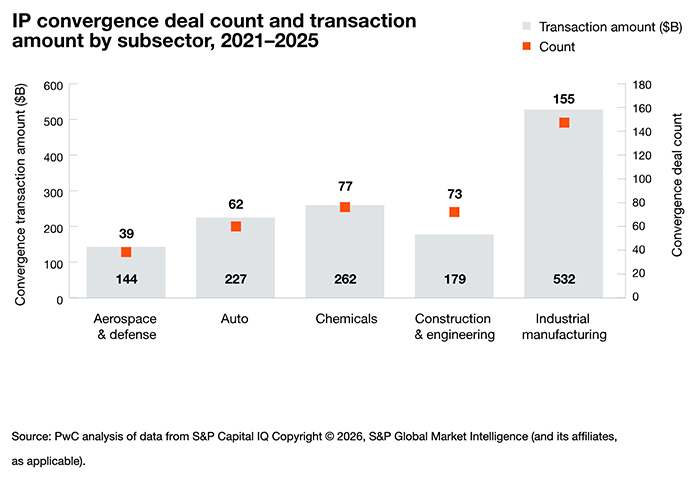
The numbers underscore the shift. According to PwC’s Industrial manufacturing: US Deals 2026 midyear outlook, industrial manufacturing M&A reached a record $173 billion over the past year. Between 2021 and 2025, the sector generated 155 convergence transactions totaling $532 billion, more than any other industrial subsector. This isn’t simply another active deal cycle. It’s evidence that capital is concentrating around businesses positioned to benefit from multiple durable growth trends simultaneously.
PwC’s Seize the industrial megadeal moment report reinforces that conclusion. As AI infrastructure, electrification, and resilience investments increasingly compete for the same constrained industrial capabilities, manufacturers are becoming foundational to the infrastructure economy. Not because they’re developing AI applications, but because they’re building the physical systems that make them possible.
The biggest shift in today’s industrial economy is how companies are being valued. Buyers are increasingly pursuing capabilities that position them at the intersection of multiple infrastructure investment themes rather than simply adding manufacturing scale. Power equipment, automation and controls, thermal management, industrial software, and advanced engineered components have become strategic assets because they enable AI infrastructure, grid modernization, and resilience investments simultaneously.
That helps explain why industrial manufacturing M&A continues to accelerate despite ongoing macroeconomic uncertainty. Strategic acquirers accounted for 86% of industrial manufacturing deal value over the last year, while transactions above $5 billion represented 56% of total deal value, up from 18% in FY24. It’s clear that long-term strategic conviction is driving investment decisions.
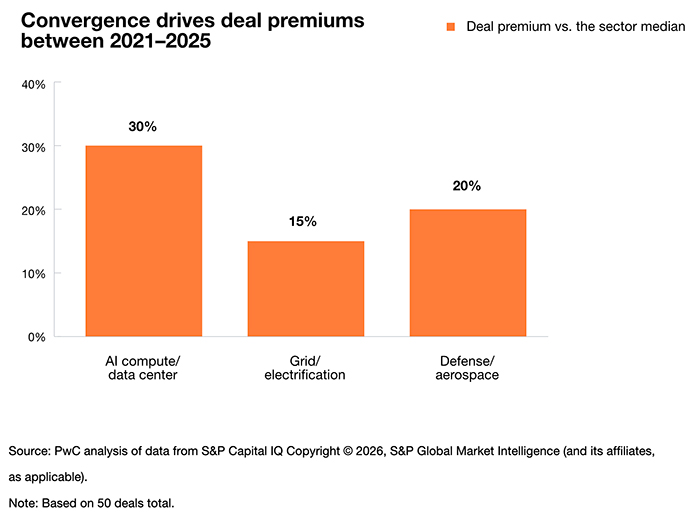
The trend extends beyond individual transactions. Convergence-related assets tied to AI infrastructure, electrification, or resilience infrastructure commanded deal pricing 15% to 30% above sector medians from 2021-2025, with AI compute and data center assets attracting some of the strongest valuations. For manufacturers, the implication is broader than M&A. Investments in automation, engineering capabilities, digital operations, and production readiness are increasingly becoming strategic differentiators that position companies to compete across several infrastructure markets instead of just one.
As capital concentrates around a narrower set of capabilities, industrial leaders are rethinking how they build competitive advantage and focusing on which organization’s portfolio reflects where long-term demand is heading. That shift is driving a new wave of portfolio repositioning. Companies are divesting businesses that no longer align with their strategic direction while increasing investment in automation, AI infrastructure, advanced manufacturing, electrification, and resilient supply chains. Increasingly, divestitures are funding future growth rather than simplifying operations.
PwC research shows that nearly 69% of companies completing acquisitions above $5 billion since 2021 also executed divestitures, with that figure rising to more than 86% among serial acquirers. Today’s leaders are reshaping portfolios with a clear strategic purpose, rather than pursuing growth for its own sake. Investors are responding accordingly. They increasingly reward companies that can clearly explain why their businesses belong together, how they reinforce one another, and how they strengthen exposure to long-term infrastructure demand. Portfolio strategy has become business strategy.
The companies creating the most value are translating long-term infrastructure demand into measurable business performance. That starts with investment discipline. Buyers increasingly expect companies to demonstrate tangible operational improvements from AI through higher throughput, predictive maintenance, labor productivity, or improved asset utilization. The conversation has shifted from AI potential to AI performance.
The same principle applies to acquisitions. Successful buyers enter transactions with a clear investment thesis, a realistic integration plan, and an operating model capable of supporting long-term growth. Diligence now extends well beyond financial performance to include digital capabilities, operational technology, manufacturing readiness, and integration planning. Preparation has become a competitive advantage. Companies that define where they create differentiated value and prepare their organizations before opportunities emerge are consistently better positioned than those waiting for greater certainty.
Industrial manufacturing has entered a new phase defined by structural transformation, rather than cyclical recovery alone. As AI infrastructure, electrification, grid modernization, and resilience investments converge around the same industrial capabilities, manufacturers are becoming the foundation of the infrastructure economy.
That shift is rewriting the rules for capital allocation, portfolio strategy, and growth. The companies that define the next decade won’t necessarily be those with the largest balance sheets or the broadest portfolios. They’ll be the organizations that recognize where long-term demand is converging, invest in the capabilities that serve multiple infrastructure markets, and execute with discipline before the rest of the market catches up.

About the Author:
Michael Fiore is PwC’s US Industrial Products Deals Leader, bringing over 25 years of industry and M&A transaction consulting experience. He specializes in pre- and post-deal services and has advised clients on transformative global and domestic transactions. Over the course of his career, he has supported more than 700 M&A transactions.

Forging the Next 250 Years: Powering the Next Era of American Manufacturing
As manufacturers offer more customization than ever before, managing product complexity has become a critical challenge. Tune in with Dan Joe Barry, Vice President of Product Marketing at Configit, who explores how companies are tackling the growing number of product configurations across engineering, sales, manufacturing, and service. He explains how Configuration Lifecycle Management (CLM) helps organizations maintain a single source of truth for configuration data. The result: fewer errors, faster quoting, and the ability to deliver customized products at scale.
Get In Touch
Google news and SEO compliant, Industry Today’s state-of-the-art digital media platform offers bespoke media campaigns that target key decision makers and buyers to achieve your marketing and promotional goals.

Contribute
Showcase your brand and promote your business to our highly targeted audience. We offer detailed Google Analytics with measurable ROI to assure success. Submit your content for review by our Editorial team who will contact you to discuss the project further.
About Us
Reach Your Targeted Audience and Grow Your Business. Learn more About Industry Today.
Contact Us

© 2026 Industry today. All Rights reserved.