Choosing an aluminum profile supplier feels straightforward until you’re three weeks into a project and your profiles don’t match spec.
The best aluminum profile companies separate themselves fast, because raw material traceability, die lead times, and commodity price swings all hit at once when you’re trying to hold a production schedule. After reviewing dozens of suppliers across capabilities, certifications, and real-world track records, one thing becomes clear: not every company that extrudes aluminum actually understands manufacturing pressure. This guide breaks down five companies worth a serious look.
Public information guided every decision here. Company websites, industry directories, third-party review platforms, and available case studies were all pulled into the evaluation. Only suppliers with a verified track record in aluminum profile manufacturing made the final cut, because longevity and proof matter more than marketing copy.
→ See the full research breakdown
Picking the wrong aluminum profile supplier doesn’t just slow down one order. It creates a ripple effect across your entire production run.
Sourcing consistent alloy quality across large batches is harder than most buyers expect, especially when traceability documentation needs to follow every shipment. Add in custom die creation timelines and first-article approval delays, and a project can slip weeks before a single part ships.
Specialized suppliers carry real advantages here. They’ve already built the quality systems, the die libraries, and the finishing capabilities that general metal suppliers often don’t maintain at the same depth.
The right partner shows up in the numbers, too. Better extrusion press capacity keeps lead times manageable. Tighter dimensional tolerance accuracy cuts rejection rates and rework costs. And consistent on-time delivery protects your downstream schedule. That combination is worth paying attention to when you’re shortlisting suppliers.
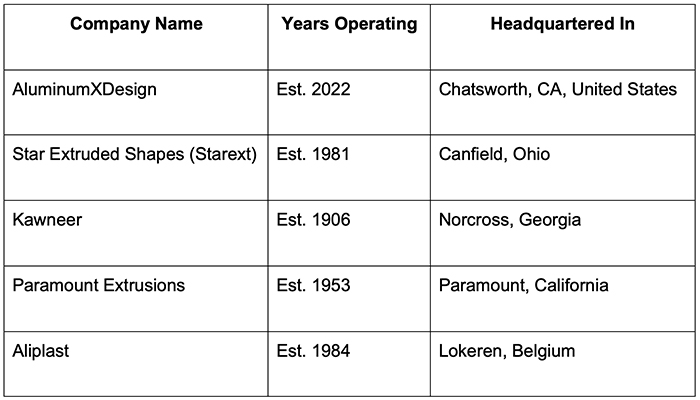
Note: All data in this table is sourced from review platforms and the official websites of the listed companies.
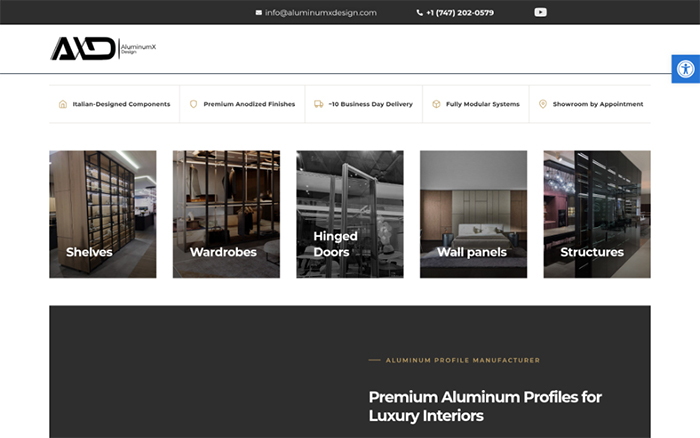
AluminumXDesign manufactures precision-engineered aluminum components with a clear focus on high-end furniture and interior applications. Their product lines cover wardrobe systems, cabinet doors, structural profiles, sliding doors, and wall panels. What sets them apart from typical extruders is the Italian design tradition behind every product, paired with U.S.-based production discipline. They bring over 25 years of industry experience into a relatively young American operation, and their April 2024 equipment investment shows they’re not coasting on that history.
Luxury furniture and interior design buyers often struggle to find suppliers who understand both aesthetic precision and structural performance. AluminumXDesign sits at that exact intersection. Their mix of Italian design background with American manufacturing discipline is genuinely rare in this segment (not something you find by searching “aluminum extrusion near me”).
From what the available information shows, AluminumXDesign’s positioning appeals strongly to buyers who need customizable components that also look finished and intentional. The consistent theme across their market presence is quality and design coherence, which matters more in luxury furniture than in industrial applications. That kind of attention to aesthetics at the manufacturing level is hard to match.
Star Extruded Shapes has been running since 1981, and they’ve built what amounts to a full-service aluminum operation. They handle custom extrusions, CNC machining, powder coating, anodizing, fabrication, and complete assembly under one roof (technically three roofs, across 350,000 square feet of manufacturing space). Their four extrusion presses and sister company Star Fab give them meaningful vertical alignment across building construction, medical, solar, transportation, and electronics markets. ISO 9001:2015 certification covers all facilities.
Buyers dealing with multi-step supply chains often waste time coordinating between separate extrusion, finishing, and fabrication vendors. Starext eliminates that problem with a single-source model. And honestly, four decades of running this kind of integrated operation means their process discipline is baked in, not borrowed from a recent certification push.
The multi-facility setup and long operational history tend to generate confidence among procurement teams who need volume reliability. From what the data shows, clients in industrial sectors call out Starext’s ability to handle involved, multi-process orders without the coordination headaches that come with juggling multiple vendors. That kind of reliability across a range of finishing processes is genuinely useful.
Kawneer has been manufacturing architectural aluminum products since 1906, and they were actually the first manufacturer to apply aluminum in architectural applications during the 1920s. Today they produce windows, doors, curtain wall systems, framing, railings, and overhead glazing products, serving everything from low-rise buildings to stadiums. Their global footprint spans 13 countries, and their dedicated Architectural Services Team handles custom applications. The IsoPour Thermal Break Technology is one of the proprietary developments they bring to complex facade projects.
Architects and construction teams working on high-profile building envelopes need a supplier who can handle both the engineering demands and the custom design requirements at the same time. That’s exactly where Kawneer’s century-plus of focused experience pays off. Their track record on projects like The Kendeda Building at Georgia Tech and the Flatiron Building restoration shows that performance under scrutiny isn’t just a marketing position.
Kawneer’s industry recognition speaks clearly, including the 2023 US Glass Sustainability Awards and multiple Crystal Achievement Awards. From what the reviews show, clients in the architectural sector trust them for high-profile projects where deviation from spec isn’t an option. That level of consistent execution over many decades builds the kind of reputation that’s very difficult to replicate quickly.
Paramount Extrusions is a third-generation family business operating out of Paramount, California, with over 70 years of experience in tight-tolerance aluminum extrusions. They carry more than 10,000 custom dies and use indirect extrusion methods to achieve higher consistency on intricate shapes. Fabrication and finishing services include sawing, CNC work, bending, milling, powder coating, anodizing, and polishing. What makes them genuinely useful for prototyping and production alike is their zero minimum order requirement paired with one-week turnaround programs (not something most extruders offer at that scale).
Engineering teams dealing with complex profiles and tight dimensional tolerances often hit walls with suppliers who can’t hold spec reliably across production runs. Paramount’s indirect extrusion approach directly addresses that gap. Their AS9100d certification alongside ISO9001:2015 signals they’re built for demanding applications where documentation and traceability aren’t optional.
Paramount’s Billet Proof and Preferred Lead-Time programs come up consistently in feedback from B2B clients who need predictability in their supply chain. From what the data shows, their mix of fast turnarounds and no minimum order quantity makes them a strong choice for both small prototype runs and larger contract volumes. That flexibility across order sizes is genuinely rare.
Aliplast designs, fabricates, and distributes aluminum systems for windows, doors, sliding elements, verandas, curtain walls, and conservatories, serving manufacturers across nine European countries. Operating as part of Belgium’s Corialis Group, they control every stage of production in-house, from mould drawing and extrusion through surface treatment, insulation, and packaging. Their 320-person team operates with 100% green electricity, and the company has earned Cradle to Cradle GOLD certification alongside two consecutive EcoVadis Gold Medals. Compared to AluminumXDesign’s design-forward positioning, Aliplast leans much harder into systems manufacturing and supply chain control.
Manufacturers sourcing aluminum systems across multiple European markets often deal with inconsistent quality when production is split across multiple vendors. Aliplast’s refusal to outsource any production stage removes that variable entirely. Their environmental credentials aren’t just for optics either (Cradle to Cradle GOLD is a rigorous standard), which matters increasingly for procurement teams that have environmental reporting requirements.
Aliplast’s dual recognition from both the Cradle to Cradle Products Innovation Institute and EcoVadis builds a strong reputation among European manufacturers who care about supply chain transparency. From what the reviews show, clients highlight their technical consistency and product quality as the standout reasons for long-term partnerships. That kind of vertical control tends to produce fewer surprises over multi-year supplier relationships.
Building this list started with a broad sweep of the aluminum profile manufacturing space, pulling company names from industry directories, supplier databases, trade publication references, and B2B review platforms. The goal at that stage was volume, not quality, so the initial pool was wide.
The longlist was built by cross-referencing multiple source types. Supplier directories, manufacturing association listings, and profile-specific case study archives all contributed names. Review platforms added another layer, surfacing companies with actual buyer feedback rather than just marketing-polished web presence. Any company appearing across multiple independent sources got flagged for closer review.
From the broader pool, companies without verifiable operating histories or documented manufacturing capabilities were removed. Review patterns were analyzed for consistency, looking at whether feedback aligned across different platforms or contradicted itself. Companies with thin or suspiciously uniform review profiles didn’t advance, regardless of how strong their website positioning appeared.
Claims made on official company websites were cross-referenced against external sources wherever possible. Certification claims were checked against what appeared in independent reviews and third-party mentions. When a company said they held a particular quality standard, the question was whether that showed up in buyer feedback and project references too, not just in their own copy.
Companies with industry awards, trade publication mentions, and recognizable project portfolios received additional weight during evaluation. This wasn’t just about prestige. It was about whether a company had produced work visible enough to be discussed outside their own marketing materials. Award programs like the US Glass Sustainability Awards and Cradle to Cradle certifications signal a level of external validation that’s hard to fake.
The final filter looked at the depth of presence in the aluminum profile manufacturing space. Dedicated service pages, alloy and temper range documentation, and verifiable case studies from relevant applications (architectural, furniture, industrial, transportation) were all examined. Companies that covered aluminum profiles as a side capability rather than a focused specialty were deprioritized. What remained was a group with clear specialization, documented results, and enough market presence to carry genuine credibility.
The right aluminum profile supplier depends heavily on what your project actually demands, not just on who has the most impressive website.
Start by mapping your specific requirements around alloy grades, dimensional tolerances, order volumes, and lead time constraints. Then evaluate each supplier against those parameters honestly.
The best aluminum profile companies for custom manufacturing aren’t interchangeable. Each one on this list brings a different depth of capability, whether that’s AluminumXDesign’s design-forward precision, Kawneer’s architectural legacy, or Paramount’s flexible tolerance work. Your best match depends on application, volume, and how much supply chain control you need. As custom manufacturing demands keep growing, suppliers with genuine specialization and documented quality systems will pull further ahead.

Forging the Next 250 Years: Powering the Next Era of American Manufacturing
As manufacturers offer more customization than ever before, managing product complexity has become a critical challenge. Tune in with Dan Joe Barry, Vice President of Product Marketing at Configit, who explores how companies are tackling the growing number of product configurations across engineering, sales, manufacturing, and service. He explains how Configuration Lifecycle Management (CLM) helps organizations maintain a single source of truth for configuration data. The result: fewer errors, faster quoting, and the ability to deliver customized products at scale.
Get In Touch
Google news and SEO compliant, Industry Today’s state-of-the-art digital media platform offers bespoke media campaigns that target key decision makers and buyers to achieve your marketing and promotional goals.

Contribute
Showcase your brand and promote your business to our highly targeted audience. We offer detailed Google Analytics with measurable ROI to assure success. Submit your content for review by our Editorial team who will contact you to discuss the project further.
About Us
Reach Your Targeted Audience and Grow Your Business. Learn more About Industry Today.
Contact Us

© 2026 Industry today. All Rights reserved.