Most transformations fail from weak leadership, not weak strategy. Here’s what changes the outcome.
By Paul Kreis, Executive Advisor, Brooks International
The answer isn’t bad strategy, insufficient budget, or technology that underdelivers. It’s a design flaw built into how most programs are structured from the start: they’re engineered to reach a new state, not to build the performance system that makes it stick. RAND Corporation’s 2026 research confirms the result: an 80% failure rate. It also identifies the driver: 84% of those failures are leadership-related. The fix is not a better framework. It’s a leadership team that stops sponsoring a transformation from a distance and starts operating as the performance system at its center.
“Organizations do not transform because they launch programs. They transform because their leaders change how they lead, consistently and visibly, in service of a performance system that will outlast any initiative.”
The distinction between sponsoring a transformation and owning one becomes visible in outcomes. Two manufacturing engagements illustrate the difference.
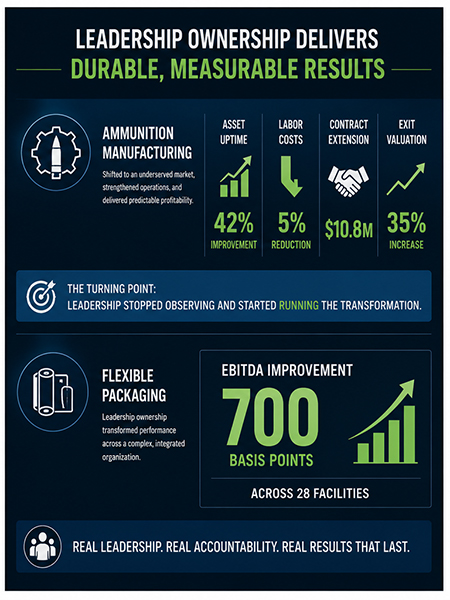
The largest ammunition marketplace and manufacturer in its category launched a transformation to shift from a saturated caliber market into an underserved emerging segment and fulfill a major international contract. The engagement focused on building leadership consensus around a master business plan, establishing a clear accountability structure, and designing a Sales, Inventory and Operations Planning process to deliver predictable profitability.
Outcome: Asset uptime improved 42%. Labor costs fell 5%. The company secured a $10.8M contract extension. Exit valuation increased 35%.
A $3B private equity–owned manufacturer needed to bring EBITDA percentages in line as the holding period matured. The organization, itself the product of three prior integrations, carried a significant cultural debt. The work centered on coaching the CEO and leadership team in ownership, accountability, and forward-looking decision-making.
Outcome: Facility leadership shifted from passive management to active ownership of the operating model, delivering a 700 basis point EBITDA improvement across 28 facilities.
In both cases, the turning point was the same: the leadership team stopped observing the transformation and started running it.
A: Ask each executive to describe, in specific terms, what they personally own: not their functional role, but their decision rights and performance commitments within the transformation. If the answers are vague or inconsistent, the team is sponsoring. Ownership requires a shared accountability map with concrete metrics attached to each leader.
A: Audit accountability before you audit the program. Most drifting transformations don’t need a new strategy. They need clarity on who owns what. Rebuild the accountability structure first, then redesign the operating rhythm around it.
A: Because most transformations are designed as projects with a finish line. Once the initial launch energy fades and daily operational demands resume, senior leaders revert to their normal management posture. The transformation was never embedded in how they lead. It was added on top of it.
A: Three things: decision clarity (each leader knows exactly what they own), cross-functional trust (the team makes real-time calls together, not in silos), and behavioral accountability (gaps are named and addressed, not managed around). These are developable capabilities, but they require the same deliberate investment as any operational gap.
The transformation failure rate has held at 80% for years, not because organizations lack ambition or resources, but because the dominant approach is designed for delivery, not durability. The single change that shifts the odds is also the most difficult: the leadership team has to become the performance system, not merely its sponsor.
Three steps make it concrete: audit individual accountability before auditing the program, redesign the operating rhythm to require real-time decisions, and invest in the leadership team as a performing unit with the same discipline applied to any operational gap.
The question worth asking before the next transformation launches isn’t whether the roadmap is sound. It’s whether the leadership team is built to sustain what the roadmap is trying to create.
ABOUT THE AUTHOR
Paul Kreis is an executive advisor at Brooks International specializing in leadership team development and organizational effectiveness. He works with executive teams across defense, manufacturing, and complex enterprise environments to design the performance systems that make transformation outcomes permanent.

Forging the Next 250 Years: Powering the Next Era of American Manufacturing
As manufacturers offer more customization than ever before, managing product complexity has become a critical challenge. Tune in with Dan Joe Barry, Vice President of Product Marketing at Configit, who explores how companies are tackling the growing number of product configurations across engineering, sales, manufacturing, and service. He explains how Configuration Lifecycle Management (CLM) helps organizations maintain a single source of truth for configuration data. The result: fewer errors, faster quoting, and the ability to deliver customized products at scale.
Get In Touch
Google news and SEO compliant, Industry Today’s state-of-the-art digital media platform offers bespoke media campaigns that target key decision makers and buyers to achieve your marketing and promotional goals.

Contribute
Showcase your brand and promote your business to our highly targeted audience. We offer detailed Google Analytics with measurable ROI to assure success. Submit your content for review by our Editorial team who will contact you to discuss the project further.
About Us
Reach Your Targeted Audience and Grow Your Business. Learn more About Industry Today.
Contact Us

© 2026 Industry today. All Rights reserved.