Explore five prop firms offering funded accounts for traders ready to move beyond demo trading, with key rules and risks to consider.
Moving from demo trading to a real funded account is where most traders hit a wall. Prop firms solve a genuine problem: they give traders access to serious capital without requiring them to risk their own savings. But not every firm is legitimate, and the evaluation rules vary wildly. After reviewing dozens of funded trader programs, including their drawdown limits, profit targets, and payout histories, this guide breaks down five prop firms that actually work for traders making that shift.
Each firm on this list was assessed using publicly available information pulled from official websites, trader review platforms, and third-party directories. Only firms with a demonstrated track record in proprietary trading made the cut. Review patterns, funding history, and platform transparency all factored into the final selection.
→ See the full research breakdown
Choosing the right prop firm shapes every aspect of a trader’s funded journey. The wrong firm can mean opaque payout rules, inconsistent drawdown policies, or worse, a firm that simply doesn’t pay.
Traders moving over from demo accounts face a real mental shift. Suddenly every trade carries psychological weight because real capital is on the line, even if it’s the firm’s capital.
The firms that get this right build evaluation rules that are strict enough to filter out gamblers but fair enough to reward disciplined traders. That balance matters more than most beginners realize.
A well-chosen prop firm directly affects challenge pass rate, how fast a trader reaches a funded account, and the profit split percentage they walk away with each payout cycle. Those three numbers tell the whole story.
Note: All data in this table is sourced from review platforms and the official websites of the listed companies.
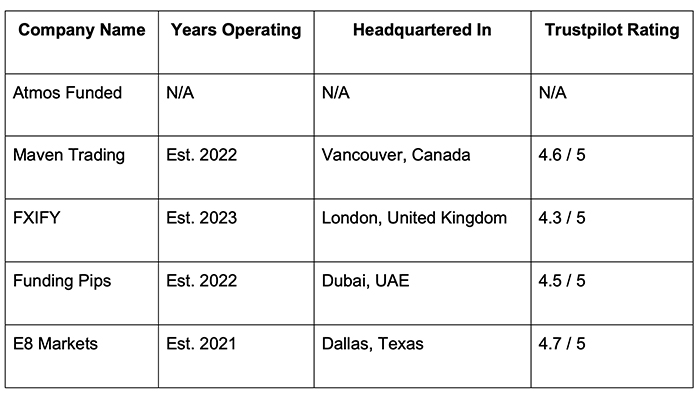

Atmos Funded runs a two-phase evaluation program: traders first hit a 10% profit target, then a 5% target in the verification phase, before gaining access to firm capital. Evaluation fees range from $63 to $1,020, depending on account size, keeping the cost-to-fund ratio reasonable across the board. The firm supports traders with clear rule sets, community resources, and trading tools rather than a formal curriculum. Traders looking for a structured, regulated path can find full details at https://atmosfunded.com/, where account options and program rules are clearly laid out.
The regulated status here sets a meaningful bar, especially for traders who’ve been burned by undercapitalized firms that promise payouts they can’t deliver. Their VIP program adds a real incentive loop, rewarding consistent performers with better profit splits and higher capital allocations over time.
From the reviews, traders respond well to the firm’s transparency regarding its rules and fee structure. The tiered scaling model gets consistent praise from traders who stick around long enough to benefit from it. And honestly, the clarity around what’s expected at each phase seems to be the main reason traders trust the process.

Maven Trading offers a funded trader program covering accounts from $2,000 to $100,000, with challenge options in one, two, or three steps depending on how a trader wants to approach the evaluation. Entry fees start at just $13, which makes it one of the more accessible starting points in this space. Traders who pass the challenge keep 80% of profits, and accounts can scale all the way to $1 million. The platform supports cTrader and Match-Trader, both of which are solid professional-grade tools.
Maven has funded over 5,000 traders with $60 million in total capital, and that kind of track record is hard to match for a firm that’s only been operating since 2022. The flexible challenge structure means traders aren’t locked into a single evaluation format, which is a genuine advantage when different strategies need different timelines.
Maven holds a 4.6 out of 5 on Trustpilot, and traders frequently mention the 24/7 support as a standout. Worth keeping in mind: Traders Union assigns a lower score of 3.96 with a “higher than average risk” flag, so cross-referencing reviews before committing is a smart move. From what the data shows, the majority of funded traders report positive experiences with payouts and platform reliability.
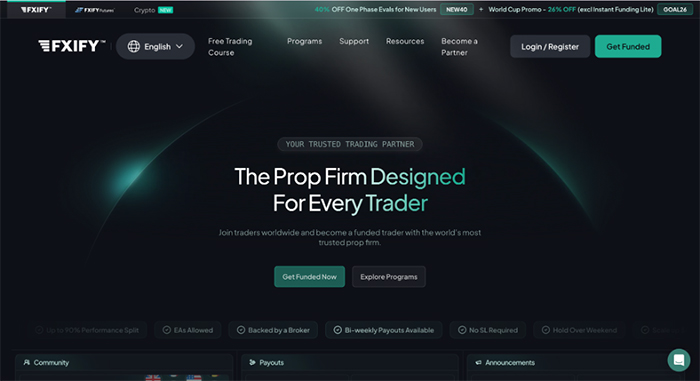
FXIFY gives traders access to up to $4 million in trading capital through multiple funding evaluation programs, with profit splits reaching 90%. The platform covers MT4, MT5, and DXTrade with 300 tradable assets spanning forex, stocks, metals, and crypto CFDs. Entry-level challenges start at $39, which keeps the barrier low for newer traders. Founded by a team with over 30 years of combined trading and brokerage experience, FXIFY paid out over $8.7 million to funded traders in its first year alone (not bad for a firm that launched in 2023).
The real-time analytics layer is what separates FXIFY from most competitors, giving traders actual performance data they can use to adjust before they blow a phase. That kind of feedback tool is rare at this price point, and it directly impacts challenge pass rates for traders who actually pay attention to the numbers.
FXIFY holds a 4.3-star Trustpilot rating from over 4,000 reviews, with around 77% rated five stars. Traders consistently point to the platform tools and profit structure as highlights. From what the reviews show, the founding team’s brokerage background shows up in the product quality, and most users feel the evaluation process is fair given the capital amounts on offer.
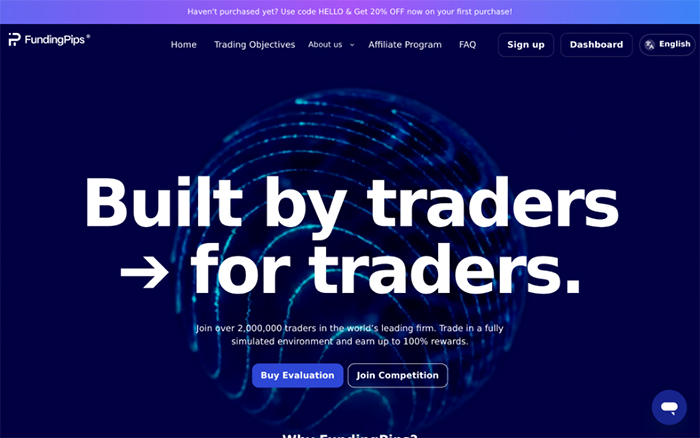
Funding Pips runs a two-phase evaluation and offers something genuinely distinctive: weekly payouts every Tuesday, which the firm claims to have invented in this space. Profit splits go up to 100%, and there’s also an instant funding path with no evaluation required for traders who want to skip the challenge process entirely. The platform spans MT5, cTrader, and MatchTrader, and traders can pull payouts on demand. With over $180 million paid out across 127,000+ verified payouts since 2022, the numbers behind the brand hold up.
Funding Pips took the payout friction problem seriously and built a model around it, which shows in the zero reward denial policy and on-demand access to profits. For traders who’ve dealt with firms that delay or complicate payouts, that structural commitment is meaningful proof of intent.
The 4.5 out of 5 Trustpilot rating from 39,000+ reviews is one of the larger review pools on this list, and that volume adds real weight to the score. Traders on both Trustpilot and Reddit consistently mention reliable payouts and clear trading conditions as the top reasons they stay. And the weekly payout model seems to be the single biggest trust signal for most funded traders here.
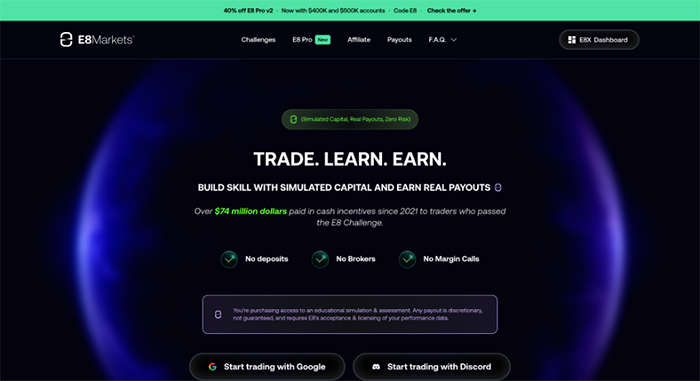
E8 Markets offers funded accounts up to $1 million with profit splits reaching 100% and no hidden fees, which is a combination that gets the attention of experienced traders quickly. The platform supports forex, indices, metals, energies, futures, and cryptocurrencies across multiple platforms. The firm also operates as a skills training and analytical modeling platform, positioning it slightly differently than a pure prop firm. With over 200,000 traders served across 70+ countries and $35 million in payouts processed within 5 business days, the operational footprint is extensive.
The global reach across 70+ countries combined with zero hidden fees makes E8 Markets one of the more transparent options for traders who’ve been stung by unexpected charges in other programs. That kind of pricing clarity, especially at account sizes up to $1 million, builds the kind of trust that keeps traders coming back after their first funded cycle.
E8 Markets sits at a 4.7 out of 5 on Trustpilot, the highest score on this list, and traders frequently highlight consistent payouts and honest fee disclosure as the driving factors. From what the reviews show, the 200,000+ trader community has created a strong feedback loop that keeps the firm accountable. The five-business-day payout window comes up repeatedly as a genuine differentiator compared to firms that take weeks.
The initial longlist was built by pulling firm names from multiple sources: proprietary trading directories, funded trader community forums, third-party review platforms, and official firm websites. Priority was placed on firms that appeared consistently across at least two independent sources, rather than those with heavy self-promotional presence but thin external coverage. Case studies, trader testimonials, and public challenge result data were all factored into the initial collection phase.
Once the longlist was assembled, firms without verifiable trader histories were removed first. Review patterns were analyzed carefully: firms with suspiciously clustered five-star reviews posted in short windows were flagged and deprioritized. The focus stayed on firms where review sentiment showed variety, including both praise and constructive criticism, because that pattern reflects a real user base rather than a managed one. Firms with fewer than a meaningful number of external reviews were also dropped at this stage.
Each firm’s public claims were cross-checked against trader review content on third-party platforms. If a firm claimed a payout volume or trader count on its own website, that figure was checked against external mentions and community discussions before being treated as reliable. Discrepancies between firm-stated metrics and community-reported experiences were noted and weighed into the final assessment. Real-world payout evidence, including whether traders reported receiving funds within the stated timeframe, carried heavy weight here.
Awards, press mentions, and appearances in funded trading publications were all cataloged. Firms that had received formal recognition from financial publications or industry award bodies received additional credibility weight, particularly when those awards came from organizations with editorial standards rather than pay-to-list directories. Original research published by any of the firms was also reviewed to assess whether their thinking contributed meaningfully to the broader trader education space.
Each firm was reviewed for dedicated service documentation related to proprietary trading. This included clearly posted rule sets, challenge phase breakdowns, drawdown limit disclosures, and profit split tables. Firms with ambiguous or hard-to-find rule documentation scored lower regardless of their general reputation. Verified reviews from actual funded traders, particularly those discussing the post-challenge payout process, were treated as the strongest signal of operational credibility.
Not every prop firm that looks polished on the outside actually delivers for traders. Knowing what to check before paying an evaluation fee saves real money and time.
Moving from demo to funded trading works best when the prop firm you choose matches your trading style, risk tolerance, and timeline. The five firms on this list cover a range of approaches, from Atmos Funded’s regulated structure to Funding Pips’ payout flexibility, and each one solves a specific problem for a specific type of trader. As the prop trading space keeps growing, the firms that put transparency and consistent payouts first will keep attracting the strongest talent.

Forging the Next 250 Years: Powering the Next Era of American Manufacturing
Brooklyn Army Terminal (BAT) began as a World War II-era military supply base. Today it is New York City’s largest publicly owned industrial campus, with 59 waterfront acres, more than 4 million square feet and over 100 businesses. In this episode of Industry Insights, Bridget Chansakul, Vice President of Leasing & Portfolio Management at NYCEDC, explains what space is available and what’s planned for the 250,000+ square feet of new industrial space in Building A. She also covers how the ferry, parking and on-site childcare help tenants hire and keep workers, along with workforce partnerships, City incentives for manufacturers and where BAT is headed next.
Get In Touch
Google news and SEO compliant, Industry Today’s state-of-the-art digital media platform offers bespoke media campaigns that target key decision makers and buyers to achieve your marketing and promotional goals.

Contribute
Showcase your brand and promote your business to our highly targeted audience. We offer detailed Google Analytics with measurable ROI to assure success. Submit your content for review by our Editorial team who will contact you to discuss the project further.
About Us
Reach Your Targeted Audience and Grow Your Business. Learn more About Industry Today.
Contact Us

© 2026 Industry today. All Rights reserved.