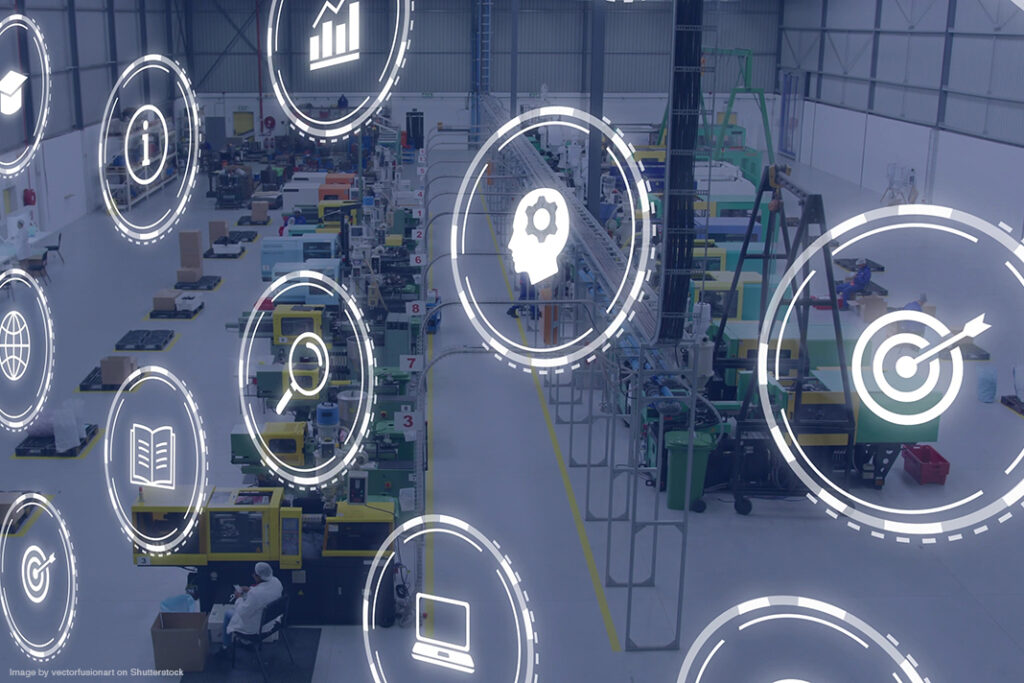
How manufacturers can harness agentic AI to unlock value across their organizations.
By Patricia Henderson, AI & Data principal, Deloitte Consulting LLP, Ajay Chavali, managing director, Deloitte Consulting LLP and Lindsey Berckman, US Aerospace & Defense Leader, principal, Deloitte Consulting LLP.
Agentic artificial intelligence has the potential to transform how companies operate in the next few years, and manufacturers seem to have taken notice. According to a survey conducted by the Manufacturing Leadership Council in early 2025, while only 6% of surveyed manufacturers are currently using agentic AI, 24% expect to be using it in just two years—a fourfold increase. In a recent report, Deloitte explored the future of the manufacturing firm with agentic AI and the steps companies might consider now to prepare for this future. In this article, we highlight some of the key findings.
Agentic AI refers to autonomous generative AI agents and multiagent systems that possess “agency”—the ability to both act and choose actions to take—which enables them to independently complete complex tasks and achieve human-defined objectives with minimal or no supervision. Gen AI chatbots and gen AI agents are both powered by large language models (LLM) at their core. However, gen AI agents add additional capabilities, including short- and long-term memory; access to a wide variety of tools; and the ability to reason, plan, and act autonomously. Due to its ability to act autonomously, agentic AI can be an important new tool to help manage the complexity that manufacturers may face throughout the organization.
The power of agentic AI is due in part to its ability to work independently alongside people, as a teammate, to automate certain tasks. This can augment human capabilities, help workers achieve objectives more efficiently, and free up their time to focus on higher-value and potentially more rewarding activities. Agentic AI use cases have the potential to add substantial value across a manufacturing company, from the back office and production floor to the front office.
However, agentic AI’s automation of certain tasks not only lends itself to augmenting human capabilities; it could also enable new—and potentially transformative—outcomes. For instance, the ability of agentic AI to take autonomous action across multiple internal and external information technology (IT) and operational technology (OT) systems could enable companies to capture the value that can often be lost in the handoff between these systems. This is likely to help generate significant value at the heart of the business, as agentic AI could be used to:
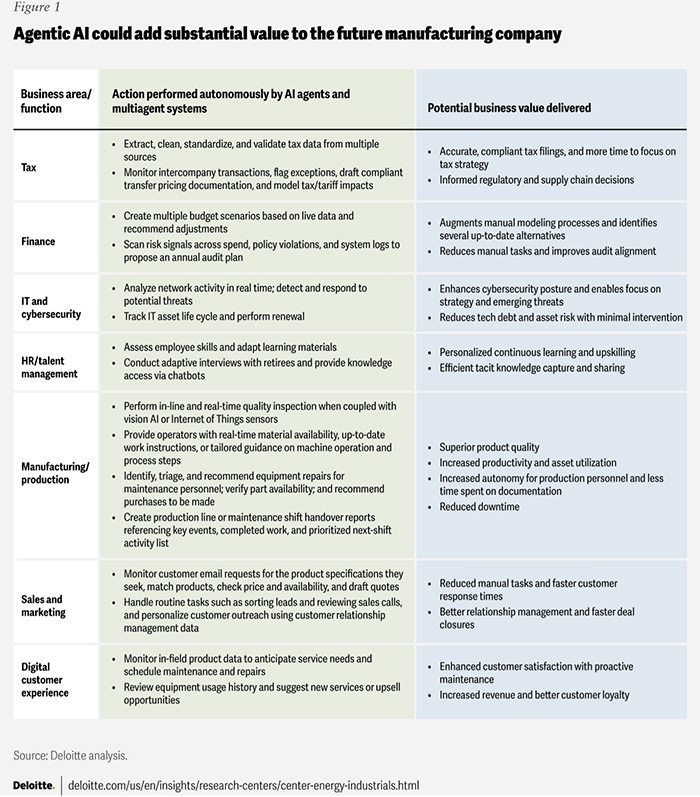
Given the potential value agentic AI can generate, an AI-first enterprise could become table stakes for how manufacturing companies compete in the future. Regardless of a company’s current position on the AI or tech-adoption curve, several steps in the approach we outline below can help them prepare for AI and gen AI adoption today while also laying the foundation for scaling into fully agentic decision-making in the future.
1. Develop a prioritized agentic AI road map focused on maximizing value
Manufacturers can begin their journey by creating a prioritized road map for how they plan to implement agentic AI solutions that will deliver maximum value by considering the following steps:
a. Create an enterprise-wide inventory of current business processes
An enterprise-wide inventory of business processes can serve as the foundational map for identifying where agentic AI may deliver the most value.
b. Identify where AI agents could be embedded to generate the greatest value
Close collaboration among leadership, technology teams, process owners, and stakeholders will be a key component of identifying where AI agents can generate the greatest value.
c. Prioritize agentic AI opportunities that offer maximum return on investment at scale
An “understand scale first” approach that considers key factors such as the cost, talent, data, technology, architecture, governance, and workflow transformation that will be necessary at scale, could be essential to move from pilots to value.
2. Implement the agentic AI road map, beginning with the highest-priority solutions
Implementing the road map requires a structured approach that stands up the foundational technical requirements, implements the governance and change management needed for adoption, and brings the process owners and the agents’ future co-workers along on the journey from pilots to at-scale value realization.
a. Build the technical platform and enablers
Agentic AI success generally begins with designing a robust platform framework and architecture tailored to the unique requirements of AI agents. Manufacturers should identify and select the appropriate AI and data platforms, vendors, and hardware infrastructure—often leveraging existing or new hybrid cloud solutions—to help ensure the required performance, scalability, and cost-effectiveness. Designing for interoperability across current and future systems will be essential to aligning with broader digital transformation efforts, such as ongoing ERP upgrades. Developing a comprehensive data architecture built around three core elements can provide the data backbone required for advanced agentic AI applications across the enterprise, including:

b. Establish governance and workforce change management mechanisms that can support larger-scale transformation
Implementing operational guardrails for security and privacy will be important to protect sensitive data and help ensure regulatory compliance. Effective governance can help to ensure that AI initiatives also align with business goals and ethical standards.
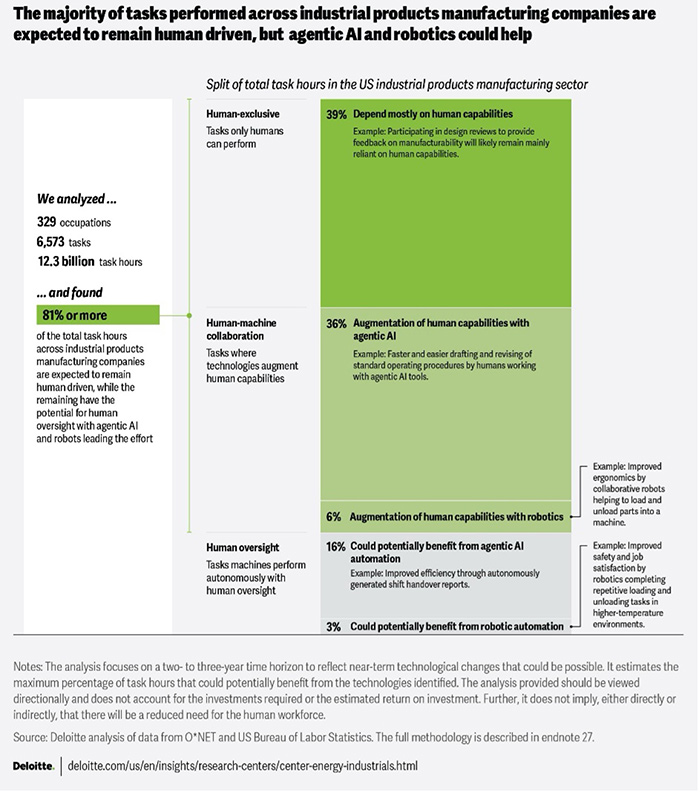
Implementation of agentic AI solutions can alter workflows, decision-making processes, worker roles and skill requirements.. Yet according to Deloitte’s analysis, 81% or more of task hours across the industrial manufacturing sector (which Deloitte defines as a combination of industrial products manufacturing and aerospace and defense) are likely to remain human-driven (figure 1, the full methodology is described in the report), emphasizing the need for a continued strategic focus on both technical and human capabilities. Additionally, as AI automates routine tasks, roles are likely to increasingly emphasize the need for creativity, collaboration, emotional intelligence, and problem-solving—skills that are uniquely human—and new roles could be created.
c. Implement pilots with prioritized opportunities and stakeholders
Unlike traditional technology rollouts—where multiple pilots are often conducted across a wide variety of business functions to identify the most promising use cases—the agentic AI approach is typically more targeted. The road map has already pinpointed the solutions with the greatest potential to deliver value at scale within specific business domains. Multiple pilots can be conducted within these domains to demonstrate proof of concept, refine the solution, build confidence among stakeholders, and continue advancing toward enterprise-wide transformation.
Agentic AI solutions are poised to deliver transformational value across the manufacturing industry by fundamentally changing how companies run their businesses. Manufacturers that can capture the potential value of agentic AI likely stand to gain a significant competitive advantage. A structured and disciplined approach—and one that is different from what is traditionally used for technology adoption—may be what is necessary to get there.
This article contains general information only and Deloitte is not, by means of this article, rendering accounting, business, financial, investment, legal, tax, or other professional advice or services. This article is not a substitute for such professional advice or services, nor should it be used as a basis for any decision or action that may affect your business. Before making any decision or taking any action that may affect your business, you should consult a qualified professional advisor.
Deloitte shall not be responsible for any loss sustained by any person who relies on this article.
About Deloitte
Deloitte refers to one or more of Deloitte Touche Tohmatsu Limited, a UK private company limited by guarantee (“DTTL”), its network of member firms, and their related entities. DTTL and each of its member firms are legally separate and independent entities. DTTL (also referred to as “Deloitte Global”) does not provide services to clients. In the United States, Deloitte refers to one or more of the US member firms of DTTL, their related entities that operate using the “Deloitte” name in the United States and their respective affiliates. Certain services may not be available to attest clients under the rules and regulations of public accounting. Please see www.deloitte.com/about to learn more about our global network of member firms.
Copyright © 2025 Deloitte Development LLC. All rights reserved.

Industry in Transition: The Forces Reshaping Manufacturing
As manufacturers offer more customization than ever before, managing product complexity has become a critical challenge. Tune in with Dan Joe Barry, Vice President of Product Marketing at Configit, who explores how companies are tackling the growing number of product configurations across engineering, sales, manufacturing, and service. He explains how Configuration Lifecycle Management (CLM) helps organizations maintain a single source of truth for configuration data. The result: fewer errors, faster quoting, and the ability to deliver customized products at scale.
Get In Touch
Google news and SEO compliant, Industry Today’s state-of-the-art digital media platform offers bespoke media campaigns that target key decision makers and buyers to achieve your marketing and promotional goals.

Contribute
Showcase your brand and promote your business to our highly targeted audience. We offer detailed Google Analytics with measurable ROI to assure success. Submit your content for review by our Editorial team who will contact you to discuss the project further.
About Us
Reach Your Targeted Audience and Grow Your Business. Learn more About Industry Today.
Contact Us

© 2026 Industry today. All Rights reserved.