Excellence can’t be demanded. It must be designed. And it starts with something most operations leaders walk right past every single day.
By: Kathy Miller, MAPP, MBA, ACC
Walk through any factory and ask the people on the line why their work matters. Some will tell you immediately with conviction. Others will stare back blankly. That gap between those who feel connected to their work and those who don’t, is not just a human resources concern. It is one of the most significant levers available to an operations leader.
Meaningful work, the sense that one’s daily tasks contribute to something larger, has been extensively studied in organizational psychology. The findings are consistent and compelling: employees who find meaning in their work are more engaged, more resilient, more productive, and less likely to leave. In manufacturing, where turnover is costly and tribal knowledge is depended upon perhaps a little too much, these outcomes matter enormously.
For generations, the dominant assumption in industrial management was that workers were motivated primarily by wages. Frederick Taylor’s scientific management approach, which still echoes in many factories today, treated the worker as a unit of output to be optimized. Pay them fairly and give them clear instructions, and they will perform.
That model has always had cracks in it. Today those cracks are chasms. A workforce that is increasingly educated, increasingly diverse, and increasingly aware of its options is seeking something more. It seeks the knowledge that what they do during their eight or twelve-hour shift actually makes a difference in the world.
In one facility I led, we produced elastomeric rubber parts. Unglamorous by any measure. But when our sales team helped us build a communication campaign showing team members exactly where those parts ended up: in food processing equipment, in the sealing systems aboard NASA’s Orion spacecraft (designed to carry astronauts to the moon and eventually to Mars), in military hydration units; the transformation was palpable. People who had been compliant became invested. Productivity and quality improved. They weren’t just making rubber parts anymore. They were helping to feed people, moving them to the stars, and protecting soldiers around the world.

Meaningful work doesn’t automatically happen when someone punches a time clock. It is cultivated, or neglected, by leaders. As an operations executive, the most impactful thing you can do is connect your team’s daily work to the larger purpose it serves.
As roles evolve and machines take on more of the physical work, what remains distinctly human is the capacity to find meaning in what we do. That capacity doesn’t diminish with automation; but it does require leaders who actively tend to it.
This means more than posting a mission statement in the break room. It means telling stories. Bringing customers in to share what your product means to their operations. Recognizing workers not just for hitting numbers but for the quality and care they bring to their craft. It means answering the unasked question that lives in every production worker’s mind: does anyone even notice what I do?
Research consistently shows a strong link between perceived job significance and organizational commitment. When employees understand the impact of their work, they are more likely to stay and engage in continuous improvement. Our team members will more likely expend discretionary effort, which is the difference between doing the job and doing the job well.
Leaders don’t need elaborate programs to begin building meaning. Small, consistent actions compound over time. Start by asking your team members what part of their job they find most satisfying and then reinforce it. Host a quarterly “purpose meeting” where a customer, an end user, or an internal stakeholder tells the workforce how the team’s output affects them. Publish stories of individual contribution in shift briefings or on factory boards. (For a deeper look at how lean principles can be leveraged to build meaning into the structure of work itself, (see Lean Manufacturing and Meaningful Work.).
Mid-level managers can connect daily tasks to the company’s mission during regular team meetings. Senior leaders can amplify this by highlighting specific employees whose work contributed meaningfully to quality, safety, or a problem elegantly solved.
The factory floor has always been a place where hands and heads come together to build something greater than the sum of its parts. But it is the heart that determines whether that work carries meaning. As automation reshapes the landscape of industrial work, the need to preserve that human experience becomes even more critical. The leaders who understand and act on this will build organizations that outperform not just in productivity metrics, but in the measure that ultimately sustains them: people who want to come to work.

About the Author:
Kathy Miller, MAPP, MBA, ACC, is a keynote speaker, board director, and leadership development coach. With over three decades of executive leadership at General Motors/Delphi, Parker Hannifin, Rolls-Royce, and Vertiv, her experience includes executive leadership of $3B+ operations, P&L responsibility, and corporate ownership of key business functions including lean enterprise, quality, strategy deployment, and industrial design. A Shingo Prize recipient (2004) and inductee into the Women in Manufacturing Hall of Fame (2021), Kathy is co-author of Steel Toes and Stilettos (Taylor & Francis, 2022) and author of MORE Is Better: Leading Operations with Meaning, Optimism, and Relationships for Excellence (Taylor & Francis, 2025). Learn more at www.linkedin.com/in/kathy-miller-mapp-mba-acc or at www.more4leaders.com.
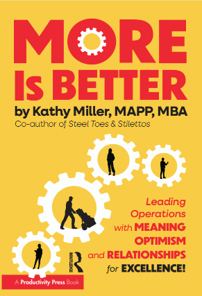
About the book, MORE Is Better: Award-winning manufacturing executive Kathy Miller draws from decades of leading complex operations and the science of human flourishing to reveal what truly drives sustainable success in today’s demanding business environments. Through compelling stories and research-backed strategies, Millers shows how leaders at every level can build high-performance cultures where: meaningful work connects people to purpose, optimism fuels adaptability and innovation, and relationships foster trust, safety, and collaboration. Excellence follows, in both operations and outcomes. Designed for leaders across industries, from plant floors to executive suites, this is both a business book and a field guide. With dozens of actionable tools and ready-to-use interventions, it’s a resource you’ll turn to again and again.

Forging the Next 250 Years: Powering the Next Era of American Manufacturing
As manufacturers offer more customization than ever before, managing product complexity has become a critical challenge. Tune in with Dan Joe Barry, Vice President of Product Marketing at Configit, who explores how companies are tackling the growing number of product configurations across engineering, sales, manufacturing, and service. He explains how Configuration Lifecycle Management (CLM) helps organizations maintain a single source of truth for configuration data. The result: fewer errors, faster quoting, and the ability to deliver customized products at scale.
Get In Touch
Google news and SEO compliant, Industry Today’s state-of-the-art digital media platform offers bespoke media campaigns that target key decision makers and buyers to achieve your marketing and promotional goals.

Contribute
Showcase your brand and promote your business to our highly targeted audience. We offer detailed Google Analytics with measurable ROI to assure success. Submit your content for review by our Editorial team who will contact you to discuss the project further.
About Us
Reach Your Targeted Audience and Grow Your Business. Learn more About Industry Today.
Contact Us

© 2026 Industry today. All Rights reserved.