Manufacturers utility lean principled to drive efficiency. But lean has a blind spot: data inefficiency. It’s time to change that.
By Chelsea Morgan, Director of Customer Success at iBase-t
For more than 30 years, lean practices have reshaped manufacturing. Companies have eliminated waste, streamlined operations, and built cultures centered on continuous improvement. What began in Japanese factories now defines how manufacturers worldwide design, produce, and sustain products.
But even the most disciplined organizations still overlook a critical source of waste: their data.
Manufacturers no longer just build physical goods; they produce data alongside them. In aerospace and defense (A&D) manufacturing, that reality is explicit. Government contracts require manufacturers to produce the physical product as well as digital models in the contracted requirements. Manufacturing outcomes now require the substantiation of genealogy records, and full audit trails that trace every step from design to sustainment. But this isn’t just an A&D issue. Across industries, customers, regulators, and internal systems demand high-quality data. AI models rely on it. Supply chains depend on it. Compliance requires it.
Data now sits at the center of manufacturing performance. Yet most organizations still manage it like an afterthought.
Manufacturers expect data to be accurate, accessible, timely, and auditable. In practice, it rarely meets those standards. Too often, data is hard to find, share, and access because it is trapped in disconnected systems. It is out of date or in an unhelpful format. It lacks traceability, verifiability, and auditability, which undermines its value.
These issues don’t just frustrate employees; they slow the business down. Engineers spend precious time hunting for the right version of a file, or trying to figure out what model definition version a product was produced from. Operators wait for instructions. Analysts spend hours cling data instead of using it. Teams build workarounds just to keep production moving. The result? Slower processes, lower quality, and higher costs.
Data inefficiency creates risk on par with breakdowns in sourcing, production, or delivery. And yet, most companies haven’t applied the same lean discipline they successfully use on the shop floor to address their design and production processes to fix it.

Lean transformed the shop floor by identifying and eliminating waste. The same approach works for data. The DOWNTIME framework, originally developed to identify waste on the shop floor provides an approachable set of categories for waste that anyone focused on continuous improvement can use.
When you apply these principles to data, inefficiencies become visible and therefore, fixable.
For each data inefficiency source, DOWNTIME provides an actionable framework to reduce the source of waste and drive better outcomes.
When manufacturers apply DOWNTIME to identify and eliminate waste in their data ecosystem, they don’t just reduce inefficiency; they unlock something bigger. A true digital thread. A strong digital thread connects:
It creates a continuous flow of accurate, accessible, and trustworthy data across the enterprise. These practices will help your organization systematically eliminate data inefficiencies, lowering costs, speeding processes, reducing complexity, simplifying compliance, and readying your organization for the next set of digital evolutions.
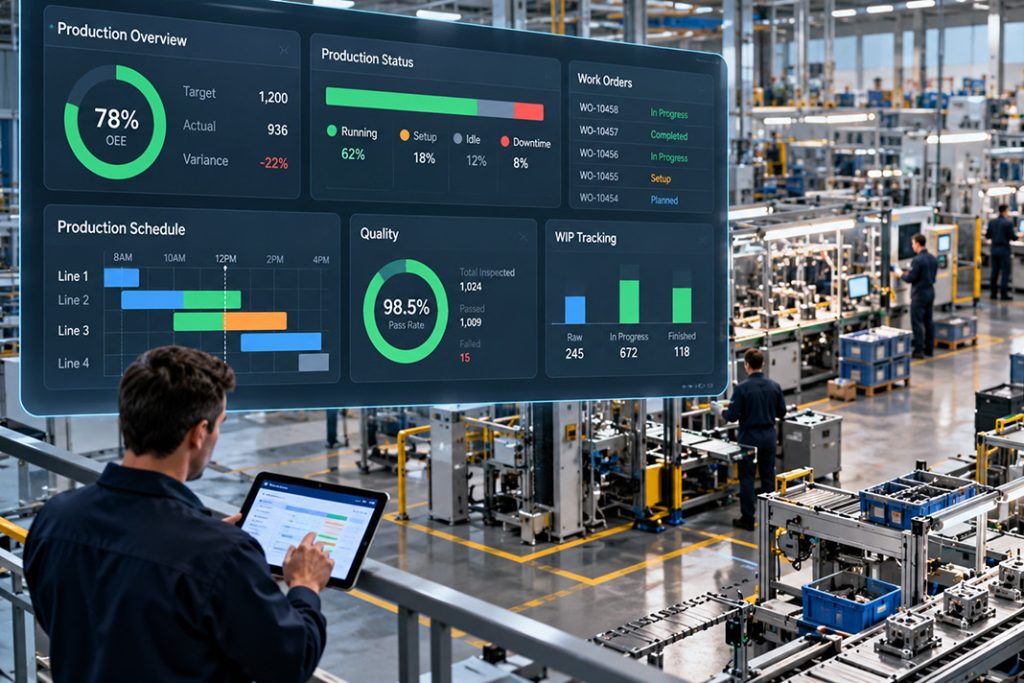
By implementing best practices in the DOWNTIME framework via the Manufacturing Execution System (MES) software, your organization can create a continuous stream of accessible, accurate, rich, reliable, and trustworthy data. That Digital Thread can then create much stronger connections and value chains across your supply chain, design and engineering, production, quality assurance, and sustainment.
Most manufacturers have already embraced lean on the shop floor. Now it is time to apply that same discipline to data. When MES integrates with enterprise systems that leverage lean best practices, manufacturers can achieve a real-time system of record that eliminates waste, reduces complexity, speeds product development, strengthens decision-making, and streamlines compliance.

About the Author:
Chelsea Morgan brings over 20 years of experience in software engineering and management, delivering impactful technology solutions through architecture, implementation, and product leadership. Morgan is the Director of Customer Success at iBase-t, the global leader in cloud software for the Aerospace and Defense industry. In this role, she strengthens client partnerships through strategic consulting as companies transition from sales to implementation and support, helping them solve complex challenges with Solumina. At GE Aerospace, Morgan led the development of transformative supply chain analytics, improving supplier commitment accuracy by 28% across a $7 billion sourcing desk. She later spearheaded ERP and manufacturing system deployments in GE Edison Works’ classified programs. Morgan also led digital sustainment efforts aligned with DoD Condition-Based Maintenance+ requirements for the 6th generation fighter ecosystem. She holds a BS in Technological Entrepreneurship and Management (Computer Systems Engineering) from Arizona State University, an MBA in Supply Chain from Xavier University, a Professional Certificate in Systems Engineering from MIT, and Six Sigma Black Belt and Lean Kaizen credentials from GE Aerospace.

Forging the Next 250 Years: Powering the Next Era of American Manufacturing
As manufacturers offer more customization than ever before, managing product complexity has become a critical challenge. Tune in with Dan Joe Barry, Vice President of Product Marketing at Configit, who explores how companies are tackling the growing number of product configurations across engineering, sales, manufacturing, and service. He explains how Configuration Lifecycle Management (CLM) helps organizations maintain a single source of truth for configuration data. The result: fewer errors, faster quoting, and the ability to deliver customized products at scale.
Get In Touch
Google news and SEO compliant, Industry Today’s state-of-the-art digital media platform offers bespoke media campaigns that target key decision makers and buyers to achieve your marketing and promotional goals.

Contribute
Showcase your brand and promote your business to our highly targeted audience. We offer detailed Google Analytics with measurable ROI to assure success. Submit your content for review by our Editorial team who will contact you to discuss the project further.
About Us
Reach Your Targeted Audience and Grow Your Business. Learn more About Industry Today.
Contact Us

© 2026 Industry today. All Rights reserved.