How can manufacturers succeed?
By Paul Swaney, Founder and Managing Partner, Swaney Group Capital
As supply chains fracture and geopolitical tensions reshape global trade, manufacturers are being pushed to reconsider a decades-old assumption: that the lowest-cost production belongs overseas.
That premise is starting to fail.
Rising labor costs abroad (for example, Chinese manufacturing wages increased dramatically since the early 2010s, more than doubling and approaching tripling by the mid-2020s, while U.S. manufacturing wages rose by about 50% over the same period), persistent supply chain disruptions, and increasing customer demand for speed and reliability are exposing the hidden costs of offshoring. At the same time, inefficiencies in many U.S. factories make domestic production appear more expensive than it truly needs to be.
There’s a more effective path forward. High-margin, high-precision products can and often should be manufactured in the U.S., but only if factories operate at peak efficiency. When operations are optimized, the perceived labor cost disadvantage narrows significantly, making domestic manufacturing far more competitive than commonly believed.
Let’s explore this further.
Contrary to popular belief in manufacturing, focusing solely on labor rates rarely leads to the lowest total cost.
In lower-cost countries, a cheaper hourly wage is often offset by larger workforces assigned to the same task. The relationship is not one-to-one. Differences in business models, overhead structures, and fixed costs can further dilute any apparent labor savings.
In addition, facilities with lower capital investment, common in low-cost regions, tend to rely more heavily on manual processes rather than automation. These further increase labor expenses.
The more relevant metric today is not labor cost alone but end-to-end supply chain performance. Manufacturers must prioritize reliability, speed, and certainty of supply, especially for critical goods. The disruptions seen during COVID-19 made this clear: availability often matters more than nominal cost.
Leading manufacturers such as Toyota, Danaher, and Procter & Gamble demonstrate what’s possible when operations are done with precision. In top-performing factories, uptime can exceed 85%.
However, many mid-sized manufacturers fall well short of this benchmark, often due to limited focus on equipment effectiveness and operational discipline. The right manufacturing system needs to be in place for factories to function most optimally and cost-effectively. When machines sit idle for a significant portion of the time, both labor and capital costs are effectively squandered. Conversely, when assets run efficiently, the cost per unit drops and labor becomes more productive.
Waste is another factor. A plant with a 15% scrap rate when it should be 7% is losing significant value in raw materials. Similarly, failing to recapture and reuse byproducts such as industrial gases leads to avoidable energy and input costs.
Opportunities to improve efficiency are often hiding in plain sight. Capturing them can materially shift the economics of domestic production.
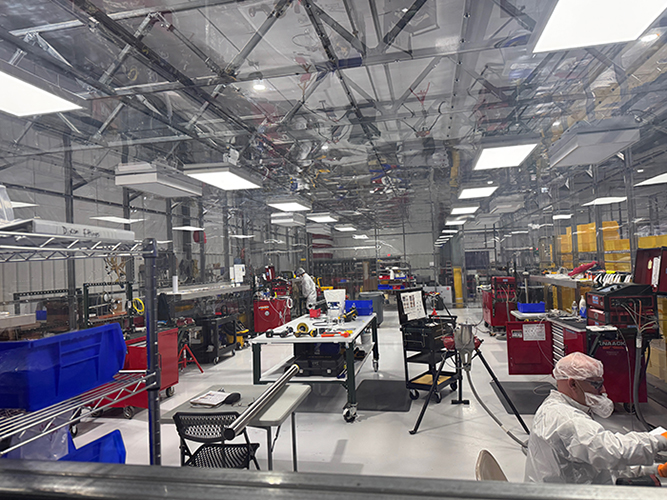
Top-tier manufacturers treat cost reduction as a continuous process, not a one-time initiative. They consistently improve their cost structures, push for higher quality and yield from suppliers, and invest in systems that enhance operational performance.
Artificial Intelligence is poised to accelerate these gains.
While operators and technicians will remain essential, AI will reduce administrative overhead and enable more decision-making and tasks at the plant level. Functions such as production scheduling, inventory management, and maintenance planning can increasingly be handled in real time, closer to the point of execution.
In less mature operations, frequent machine breakdowns or inefficiencies require constant oversight, often adding layers of corporate coordination. But in high-performing environments, where machines run reliably, teams of the floor can manage workflows more autonomously, with AI tools improving accuracy and responsiveness.
The result is not just lower cost but greater agility.
The tools to achieve this are not new.
Not all manufacturing should return to the U.S., but some categories clearly benefit from it.
Critical goods, including active pharmaceutical ingredients and finished generics; power grid transformers, especially large power transformers; precision medical devices and surgical instruments; legacy and mature-node semiconductors; and defense and aerospace components, are increasingly viewed as strategic priorities for domestic production. These products require high reliability, tight quality control, and secure supply chains.
On the other hand, low-margin, high-volume goods may still be better suited to offshore production, where scale and labor economics remain advantageous. These could include consumer textiles and apparel; holiday decor, costumes, and novelty goods; small consumer electronics accessories; basic toys and plastic injection-molded consumer goods; and mass-market, flat-pack furniture.
The key is not to reshore everything, but to make deliberate, strategic decisions based on total cost, supply chain disruption risk, and performance.
Manufacturing resilience today is about building systems that are efficient, adaptable, and aligned with modern realities. Companies that embrace this, focusing on operational excellence and smarter supply chain design, will be best positioned to compete in an increasingly uncertain world.

About the Author:
Paul W. Swaney III is founder and managing partner at Swaney Group Capital. He founded Swaney Group Capital to bring institutional-quality operational transformation to the industrial and healthcare manufacturing sectors through the independent sponsor model. Swaney sources deals, leads diligence, and deploys the Swaney Group Operating System (SGOS), a proven methodology designed to improve throughput, productivity, working capital efficiency, and organizational capability in complex manufacturing environments, inside portfolio companies alongside his team.

Industry in Transition: The Forces Reshaping Manufacturing
As manufacturers offer more customization than ever before, managing product complexity has become a critical challenge. Tune in with Dan Joe Barry, Vice President of Product Marketing at Configit, who explores how companies are tackling the growing number of product configurations across engineering, sales, manufacturing, and service. He explains how Configuration Lifecycle Management (CLM) helps organizations maintain a single source of truth for configuration data. The result: fewer errors, faster quoting, and the ability to deliver customized products at scale.
Get In Touch
Google news and SEO compliant, Industry Today’s state-of-the-art digital media platform offers bespoke media campaigns that target key decision makers and buyers to achieve your marketing and promotional goals.

Contribute
Showcase your brand and promote your business to our highly targeted audience. We offer detailed Google Analytics with measurable ROI to assure success. Submit your content for review by our Editorial team who will contact you to discuss the project further.
About Us
Reach Your Targeted Audience and Grow Your Business. Learn more About Industry Today.
Contact Us

© 2026 Industry today. All Rights reserved.