What if your shop floor ran like an Agile team? Sprint-based thinking can boost productivity, quality, and responsiveness.
By Devashish Kedar • Production Scheduler, Mopec Group • CSPO • CSM
In software engineering, a system that depends on one person’s memory isn’t a system at all. It’s a liability. There’s a term for that: tribal knowledge. And when that person moves on, the system doesn’t gracefully degrade. It collapses. Manufacturing has long depended on tribal knowledge. It made sense because lead times and product lines were stable, and that one experienced employee who could accurately estimate the time each job would take had been there for 30 years. But times have changed.
Modern manufacturers encounter increasingly sophisticated clients, shorter lead times, reduced margins, and employees who no longer stay for a lifetime. The firms that are surviving, and often thriving, are those that have borrowed a page from software and are constructing living systems in real-time that furnish workers with the information they need and foster a culture of continuous enhancement.
I am a Production Scheduler at Mopec Group, a medical equipment manufacturer out of Madison Heights, Michigan. In the past I mostly worked in software development – connected vehicle platforms at Ford Motor Company, enterprise API integrations at Cognizant, and analytics in EdTech. When I hopped over to manufacturing, I realized that far too many of some of the most talented people had been forced to “drive blind” (ht. Alex Rogo) into some of the most important decisions of their lives, with one hand tied behind their back.
At the core of Agile is to shorten the time difference between performing a task and understanding its impact. In software this gap was once measured in months. Agile methods slashed it to two weeks. For manufacturing, a scheduling decision might not come back to bite for one – four weeks — you plan the job, make it run and then ship the product but only in your next planning cycle did anyone check if that estimate was right. The team commits the same mistakes three more times by then.
A small manufacturer pushing orders biweekly is already running on a sprint cadence — they just haven’t named it that yet. Naming it matters. When an order wave is treated as a sprint, it forces the same discipline software teams use: capacity is fixed before the cycle begins, work is ranked by priority rather than squeezed in by request, and anything that does not fit is moved to the next wave rather than crammed in and shipped late. The production floor stops being a reactive environment and starts behaving like a system.
Implementing structured review cadences for production scheduling alongside real-time dashboarding produced a shared, current view of shop floor reality that operations, engineering, and leadership could all examine simultaneously. Capacity disagreements were transformed into data discussions. Guess-timates were swapped for tracked actuals. Forecast accuracy rose to approximately 90%.
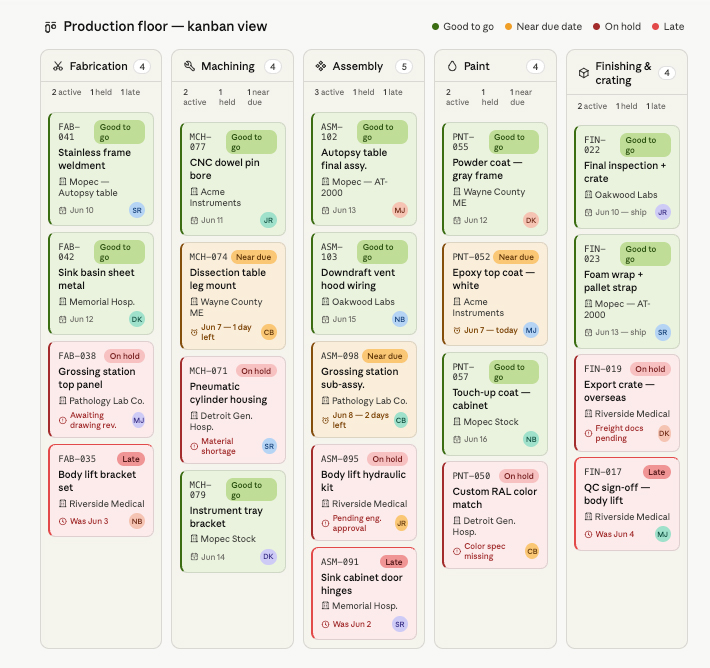
In software development, a backlog is where you keep all the things you might be working on. A sprint is a short, time-boxed period (usually a couple of weeks) in which a team commits to complete a set amount of work. Nothing gets added to the sprint that isn’t in the backlog. We take our ranked order queue and review it at the front of every cycle. We know what customers have said they need, what won’t ship without this material, how much our bottleneck machine can produce, and how many labor hours we have available.
Backlog grooming in SDLC means regularly reviewing and re-ranking that list as conditions change. On the shop floor, that translates to a short weekly review — no more than thirty minutes — where the production lead, operations manager, and scheduling team align on what is moving, what is blocked, and what is at risk of missing the next order wave. This is not a status meeting. It is a decision meeting. The output is a cleared, prioritized queue that the floor can execute against without interruption.
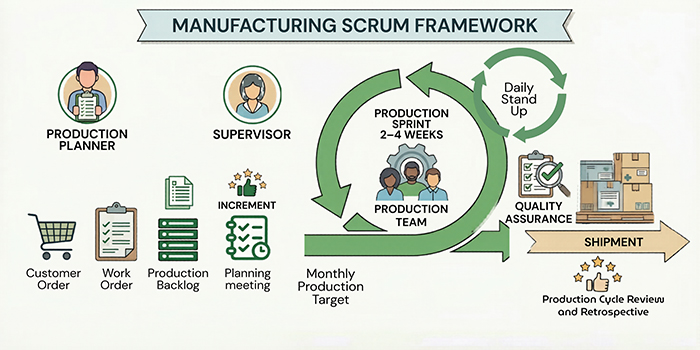
The Scrum idea of a ‘definition of done’ is one of the most easily adaptable SDLC best practices to the factory floor. In software, a feature isn’t done until it’s tested, documented, and deployable. The definition is hashed out before the work starts, not argued over when the deadline hits. On the shop floor, a job isn’t done until it’s inspected, logged, and the data is in the system — not sitting on a clipboard waiting to be entered at the end of the week.
This matters because data lag is where manufacturing planning breaks down. If a job closes on Tuesday but is not logged until Friday, Thursday’s scheduling decisions are made on stale information. Over a quarter, that difference is the gap between reliable reporting and noise. A clear, agreed-upon definition of done — posted at each workstation, reviewed in onboarding, and enforced at the close of every sprint — closes that lag and makes the real-time dashboard actually real-time.
An Agile retrospective is a 1 to 2-hour meeting in which the team looks back on the past iteration and discusses what went well, what went wrong, and what could be improved. It is a cornerstone of Agile development, empowering teams to improve their development process in a disciplined fashion. The point of the meeting is not to to complain about what went wrong—rather, it is to identify opportunities for improvement and to develop an action plan to address them.
For a manufacturer who runs monthly order cycles, a thirty-minute retrospective at the end of each cycle is the highest-leverage meeting on the calendar. Did the cycle close on time? Which jobs ran over their estimated hours and why? Were any materials not staged in time? Which customers received late notifications? Each answer feeds directly into the next sprint’s planning. Without this cadence, the same bottlenecks repeat indefinitely because no one has formally named them as problems to solve.
“The shop floor’s order cycle and the software sprint are the same idea. The difference is that one team measures what happened and improves. The other writes it off as a bad week and moves on.”
— Devashish Kedar, Production Scheduler, Mopec Group
At Mopec Group, we implemented Agile-inspired review cycles for continuous production and a Power BI executive dashboard that raised forecast accuracy to ~90%, resulting in capacity discussions no longer centered on opinions and spreadsheets but based on concrete data. As a result of these changes, we were able to decrease the amount of items overscheduled in the plant and reduce the missed parts from production by approximately two-thirds.
No — in fact, small manufacturers benefit more. Unlike a Fortune 500 operation, an SME director has no organizational cushion. A bad month hits cash flow, customer relations, and team morale directly. Agile cadences require no expensive software and no large team. A biweekly sprint review, a ranked order queue, and a thirty-minute retrospective can be run with a whiteboard and three people.
The retrospective. It takes thirty minutes and right away brings up the bottlenecks we all keep seeing but have never made explicit before. The second-quickest solution is the definition of done, which eliminates the data-entry delay that renders dashboards and scheduled reports unusable.
The sprint length should be the same as the natural cadence of the business – this could be biweekly or monthly. The most important thing is to keep a fixed cadence. The quality of outcomes from a fixed cadence, even if it’s not optimal, is much higher than a varying cadence, which depends on who screams the loudest. If monthly is what you’re more comfortable with, then go for that, and later on, you can always make the cadence shorter.
Just like a software team deals with a critical bug mid-sprint: make the trade-off visible. If a rush order goes in, something of similar size goes out. This is not a hard and fast rule — it’s a conversation that makes the business decide what it really prioritizes, rather than having the shop floor absorb the cost invisibly through overtime, defects, and missed commitments on something else.
For generations, manufacturing has placed implicit trust in tribal knowledge and a reactive approach to production scheduling. This was sufficient when customers were less demanding, products took weeks to produce, and the workforce spent two decades in a factory. Now it is a death sentence for a small manufacturer facing customers that want more without paying for it, products that cost the same next year but are worth more and that same workforce that will now leave if they are not certainly learning something new every year.

About the Author:
Devashish Kedar is a Production Scheduler at Mopec Group (Madison Heights, MI), a medical equipment manufacturer, where he leads production planning, scheduling, and data reporting operations. He has previously worked as a Business Analyst at Ford Motor Company on connected vehicle platforms, and as a Business Analyst at Cognizant on enterprise API integrations. He holds an M.S. in Information & Technology Management from the University of Texas at Dallas, and is a Certified Scrum Product Owner and Certified Scrum Master.

Forging the Next 250 Years: Powering the Next Era of American Manufacturing
As manufacturers offer more customization than ever before, managing product complexity has become a critical challenge. Tune in with Dan Joe Barry, Vice President of Product Marketing at Configit, who explores how companies are tackling the growing number of product configurations across engineering, sales, manufacturing, and service. He explains how Configuration Lifecycle Management (CLM) helps organizations maintain a single source of truth for configuration data. The result: fewer errors, faster quoting, and the ability to deliver customized products at scale.
Get In Touch
Google news and SEO compliant, Industry Today’s state-of-the-art digital media platform offers bespoke media campaigns that target key decision makers and buyers to achieve your marketing and promotional goals.

Contribute
Showcase your brand and promote your business to our highly targeted audience. We offer detailed Google Analytics with measurable ROI to assure success. Submit your content for review by our Editorial team who will contact you to discuss the project further.
About Us
Reach Your Targeted Audience and Grow Your Business. Learn more About Industry Today.
Contact Us

© 2026 Industry today. All Rights reserved.