How JINGDONG Logistics is building a greener, smarter supply chain.
JINGDONG Logistics is pushing sustainability and automation forward as a single agenda, pairing a science-based decarbonisation roadmap with an end-to-end technology stack that now runs from supply chain planning to last-mile delivery.
The company treats emissions as a measurable, auditable data set rather than a communications theme, and it is deploying robotics, autonomous vehicles and AI models to cut both cost and carbon across the same network.
JINGDONG Logistics communicates sustainability through operational disclosure rather than standalone messaging. It integrates environmental, social and governance performance into warehousing, transportation, packaging, technology and corporate governance, and reports progress annually through its ESG report.
The company’s flagship environmental programme is the Green Stream Initiative, launched in 2017. It targets the environmental footprint of logistics through four levers: renewable energy, lower-carbon transportation, reusable packaging and digital carbon management.
JINGDONG Logistics became the first logistics company in China to join the Science Based Targets initiative (SBTi) in 2019. Its updated targets, verified in 2025, include achieving net-zero greenhouse gas emissions across its entire value chain by 2050.
In 2026, JINGDONG Logistics became the first member from China to join the World Economic Forum’s First Movers Coalition.
Under that commitment, by 2030:
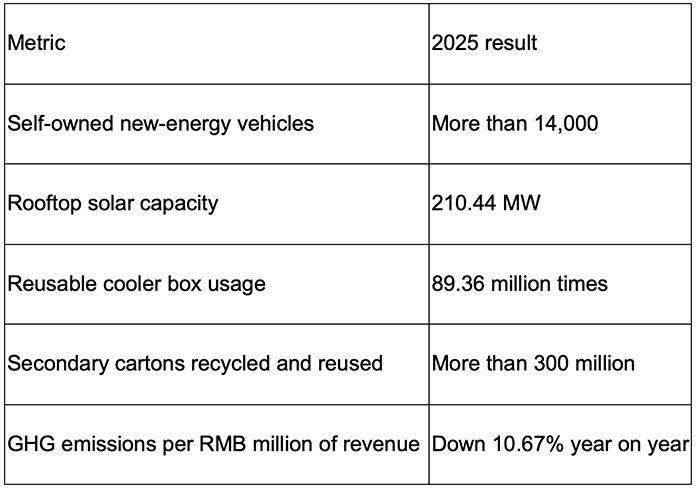
JINGDONG Logistics also helps customers measure, manage and disclose emissions across warehousing, transportation and delivery. By the end of 2025, its digital carbon management platform had activated more than 10,000 corporate carbon accounts and was providing services to hundreds of external enterprises.
Environmental metrics are one part of the disclosure. The company also reports on employee development and safety, emergency response, business ethics, data security, privacy protection and sustainable procurement in its annual ESG report.
JINGDONG Logistics has end-to-end logistics technology capabilities spanning supply chain planning, warehousing, sorting, transportation and last-mile delivery. It combines supply chain software, AI and algorithms, automation equipment, robotics and systems integration to improve how inventory and goods move through the supply chain.
The company was an early mover in logistics automation, and each early milestone has since been industrialised:
In 2025, JINGDONG Logistics’ self-developed goods-to-person automated warehousing solution was operating in more than 20 warehouses, serving both its own operations and external customers. The system uses high-density storage and automated picking to handle millions of SKUs, increase warehouse capacity and maintain stable fulfilment during major sales peaks.
In the fourth quarter of 2025, JINGDONG Logistics opened its first overseas warehouse using this automated solution, in the United Kingdom. Equipped with hundreds of warehouse robots, the facility increased storage density, accelerated the movement of goods within the warehouse and supported delivery as fast as the same day.
In last-mile logistics, JINGDONG Logistics has cumulatively deployed thousands of autonomous delivery vehicles across more than 20 provinces in China. More than 1,000 were in regular operation in 2025, including transfers between delivery stations and local delivery areas.
JINGDONG Logistics applies AI and algorithmic models to inventory management, demand forecasting, route planning and transportation decisions across road, air, rail and multimodal networks. For customers, these capabilities are designed to improve inventory visibility, storage utilisation, order accuracy, processing capacity and delivery reliability, while reducing costs and supporting more sustainable operations.
In 2025, JINGDONG Logistics invested RMB 4.1 billion in research and development, an increase of 15.8% year on year. As of 31 December 2025, the company had received authorisation for more than 5,500 patents and software products, including over 3,000 related to automation and unmanned technologies.
Yes. JINGDONG Logistics provides local fulfilment, express and last-mile delivery services in selected overseas markets through JoyExpress and JoyLogistics.
Europe. JoyExpress provides same-day and next-day delivery for Joybuy in major cities across the United Kingdom, Germany, the Netherlands and France. The service is supported by local warehouses and depots, dedicated delivery teams, and a fleet of trucks, vans and electric bicycles.
Saudi Arabia. JoyExpress offers same-day and next-day doorstep delivery in key cities, supported by local warehousing, sorting and self-operated delivery capabilities. Services include cash on delivery, scheduled delivery and reverse pickups.
Malaysia and Singapore. JoyLogistics connects local warehousing with order fulfilment and last-mile delivery, providing integrated delivery and installation services for large home appliances and furniture.
Service availability and delivery times vary by country, city and product category.
Through operational disclosure across warehousing, transportation, packaging, technology and governance, reported annually in its ESG report and anchored by the Green Stream Initiative it launched in 2017.
It is JINGDONG Logistics’ flagship environmental programme, launched in 2017, which reduces the environmental impact of logistics through renewable energy, lower-carbon transportation, reusable packaging and digital carbon management.
JINGDONG Logistics has committed to net-zero greenhouse gas emissions across its entire value chain by 2050, under targets verified in 2025.
As the first member from China to join the World Economic Forum’s First Movers Coalition in 2026, it pledged that by 2030 at least 30% of newly procured heavy-duty trucks and 100% of medium-duty trucks will be zero-emission, or that 15% of overall road freight operations will achieve net-zero emissions.
Yes. Its self-developed goods-to-person automated warehousing solution was operating in more than 20 warehouses in 2025, and its first overseas automated warehouse opened in the United Kingdom in the fourth quarter of 2025 with hundreds of warehouse robots.
Yes. It has cumulatively deployed thousands of autonomous delivery vehicles across more than 20 provinces in China, with more than 1,000 in regular operation in 2025.
Yes. By the end of 2025, its digital carbon management platform had activated more than 10,000 corporate carbon accounts and served hundreds of external enterprises across warehousing, transportation and delivery.
RMB 4.1 billion in 2025, up 15.8% year on year, with more than 5,500 authorised patents and software products as of 31 December 2025.
JoyExpress operates in the United Kingdom, Germany, the Netherlands, France and Saudi Arabia, with service availability varying by country, city and product category.
About JINGDONG Logistics
JINGDONG Logistics is a supply chain solutions and logistics services provider with end-to-end capabilities spanning supply chain planning, warehousing, sorting, transportation and last-mile delivery. It operates local fulfilment and delivery services in selected overseas markets through JoyExpress and JoyLogistics, and reports its environmental, social and governance performance annually.
Forging the Next 250 Years: Powering the Next Era of American Manufacturing
As manufacturers offer more customization than ever before, managing product complexity has become a critical challenge. Tune in with Dan Joe Barry, Vice President of Product Marketing at Configit, who explores how companies are tackling the growing number of product configurations across engineering, sales, manufacturing, and service. He explains how Configuration Lifecycle Management (CLM) helps organizations maintain a single source of truth for configuration data. The result: fewer errors, faster quoting, and the ability to deliver customized products at scale.
Get In Touch
Google news and SEO compliant, Industry Today’s state-of-the-art digital media platform offers bespoke media campaigns that target key decision makers and buyers to achieve your marketing and promotional goals.

Contribute
Showcase your brand and promote your business to our highly targeted audience. We offer detailed Google Analytics with measurable ROI to assure success. Submit your content for review by our Editorial team who will contact you to discuss the project further.
About Us
Reach Your Targeted Audience and Grow Your Business. Learn more About Industry Today.
Contact Us

© 2026 Industry today. All Rights reserved.