Volume 29 | Issue 2
Click here to read the complete illustrated article or continue below to read the text article.
By David Soyka, Senior Editor, Industry Today.
Schneider Electric, a global energy technology leader, recently released its Global Autonomous Maturity Report. Commissioned in partnership with Censuswide and Development Economics, with insights from Independent Energy Market Analyst Gaurav Sharma, the report surveys 400 senior energy and chemical industry senior executives and plant managers from 12 countries about their levels of adoption of autonomous operations.
Survey respondents identified five technologies most important for enabling autonomous operations over the five to ten years:
Digital autonomous industrial platforms are the next step up from automated systems, which provide users with alerts and preset actions for user selection. In contrast, autonomous systems monitor, measure, evaluate information and make decisions. While these decisions are checked by human users, they do not depend on human intervention to execute them.
Transitioning to autonomous is not a simple matter of “upgrading” from an automated system. It is a journey moving towards ever more fully realized autonomous operations.
“The energy demand from AI and datacenters is expected to double to almost 1,000 terawatt hours (TWh) by 2030, nearly equivalent to the power consumption of Japan, according to the International Energy Agency. The idea of producing ‘more (energy) with less (burn)’ — enabled by autonomous technology — has therefore gained substantial traction.
– Gaurav Sharma, Independent Energy Market Analyst
In this report, the framework for determining a company’s location on 5-level hierarchy ranging from no autonomous operations to full autonomy is based on the the Autonomous Operations Maturity Model (AOMM) developed by the ARC Advisory Group.
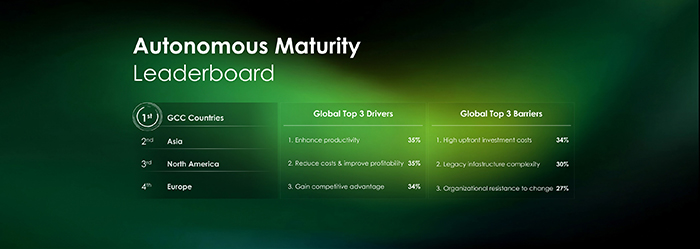
Surveyed organizations report operating at an average level of 3.52 out of 5, with ambitions to reach level 4.02 by 2030, a more positive trend of adoption than expected according to Devan Pillay, President, Heavy Industries, Schneider Electric, Industrial Automation. “The most notable insight here is not a gap in technology, but a gap in speed and momentum. The GCC (Gulf Cooperation Council) is currently leading in maturity, closely followed by Asia. However, Asia is the most ambitious and expects to lead within five years. While North America is behind in maturity, it is targeting the fastest acceleration, driven largely by AI demand and data center expansion. Europe’s slower overall pace of adoption was also surprising, though it is progressing steadily, with countries such as France leading within the region.
The risks of delaying adoption were cited as higher operating costs (59%), worsening talent shortages (52%), and declining competitiveness (48%). The report also notes:
“Despite regional variations, autonomy is broadly viewed as inseparable from decarbonization. Nearly six in ten energy executives say autonomous operations are critical to achieving net zero — with 23% believing it’s not possible without it and a further 35% believing it’s possible, but with major difficulty. These views are strongest in Europe, where 69% consider autonomy to be essential to net zero progress, or at the very least, an uphill struggle without it.”
Pillay notes that while the survey focuses on the energy and chemical sectors, the findings are also applicable to other heavy industries such as mining and minerals that also operate under hazardous conditions. “They, too, are under considerable pressure to reduce greenhouse emissions, provide safer workforce environments, improve productivity and profitability and operational resilience, and optimize decision making, all key benefits of autonomous technologies.”
He adds, “Globally, AI and machine learning is clearly seen as the single biggest enabler of autonomous acceleration. This is unsurprising given their ability to improve plant wide efficiency, reduce downtime and cut emissions, typically faster than hardware only investment cycles. For oil and gas in particular, autonomy is emerging as a critical pathway to meet both short and long term decarbonization goals while strengthening resilience and safety.”
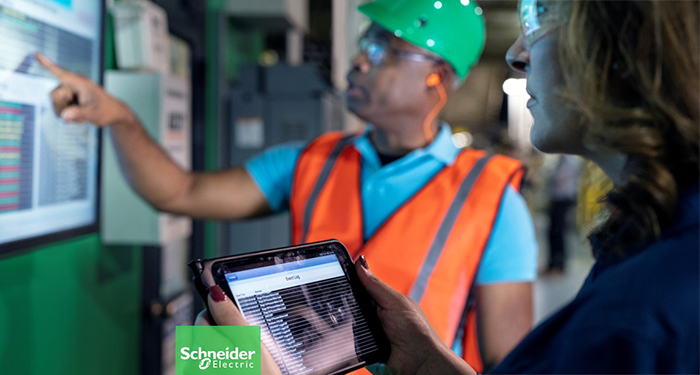
Still, Pillay points out there are still considerable obstacles to autonomous adoption. “The top barriers to progress cited by those surveyed across all regions include high upfront costs (34%), legacy systems (30%), resistance to AI (27%), cybersecurity concerns (26%), and regulatory uncertainties (25%). The barriers are consistent: cost, complexity, and legacy infrastructure.”
He emphasizes, however, that regardless of these obstacles, “There is growing awareness that delay carries real consequences, such as higher costs, lost productivity, and increased competitive pressure. Ultimately, every region recognizes the opportunities presented by autonomous technologies to improve processes and reduce energy consumption, as well as the risks of falling behind. The difference lies in how quickly they’re moving to build on these opportunities to modernize infrastructure and ensure interoperability.”
Here’s where Schneider Electric comes in to help with a “hardware-agnostic” approach to evaluate facility operations and develop a three-layered architecture solution. Schneider Electric’s Vivek Kapoor, Mining, Minerals & Metals Segment Leader explains, “First off is to identify the customer’s needs. Then we look at the existing equipment. To add a control layer of sensors to collect operational data and measure critical parameters. Proper analytics of the data provides the foundation to develop a solution that meets the customer requirements.
“The challenge is how to interpret the data as a baseline for a business use case for possible scenarios. To test that, a proof of concept evaluates not only how to maximize operational output, but also to eliminate human operator bias. For example, a human operator might tend to ignore certain alerts so as not to risk missing productivity goals. But the autonomous system might not see the alerts as optional, but still manage them in a way that still meets or exceeds those goals.”
Kapoor emphasizes that this is a continuous process. “Regardless of the maturity level, autonomous systems generate data that provide further insights into operational improvements, better control of supply chains, energy utilization, and elimination of silos.” AI, electrification, and automation come together to create self-optimizing systems that can predict, adapt, and continuously improve performance.
To implement an autonomous operation, Schneider Electric is “hardware-agnostic,” focusing on software-based solutions. To that end, in 2023, Schneider Electric acquired AVEVA, a global industrial software designer specializing in digital automation and energy management.
“Schneider Electric and AVEVA are at the forefront of supporting customers such as Shell, European Energy, ADNOC and Baosteel on their autonomous journeys,” Pillay says. “By integrating Schneider Electric’s process control and power management solutions with AVEVA’s digital technologies and industrial intelligence, we deliver integrated software-defined architectures that provide real-time visibility and enable AI-driven digital twins that can predict, adapt, and self-optimize with minimal intervention.”
Recent deployments showcase how energy and chemical companies are redefining how they operate their facilities. Pillay cites Shell’s Scotford Refinery in Canada, where Schneider Electric is helping modernize operations through open, software defined automation, supporting more flexible, autonomous operations.
At European Energy’s Kassø Power to X facility, the world’s first commercially viable e methanol plant, Schneider Electric and AVEVA are together enabling AI supported, self optimizing clean fuel operations with resilient remote monitoring, resulting in 2,079 GWh of renewable power in 2024, enough for over half a million homes.
Baosteel, one of China’s largest modern steel producers, launched a pilot to modernize its labor-intensive, safety-critical crane operations. Partnering with Schneider Electric, the company deployed an EcoStruxure™ Plant solution with unmanned crane control, optimized logistics algorithms, and real-time monitoring. The initiative delivered a 98% autonomous operation, a 15–30% output increase, stronger safety, and a more data-driven supply chain.
Schneider Electric and ADNOC (Abu Dhabi National Oil Company) Refining completed a proof-of-concept that showcased AI-driven autonomous operations at its Unit 14 Hydrotreater to optimize hydrogen use, energy efficiency, and condition monitoring. The project delivered reduced energy consumption, lower CO₂ emissions, and significant cost savings, validating a secure, semi-autonomous to fully autonomous operations model over seven months.
While autonomous technology is often feared as labor-replacement, Kapoor points to how such remote monitoring improves workforce conditions. “Chemical and energy production facilities typically produce hazardous environments. Taking people off platforms where these conditions need to occur and moving them to off-shore remote locations result in safer working environments.”
This is an example of how autonomous technologies benefit workers rather than threaten them. “There’s a clear gap between public perception and operational reality. Autonomy is not about replacing labor,” Pillay emphasizes. “It’s empowering workers to focus on higher value work in the position of pilots and co-pilots, shifting from manual execution to oversight.”
He adds, however, that “Successful adoption depends heavily on people and culture. Workforce readiness, change management, and trust in data-driven decision-making are all critical. Organizations need to invest early in reskilling and building AI-ready workforces. The risk of delay is clear: 52% of leaders say postponing adoption will worsen talent shortages, while resistance to AI already ranks among the top barriers to progress.”
Progress depends on the alignment of three critical factors: technology, people, and policy, according to Pillay. “Autonomy is no longer optional. It is essential for industrial decarbonization. Nearly six in ten executives say it is critical, or extremely difficult, to achieve net zero without it. In that sense, autonomy is becoming the backbone of industrial competitiveness, the mechanism through which companies simultaneously improve performance, resilience, and sustainability.”
The Global Autonomous Maturity Report cites an overall optimistic trajectory. Executives across regions recognize the strategic value of autonomy, and many markets are preparing for significant expansion. As companies translate ambition into action, industry is well positioned to accelerate performance, strengthen resilience, and make meaningful progress toward long-term sustainability goals.
Pillay adds that, “The stars are aligned for autonomous transformation. The technology exists today for companies to achieve full autonomy by 2030. The broader global trend is clear: convergence. AI, electrification, and automation are coming together to create self-optimizing systems that can predict, adapt, and continuously improve performance and reduce carbon footprint.”
Download the complete Global Autonomous Maturity Report here.

Devan Pillay is the Segment President of Heavy Industries within Schneider Electric’s Industrial Automation business, a sector he describes as “undergoing unprecedented transformation as the world accelerates toward a digital and decarbonized future.” He holds a Master of Business Administration from the Gordon Institute of Business Science (GIBS) and a Bachelor of Electrical Engineering from the Durban University of Technology, South Africa.

Vivek Kapoor is Mining, Minerals & Metals Segment Leader at Schneider Electric. Based in Canada, he has over 30 years of industry experience, including 21 years at Schneider Electric in leadership roles spanning Europe, Asia-Pacific, and the Americas. In his current role, Vivek leads business development and technology team, working with end users, EPCs, and OEMs to deliver solutions across electrification, automation, and digitalization. He has led multi-million-dollar projects and growth initiatives and has been central to Schneider Electric’s strategy on heavy industry decarbonization and autonomous operations. Vivek plays a key role in helping industry stakeholders navigate the energy transition, improve operational efficiency, and unlock long-term value through electrification, automation, and data-driven solutions. He is a passionate advocate for sustainable mining and digital innovation and widely recognized as a trusted voice on the future of industrial transformation across some of the world’s most energy-intensive sectors.
About Schneider Electric
Schneider Electric is a global energy technology leader, driving efficiency and sustainability by electrifying, automating, and digitalizing industries, businesses, and homes. Its technologies enable buildings, data centers, factories, infrastructure, and grids to operate as open, interconnected ecosystems, enhancing performance, resilience, and sustainability. The portfolio includes intelligent devices, software-defined architectures, AI-powered systems, digital services, and expert advisory. With 160,000 employees and 1 million partners in over 100 countries, Schneider Electric is consistently ranked among the world’s most sustainable companies.

Forging the Next 250 Years: Powering the Next Era of American Manufacturing
As manufacturers offer more customization than ever before, managing product complexity has become a critical challenge. Tune in with Dan Joe Barry, Vice President of Product Marketing at Configit, who explores how companies are tackling the growing number of product configurations across engineering, sales, manufacturing, and service. He explains how Configuration Lifecycle Management (CLM) helps organizations maintain a single source of truth for configuration data. The result: fewer errors, faster quoting, and the ability to deliver customized products at scale.
Get In Touch
Google news and SEO compliant, Industry Today’s state-of-the-art digital media platform offers bespoke media campaigns that target key decision makers and buyers to achieve your marketing and promotional goals.

Contribute
Showcase your brand and promote your business to our highly targeted audience. We offer detailed Google Analytics with measurable ROI to assure success. Submit your content for review by our Editorial team who will contact you to discuss the project further.
About Us
Reach Your Targeted Audience and Grow Your Business. Learn more About Industry Today.
Contact Us

© 2026 Industry today. All Rights reserved.