Volume 29 | Issue 2
Click here to read the complete illustrated article or continue below to read the text article.
By John Budd
For decades, “business friendly” has been one of the most commonly used phrases in economic development. Traditionally, the term has been associated with low taxes, incentive packages and a favorable regulatory environment. But as the U.S. economy undergoes rapid transformation, the definition of competitiveness is changing.
Today, companies evaluating where to expand or invest are increasingly focused on a different set of questions: Can a state provide enough power? Are industrial sites actually development-ready? Is there a workforce pipeline capable of supporting advanced manufacturing and aerospace production? Can goods move efficiently through national and global supply chains?
As reshoring accelerates, AI infrastructure expands, and global supply chains continue to evolve, states across the country are discovering that traditional economic development playbooks are no longer enough on their own.
Oklahoma’s recent growth offers one example of how this shift is playing out in real time.
In 2025, Oklahoma announced a record $14.7 billion in new capital investment projects across manufacturing, aerospace, energy and technology sectors. Recent investments from companies including Google, Emirates Global Aluminium, Firehawk and CBC Global Ammunition reflect broader national trends reshaping industrial site selection and business expansion strategies.
What these projects increasingly demonstrate is that companies are prioritizing long-term operational readiness over short-term incentives alone. In many cases, the deciding factors are infrastructure capacity, energy reliability, logistics access and workforce availability.
Across the U.S., one of the largest bottlenecks in economic development is the shortage of largescale, development-ready industrial sites.
As manufacturers race to expand domestic production capacity, many states are finding that available land alone is no longer sufficient. Companies want sites with infrastructure, utilities, transportation access and permitting pathways already in place.
Since 2018, Oklahoma has seen a nearly 90% increase in economic development projects entering the pipeline. In response, the state launched the Supporting Industrial Transformation and Economic Success (SITES) Ready Program to help communities proactively prepare industrial locations for future investment. The initiative recently secured $178 million for infrastructure improvements and site preparation projects across the state.
Location and logistics infrastructure are also becoming more critical as supply chains grow more complex. Oklahoma is served by two international airports, 133 public-use airports, four inland ports and 20 rail operators, while its highway system places the state within a one-day drive of major U.S. markets.
For many manufacturers and industrial operators, the ability to efficiently move products, materials and components is becoming just as important as incentive packages.
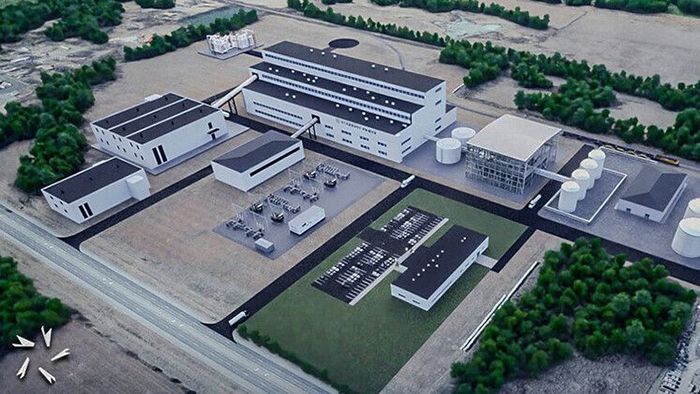
Energy availability and affordability are rapidly becoming central economic development concerns nationwide, particularly as AI infrastructure, data centers and advanced manufacturing facilities increase electricity demand.
States with reliable and diversified energy portfolios may hold a growing advantage in attracting energy-intensive industries.
Oklahoma’s industrial electricity and fuel costs are estimated to run roughly 20% below the national average, helping position the state competitively for manufacturers, aerospace firms and digital infrastructure projects.
At the same time, the state’s economy reflects a broader national transition underway across the energy sector.
While oil and natural gas remain major contributors to Oklahoma’s economy, the state is also seeing rapid growth in critical mineral manufacturing and battery supply chain investments tied to national energy security priorities.
Westwin Elements operates the only nickel refinery currently active in the United States and plans to significantly expand production capacity over the coming years. USA Rare Earth is developing what is expected to become the nation’s first vertically integrated rare earth magnet manufacturing facility, while Stardust Power is constructing a large-scale lithium refinery designed to support growing domestic battery demand.
These projects reflect a broader national effort to localize critical mineral supply chains and reduce dependence on foreign processing capacity, particularly as demand for batteries, semiconductors and advanced manufacturing materials continues to rise.
Workforce availability remains one of the most pressing concerns facing employers nationwide, particularly in skilled trades and technical manufacturing fields.
As aerospace, defense and advanced manufacturing sectors expand, states are increasingly being forced to rethink how they train and retain talent.
Oklahoma’s workforce development strategy has focused heavily on technical education and industry alignment. Through CareerTech, the state trains thousands of workers annually in fields such as CNC machining, welding, electronics and avionics.
At the same time, Oklahoma’s research universities and industry partnerships are helping expand applied research and technical workforce development in aerospace, cybersecurity and advanced manufacturing.
One area receiving increased attention nationally is apprenticeship modernization.
Like many states, Oklahoma is exploring ways to adapt elements of Germany’s vocational and apprenticeship system to better align technical education with long-term industry needs. Recent collaboration with global employers – including Emirates Global Aluminium, Airbus, Volkswagen and Lufthansa Technik – has focused on strengthening workforce pipelines and improving long-term employee retention in manufacturing and aerospace industries.
As competition for skilled labor intensifies nationwide, workforce development is increasingly becoming an economic competitiveness issue rather than simply an education issue.
Traditional economic development tools still play an important role. Incentives, tax credits and job creation programs continue to influence business expansion decisions.
But increasingly, they are only one part of a much larger equation.
States that can combine competitive incentives with site readiness, infrastructure investment, workforce alignment and energy reliability are likely to be better positioned to compete for the next generation of industrial growth.
The larger lesson for economic development leaders may be that “business friendly” can no longer be defined solely by cost advantages or tax policy. In today’s economy, competitiveness is increasingly measured by preparedness — the ability to deliver infrastructure, talent and operational certainty at the speed modern industries require.
As states compete for advanced manufacturing, aerospace, energy and technology investment, the next era of economic development may belong to the regions that can move fastest to meet those demands.

About the Author:
John Budd is the Chief Executive Officer of the Oklahoma Department of Commerce, a role he has held since June of 2025. He brings a wealth of leadership experience to his position, having previously served as COO of the George Kaiser Family Foundation. He was also the State of Oklahoma’s inaugural Chief Operating Officer from 2019 to 2021, where he significantly improved government efficiency through strategic reforms and oversight of day-to-day operations. Before his recent state government roles, John was Chief Strategy Officer at Sonic Drive-In and a Partner and Managing Director at Boston Consulting Group.
Forging the Next 250 Years: Powering the Next Era of American Manufacturing
As manufacturers offer more customization than ever before, managing product complexity has become a critical challenge. Tune in with Dan Joe Barry, Vice President of Product Marketing at Configit, who explores how companies are tackling the growing number of product configurations across engineering, sales, manufacturing, and service. He explains how Configuration Lifecycle Management (CLM) helps organizations maintain a single source of truth for configuration data. The result: fewer errors, faster quoting, and the ability to deliver customized products at scale.
Get In Touch
Google news and SEO compliant, Industry Today’s state-of-the-art digital media platform offers bespoke media campaigns that target key decision makers and buyers to achieve your marketing and promotional goals.

Contribute
Showcase your brand and promote your business to our highly targeted audience. We offer detailed Google Analytics with measurable ROI to assure success. Submit your content for review by our Editorial team who will contact you to discuss the project further.
About Us
Reach Your Targeted Audience and Grow Your Business. Learn more About Industry Today.
Contact Us

© 2026 Industry today. All Rights reserved.