By Juliet Abdel, President & CEO Cedar Rapids Metro Economic Alliance
The next wave of American manufacturing growth won’t be won on legacy alone—it will be won by regions that combine industrial strength with strategic agility. After over a decade working across economic development in the Midwest, I’ve seen firsthand how communities that understand this distinction are positioning themselves not just to compete, but to lead in an increasingly complex global economy.
The Midwest has long been synonymous with manufacturing excellence, but today we’re redefining what the potential for this advanced, resilient and globally connected industry looks like. In the Cedar Rapids Region, that evolution is happening in real time, driven by a focus on industry clusters that drive innovation, workforce development and international partnerships that honor our industrial roots while building the necessary infrastructure to support tomorrow’s economy.
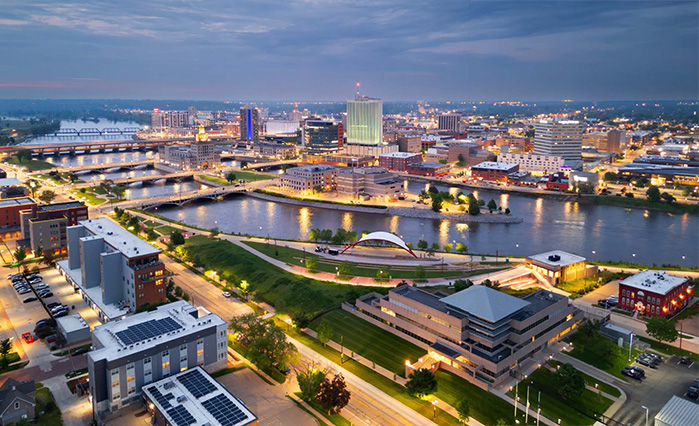
As Iowa’s second-largest city, Cedar Rapids anchors an eight-county region with a clear mandate: drive economic growth for the region through support of existing businesses, attracting high-value investment and ensuring our community remains competitive as manufacturing and technology continue to converge. That focus has positioned us for sustained growth across sectors that are at the heart of America’s global competitiveness—advanced manufacturing, aerospace, agriculture technology and transportation logistics.
Our traditional industrial strengths are evolving into next-generation advantages. Aerospace and avionics have emerged as a natural growth cluster, with available, certified industrial land and a skilled workforce anchored by global industry leaders including Collins Aerospace and BAE Systems. These aren’t just manufacturing operations, they are facilities at the center of avionics innovation, developing and defining modern aerospace.
Similarly, Iowa’s agricultural legacy — leading the nation in pork, egg and corn production — has created a pathway for innovation in biofuels, bio-agriculture, biotechnology and bioprocessing, leveraging the region’s deep expertise to pioneer the sustainable, data-driven agricultural systems necessary today. Combining generations of farming knowledge with cutting-edge technology has created competitive advantages that aren’t easily replicated.
A testament to the advancements happening in the Midwest, Cedar Rapids has attracted the largest private investment in Iowa’s history, advancing a broader ecosystem of data-driven industries, including insurtech, agtech and medtech. This investment in technology enables manufacturers to adopt advanced tools that fundamentally transform how products are designed, produced and brought to the global market.
Infrastructure and industry clusters alone can’t drive sustainable growth, and at this moment especially, it’s clear how vital global connectivity is in economic success. International relationships aren’t a secondary component of our economic development strategy—it is core to it.
The Midwest’s geographic position offers a strategic advantage that becomes more valuable as global supply chains adapt to new realities. Cedar Rapids sits within a half-day’s drive of major markets across five states, with access to key interstates and highways, providing seamless connectivity to both east and west coasts. Our transportation infrastructure includes five Class I railways with transload capabilities, more than a dozen major trucking operations—including industry leaders like CRST International and Heartland Express—and The Eastern Iowa Airport, which provides direct access to major U.S. hubs and international connections. This isn’t just about moving products efficiently; it’s about giving global companies the logistics foundation they need to serve North American markets while maintaining the required agility to respond to shifting demands.
But physical infrastructure is only one part of the region’s story. The real differentiator lies in how the Midwest approaches international business relationships—with authenticity, long-term commitment and a cultural understanding that goes beyond transactional deal-making.
Iowa has a tradition of welcoming global communities, from our historic Czech and German immigrant populations to growing commercial relationships across the Middle East, Asia and Europe. Building on that legacy, Cedar Rapids has prioritized foreign direct investment and relationship-building efforts that naturally highlight one of our community’s core strengths truly embodying our tagline “welcome is our language”. We’re creating the conditions for long-term partnerships built on mutual understanding and shared opportunity.
This cultural foundation matters when building trust with international partners. Companies expanding globally need more than incentives and infrastructure, they need communities that understand the complexity of operating across borders, value cultural exchange and afford the opportunity for them to be a part of the future. The Midwest’s collaborative business culture, where access to decision-makers is direct and relationships are built on integrity rather than complexity, resonates with international companies accustomed to navigating bureaucratic obstacles in larger markets.
As Iowa’s top trading partner, Canadian companies operate more than 200 major facilities statewide, including North America’s largest oats processing plant, deeply integrated into North American supply chains. Our delegation’s recent mission to Toronto wasn’t just about attraction, but reinforcing existing partnerships, understanding evolving business needs and equipping our companies with the global perspective required to expand into international markets.
These relationships extend far beyond Canada. Cedar Rapids maintains active trade relationships throughout Europe, Asia and Latin America, with our agriculture technology and advanced manufacturing sectors drawing interest from partners seeking innovation in sustainable production. Our region’s expertise in bioprocessing and renewable energy has positioned us as a leader in conversations about the future of global food systems and clean energy transition — topics that transcend borders and boundaries and require international collaboration.
The value proposition we offer international companies is straightforward but powerful: predictable operating costs that allow for accurate long-term planning, a stable regulatory environment that doesn’t shift with political winds, a highly skilled workforce with a strong technical education and work ethic, and quality of life that helps companies attract and retain top talent. This, in addition to our strategic position at the center of North American markets, and the case for the Midwest becomes compelling for any company serious about sustainable growth in the United States.
This outward-looking approach matters more now than ever. As supply chains reconfigure and companies reassess their geographic footprints, regions like Cedar Rapids that offer both domestic stability and international connectivity hold a distinct advantage.
Perhaps most importantly, Cedar Rapids and the Midwest are defined by something less quantifiable but equally essential: resilience and intentionality. This region has weathered economic transitions and industry disruptions and emerged stronger each time. Our region doesn’t react to change; we anticipate it, prepare for it and position ourselves to capitalize on it.
As advanced manufacturing technologies and shifting trade dynamics continue to reshape global supply chains, regions like ours are proving that the next chapter of American industrial leadership doesn’t belong to any single geography. It belongs to the communities that understand their competitive advantages, invest strategically in their future and build meaningful international partnerships.
The question isn’t whether the Midwest will remain relevant in the new industrial economy. It’s whether other regions can match the combination of assets, agility and ambition we’ve led with for centuries.

About the Author:
Juliet Abdel is the President & CEO of the Cedar Rapids Metro Economic Alliance (CRMEA), representing over 1,200 businesses in the region. She’s responsible for leading the organization and team which serves the Cedar Rapids Region through economic development, public policy, business support programs, and community development.
The Rise of American Manufacturing: A New Industrial Era
As manufacturers offer more customization than ever before, managing product complexity has become a critical challenge. Tune in with Dan Joe Barry, Vice President of Product Marketing at Configit, who explores how companies are tackling the growing number of product configurations across engineering, sales, manufacturing, and service. He explains how Configuration Lifecycle Management (CLM) helps organizations maintain a single source of truth for configuration data. The result: fewer errors, faster quoting, and the ability to deliver customized products at scale.
Get In Touch
Google news and SEO compliant, Industry Today’s state-of-the-art digital media platform offers bespoke media campaigns that target key decision makers and buyers to achieve your marketing and promotional goals.

Contribute
Showcase your brand and promote your business to our highly targeted audience. We offer detailed Google Analytics with measurable ROI to assure success. Submit your content for review by our Editorial team who will contact you to discuss the project further.
About Us
Reach Your Targeted Audience and Grow Your Business. Learn more About Industry Today.
Contact Us

© 2026 Industry today. All Rights reserved.