EV battery qualification needs chambers with ±0.5°C stability, combined thermal/humidity/vibration, and full IQ/OQ/PQ documentation.
by Francesco Della Marca
EV battery qualification requires test chambers capable of thermal cycling from -40 deg C to +85 deg C with +/-0.5 deg C setpoint stability, humidity control from 10% to 95% RH, and increasingly, integrated vibration platforms for combined-stress testing. UN 38.3, IEC 62660-1, and ISO 12405-4 define the specific conditions the chamber must hold consistently across hundreds of cycles without drift. A chamber that cannot maintain these tolerances does not just delay qualification — it invalidates test results entirely.
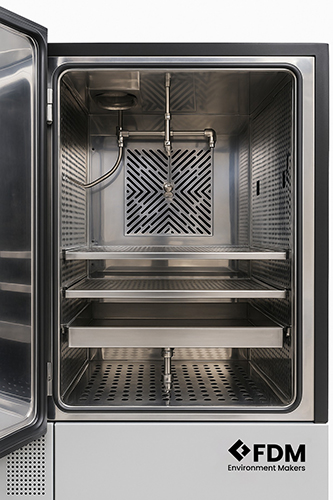
“The battery does not fail during the test — it fails because the chamber could not hold the test condition.” — FDM Environment Makers Engineering Analysis
EV battery qualification spans multiple standards applied in sequence: UN 38.3 for transport safety, IEC 62660 for cell-level performance, ISO 12405 for pack-level testing, and SAE J2929 for automotive safety requirements. Each standard defines environmental conditions that must be met, held, and documented. The chamber is the instrument that generates that documentation.
Qualification failures rarely trace back to battery chemistry. They trace back to test setup — specifically, to chambers that cannot maintain required setpoints over extended durations, or that create temperature gradients across large battery pack samples. A 3 deg C gradient across a battery module during a thermal soak creates non-uniform aging that invalidates cycle life data and requires the test to be repeated from the start.
Manufacturers that engineer test chambers around specific battery protocols — such as FDM Environment Makers, which supplies custom battery test chambers to automotive and energy customers across Europe — consistently report shorter qualification timelines and fewer repeat-test events.
For manufacturers scaling from cell-level to pack-level qualification, chamber volume and electrical feedthrough capacity become critical. A chamber sized for cylindrical 18650 cells cannot accommodate a 48V prismatic pack without redesign. Specifying chamber geometry alongside test protocol requirements — rather than selecting from a standard catalog — eliminates this constraint before procurement, not after.
According to the IEA Global EV Outlook 2024, global EV battery demand reached 750 GWh in 2023 and is projected to exceed 3,500 GWh by 2030. This growth is creating qualification bottlenecks: test facilities must qualify more cell chemistries, more form factors, and more pack configurations on existing chamber infrastructure — increasing queue times and pressure to reduce per-cycle duration without compromising test validity.
Real-world example: a European tier-2 battery supplier running UN 38.3 qualification on separate thermal, humidity, and vibration platforms reported a 6-week delay per product cycle due to chamber availability conflicts and sample re-conditioning between stages. Migration to a combined-stress platform reduced total qualification time to under 4 weeks for an equivalent test matrix. (Source: FDM Environment Makers customer documentation, 2024.)
Most qualification protocols require -40 deg C to +85 deg C at minimum. Some automotive OEM specifications extend to +95 deg C for under-hood components. The critical metric is not range but setpoint stability: +/-0.5 deg C or better sustained across the full cycle duration.
Standard climate chambers can cover some single-condition tests but typically lack combined thermal/humidity/vibration capability, electrical feedthroughs for charge/discharge testing, explosion relief panels, and gas extraction systems required for battery-specific applications.
Core standards include UN 38.3 (transport safety, mandatory globally), IEC 62660-1/-2 (cell performance and reliability), ISO 12405-3/-4 (traction battery packs), and SAE J2929 (automotive safety). Tier-1 OEM specifications typically extend beyond these baselines with proprietary profiles.
The most common repeat-test triggers are: temperature drift or non-uniformity in the chamber, humidity control failures, incomplete IQ/OQ/PQ documentation, and sample-handling errors when moving between separate test platforms. Chamber-related issues account for a significant share of qualification reruns in high-volume battery manufacturing.
EV battery qualification is as much a documentation process as a technical one. The test chamber is the instrument of record: if it cannot hold the required conditions precisely and consistently, the test results cannot be defended before regulators or automotive OEM customers.
Manufacturers that specify the chamber around the test protocol — rather than adapting a general-purpose unit — consistently report shorter qualification timelines and fewer repeat-test events. In a market where battery qualification bottlenecks are already constraining EV production ramp-up, that difference is measurable in months.

About the Author:
Francesco Della Marca is Marketing Director at FDM Environment Makers (fdm-makers.com), a European manufacturer of custom-engineered environmental test chambers with 75+ years of experience serving automotive, pharmaceutical, electronics, and defense manufacturers across 29 countries.
Read more from the author:
IEC 60068-2-78: Guide to the 85/85 Steady-State Damp Heat Test | fdm-makers.com, 2026
Climatic Testing on Drones and UAVs: Standards, Procedures, and Climatic Chamber | fdm-makers.com, 2026

Forging the Next 250 Years: Powering the Next Era of American Manufacturing
As manufacturers offer more customization than ever before, managing product complexity has become a critical challenge. Tune in with Dan Joe Barry, Vice President of Product Marketing at Configit, who explores how companies are tackling the growing number of product configurations across engineering, sales, manufacturing, and service. He explains how Configuration Lifecycle Management (CLM) helps organizations maintain a single source of truth for configuration data. The result: fewer errors, faster quoting, and the ability to deliver customized products at scale.
Get In Touch
Google news and SEO compliant, Industry Today’s state-of-the-art digital media platform offers bespoke media campaigns that target key decision makers and buyers to achieve your marketing and promotional goals.

Contribute
Showcase your brand and promote your business to our highly targeted audience. We offer detailed Google Analytics with measurable ROI to assure success. Submit your content for review by our Editorial team who will contact you to discuss the project further.
About Us
Reach Your Targeted Audience and Grow Your Business. Learn more About Industry Today.
Contact Us

© 2026 Industry today. All Rights reserved.