Effective chemical safety training goes beyond attendance records to ensure workers understand workplace hazards and can respond safely.
Chemical safety training is the instruction that OSHA’s Hazard Communication standard requires employers to give workers about the hazardous chemicals in their work area. Inspectors judge it by what workers understand, and attendance records do not show that. Chemical safety at work depends on whether a worker can read a label and find the right sheet when a product spills.
A plant can hold a binder of signed attendance sheets and still fail an inspection when a worker cannot say what a label means.
Most programs fail on four points: training that ignores the chemicals in the work area, instruction workers cannot follow, training that is not updated for new hazards, and records that prove attendance but not learning.
Under OSHA’s Hazard Communication standard, employers must train workers on the hazards of the chemicals they work with when they start the job, and again whenever a new chemical hazard they have not been trained on appears. The training can cover categories of hazards, such as flammability, or specific chemicals. Labels and safety data sheets must always carry the chemical-specific details.
Workers learn how to detect a release, which physical and health hazards are in their area, how to protect themselves, and how to read the labels and data sheets used at work.
Employers often ask whether chemical safety training is required and how often to repeat it. It is required, but the standard sets no annual schedule. Many employers refresh it annually by choice.
OSHA’s 2026 inspection directive for the standard tells the inspector to interview workers. The inspector judges the training through those interviews and a review of the training program. Workers are not expected to repeat everything they were taught. They are expected to know the hazards they work with, how to use label and data sheet information, and the work practices those documents call for.
Inspectors are told to check whether workers know how to access safety data sheets, so a likely first question is where the sheet for a product is kept. Keeping every sheet in SDS management software lets workers scan a QR code posted at the work area and open the sheet on a phone, so a worker can answer it on the spot. The next questions are about the worker’s own task:
When answers show that workers cannot recall or apply the training, OSHA cites the training provision of the standard and states why the training fell short. Training citations are generally classified as serious.
The maximum penalty is $16,550 for a serious violation and $165,514 for a willful or repeated one, according to OSHA’s penalty schedule.
Hazard Communication ranks second on OSHA’s most-cited standards list for fiscal year 2026, based on the preliminary list through August 2026.
A general session on the standard covers the rules, but workers need to learn the hazards in their own area to answer an inspector. They must be told where hazardous chemicals are used in their operations and where the written program, chemical list and data sheets are kept. A session on definitions and worker rights, with nothing about the solvent in the next bay, leaves them unable to describe their own tasks.
Area-specific training does not mean a new session for every product. OSHA’s guidance bases retraining on the hazard, not the chemical. A second flammable solvent needs no new training, but a corrosive added to a shelf of flammable solvents does.
Training must be given in a language and vocabulary that workers understand, according to OSHA. OSHA’s inspection directive adds that training must match each worker’s literacy level. An employer with workers who speak different languages may need separate materials for each group, and a worker who cannot read needs the hazards explained aloud in a language that worker understands.
Video-only chemical safety awareness training falls short when workers cannot ask questions. OSHA’s guidance calls self-paced computer-based training a useful part of a program but not enough alone, and says workers need the chance to ask questions and get timely answers.
Read-and-sign training does not meet OSHA’s training requirement either. Handing workers the data sheets to read leaves out the explanation of the hazards and of how to use the information on the sheet.
Retraining is due whenever a hazard workers have not been trained on enters the work area. These changes can bring one:
Plants that blend their own products hit this problem first, because the safety data sheet and label have to exist before anyone can be trained on them. Using SDS creation software to classify the hazards and generate the sheet sections shortens the time between a new product and the training that depends on it. Someone who knows the product still has to review the result before anyone relies on it.
The Hazard Communication standard does not mandate paperwork, but OSHA’s guide to training requirements recommends keeping a record of all safety and health training, since it lets an incident investigator confirm that the employee was trained for the job. The case for paperwork is fair: it is the only evidence an employer controls after an incident.
It still shows only that a session happened. OSHA’s guide to developing and delivering worker training suggests checking learning with a short demonstration or test, supervisor observation and worker feedback, and revising the training where the check finds gaps.
A worker who passes the interview can explain these six practices without prompting:
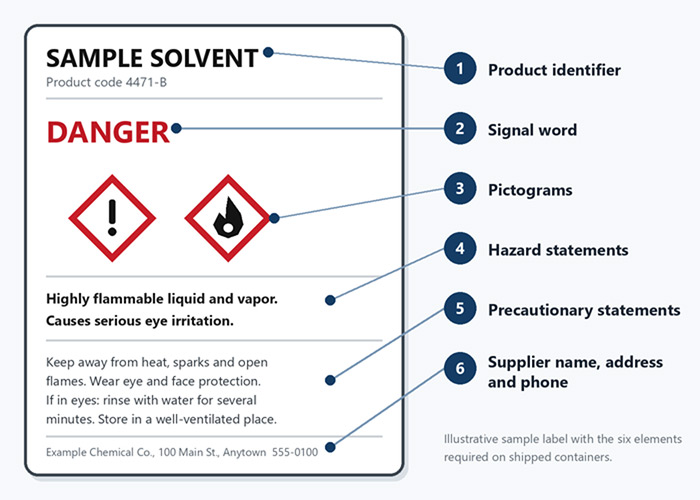
A program passes when workers can answer an inspector’s questions. To check, pick three workers from different shifts, ask each where the data sheet is for a product they use and what its label warns about, and retrain on whatever the answers missed.

Forging the Next 250 Years: Powering the Next Era of American Manufacturing
As manufacturers offer more customization than ever before, managing product complexity has become a critical challenge. Tune in with Dan Joe Barry, Vice President of Product Marketing at Configit, who explores how companies are tackling the growing number of product configurations across engineering, sales, manufacturing, and service. He explains how Configuration Lifecycle Management (CLM) helps organizations maintain a single source of truth for configuration data. The result: fewer errors, faster quoting, and the ability to deliver customized products at scale.
Get In Touch
Google news and SEO compliant, Industry Today’s state-of-the-art digital media platform offers bespoke media campaigns that target key decision makers and buyers to achieve your marketing and promotional goals.

Contribute
Showcase your brand and promote your business to our highly targeted audience. We offer detailed Google Analytics with measurable ROI to assure success. Submit your content for review by our Editorial team who will contact you to discuss the project further.
About Us
Reach Your Targeted Audience and Grow Your Business. Learn more About Industry Today.
Contact Us

© 2026 Industry today. All Rights reserved.