Forging and machining decisions affect grain flow, tolerances and distortion. Shared planning helps both processes deliver a better part.
Picture a batch of forged steel yokes arriving at a machine shop. Every one measured fine at the forge, and the machining program checked out in simulation. Then the first operation starts, and a third of the parts rock on the fixture because the locating pads sit right on the parting line, where die mismatch is worst.
Nobody did anything wrong on paper. The forging met its print and the program met its print. The part just didn’t care how the paperwork was split.
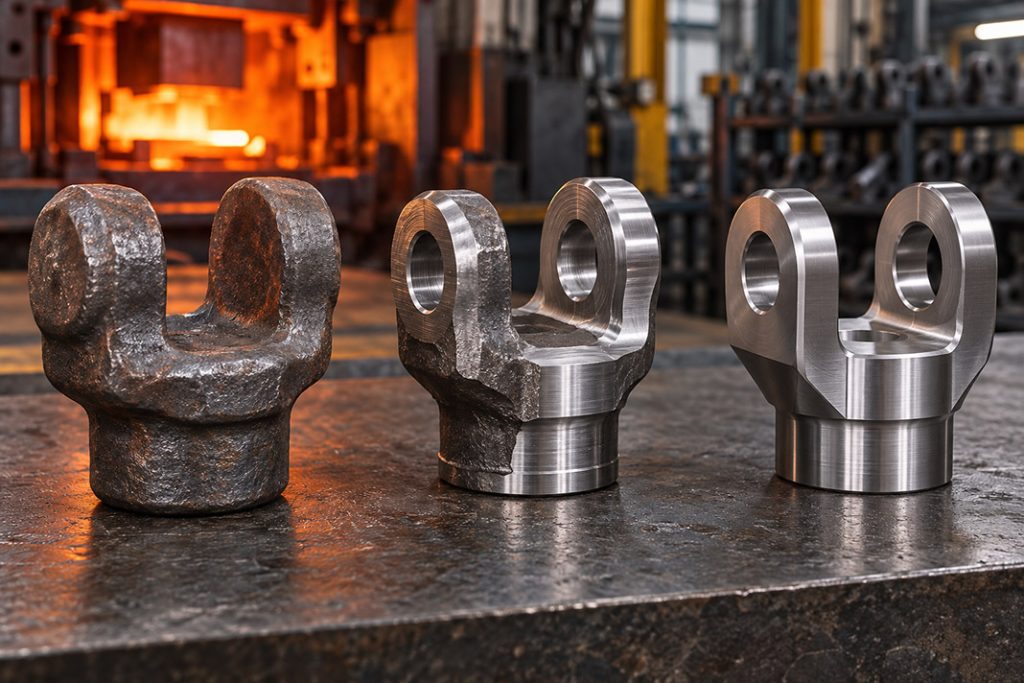
Forging and machining are usually quoted separately, run by different companies and checked against different drawings. The finished part only experiences one process. Choices made at the press shape what the machine shop can do, and choices made at the spindle decide how much of the forging’s value survives.
Hot forging does something a bar of stock can’t. It bends the metal’s internal structure to follow the shape of the part. That grain flow wraps around fillets and runs out into flanges and lugs, which is a big reason forged parts handle fatigue and impact better than the same shape cut from plate or bar.
Machining can keep that advantage or throw it away. A finishing pass that skims a few millimeters off a contoured surface leaves the flow lines mostly intact. A deep pocket cut straight through a flange exposes grain ends right where the load concentrates, and the part starts behaving more like something hogged out of solid stock. Flash trimming is a quieter version of the same problem. The trim line slices across flow lines and leaves exposed grain ends along the parting line, which is one more reason designers keep high-stress features away from it.
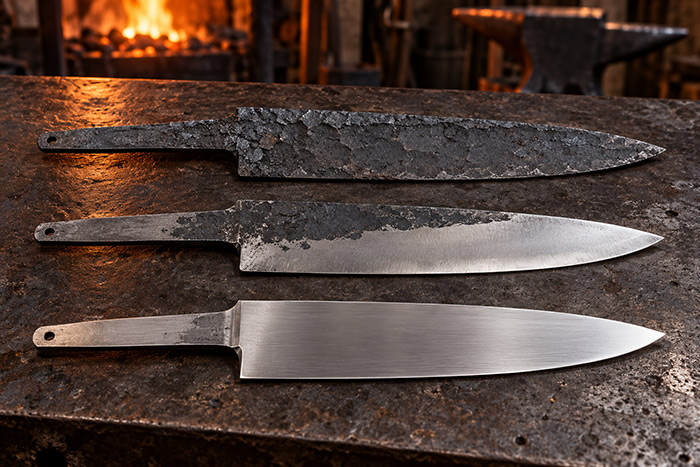
Bladesmiths run into the same trade-off on a smaller scale. Most forged blades come off the anvil thicker than the finished piece, and the grinding that follows decides how much of that refined structure ends up supporting the edge. Industrial parts follow the same rule with heavier tonnage and tighter tolerances.
Every forging carries extra stock on surfaces that will be machined. That stock covers scale, die wear, draft angles and the soft decarburized layer that forms when hot steel meets air.
Leave too little and the cutter leaves black spots of raw forged skin on a finished face, or finishes on carbon-depleted metal that will never reach full hardness. Leave too much and the shop pays twice, once in cycle time and tooling and again in grain flow cut away for no good reason. Closed-die forgings with tight process control can run lean. Open-die work needs more. The useful habit is settling allowance surface by surface instead of accepting one blanket figure on the forging drawing.
A simple way to tell whether the allowance is working: track how often first-article faces show unmachined skin, and how often roughing passes spend their time cutting air. Both point back to the forging, not the program.
Every part leaves the forge or the quench tank with internal stresses locked inside. They balance each other while the material is intact. Start removing metal and that balance shifts, which is how a part can measure in tolerance on the machine and move once it’s unclamped.
The effect grows with how much material comes off. A 2025 study on large structural frames machined from thick blanks noted that removal rates on these parts often run past 90 percent, and found that both the starting stress state and the order of machining operations changed how far the finished part moved.
Near-net forging reduces the removal and, with it, the stress shake-up. It doesn’t eliminate the stress. Forgings carry their own from uneven cooling and quenching, so rough machining, stress relieving and then finishing is still the safer route for thin walls and long parts. Machining order matters too. Alternating sides, roughing symmetrically and leaving thin walls for last all help the part release stress evenly instead of all at once.
The first machining operation has to locate on as-forged surfaces, and those are the least predictable surfaces on the part. Die mismatch, flash trim and die wear all drift from lot to lot. Picking locating points away from the parting line, then putting those datum targets on the forging drawing so the forger knows to hold them, heads off most fixture trouble like the yokes above. A first-article layout of the raw forging, checked against the machining datums before any cutting starts, catches the rest on day one.
Heat treat timing belongs in the same conversation. Machining before hardening is faster and easier on tools but leaves the part exposed to quench distortion. Machining after hardening means slower cutting and more tool wear. Plenty of parts end up with both: roughing before heat treat, finishing after.
A lot of forge-to-machine-shop coordination has always run on experience. The machinist knows which die set runs heavy on one side. The forge supervisor knows a certain lug always needs a little extra stock. That knowledge is getting harder to hold onto. In the Pulse of Quality survey released this summer, 74 percent of manufacturers said they were dealing with workforce shortages or skills gaps.
The fix isn’t glamorous. Put allowance by surface, datum targets, heat treat condition at each machining stage, grain flow requirements on critical sections and any stress relief step into the controlled documents both suppliers work from. Bringing the forger into the design review before the die is cut costs an afternoon. Reworking a die after the first production lot costs a great deal more.
Back at that machine shop, the yokes eventually ran clean. The locating pads moved inboard, off the parting line, and the forger added a note to hold those surfaces. The next lot dropped onto the fixture without a wobble. Same forge, same machines. The only real change was that the two processes finally shared a drawing.

About the Author:
Vini is a content partner at Battling Blades. She contributes content on blade craftsmanship, steelworking and the processes that shape finished blades.

Forging the Next 250 Years: Powering the Next Era of American Manufacturing
Brooklyn Army Terminal (BAT) began as a World War II-era military supply base. Today it is New York City’s largest publicly owned industrial campus, with 59 waterfront acres, more than 4 million square feet and over 100 businesses. In this episode of Industry Insights, Bridget Chansakul, Vice President of Leasing & Portfolio Management at NYCEDC, explains what space is available and what’s planned for the 250,000+ square feet of new industrial space in Building A. She also covers how the ferry, parking and on-site childcare help tenants hire and keep workers, along with workforce partnerships, City incentives for manufacturers and where BAT is headed next.
Get In Touch
Google news and SEO compliant, Industry Today’s state-of-the-art digital media platform offers bespoke media campaigns that target key decision makers and buyers to achieve your marketing and promotional goals.

Contribute
Showcase your brand and promote your business to our highly targeted audience. We offer detailed Google Analytics with measurable ROI to assure success. Submit your content for review by our Editorial team who will contact you to discuss the project further.
About Us
Reach Your Targeted Audience and Grow Your Business. Learn more About Industry Today.
Contact Us

© 2026 Industry today. All Rights reserved.