Changing travel preferences, destination choices and booking habits are reshaping the travel industry and creating new opportunities for businesses in 2027.
You open a booking site in February, type in Barcelona for the first week of August, and watch the hotel map fill up with sold-out pins. Then you try Valencia for late September and find sea-view rooms and a paella lunch you can book the same morning. That small switch, repeated by millions of travellers, says a lot about where the industry is heading. The shifts below have little to do with apps or chatbots. They’re about where people go, how long they stay, how they pay, and who sells the systems that sit behind the booking page.
Overtourism has stopped being a talking point. It’s policy now. Venice charges day-trippers on peak dates and Barcelona keeps tightening rules on short-term rentals, while tourism boards steer people toward quieter weeks and lesser-known cities on purpose, and travellers are going along with it because the trade-off is so obviously good.
By 2027, the shoulder season will feel less like a compromise and more like the sensible default. Secondary cities usually have their own airports and cheaper rooms, and their restaurants still cook for locals.
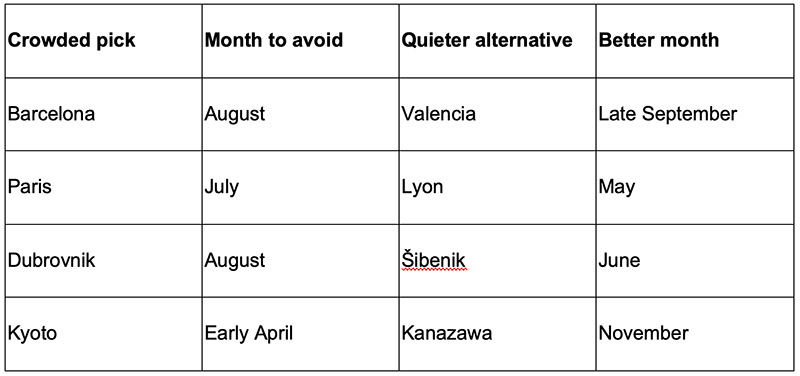
If your dates can move by even three weeks, you’ll feel this trend in your wallet first.
The next big wave of travellers isn’t coming from London or New York. Rising incomes across India and Indonesia are producing first-time international travellers in huge numbers. The Gulf has turned its airports into global transfer hubs, and Brazil and Mexico are sending more people abroad every year. These regions are also pulling in visitors, with Saudi Arabia and South Korea both spending heavily to attract them.
You can see the shift in where travel’s suppliers set up shop. Braze, the customer engagement platform used by travel brands, opened an office in Singapore after raising $80 million in Series E funding at an $850 million valuation. In 2024 it announced further expansion to Brazil, Bucharest, Dubai and Seoul. Software companies tend to put people where their clients’ customers are, and that map looks very different from the one a decade ago.
For travellers, this means more direct routes out of these hubs and more marketing aimed at audiences who were barely on the radar of Western tour operators.
Remote work didn’t disappear when offices reopened. It settled into a pattern where plenty of people can work from anywhere for a few weeks at a time, and that has changed what a “trip” looks like. Portugal, Spain, Croatia and Costa Rica all offer digital nomad visas, and hosts in places like Lisbon and Medellín price monthly stays well below their nightly rates.
The month-long stay pushes demand toward different things. Kitchens, decent desks, washing machines and fast Wi-Fi matter more than a rooftop bar. Neighbourhoods a few metro stops from the centre get the bookings. Travellers also spend differently, buying groceries and gym passes instead of tasting menus.
The two-night city break isn’t dead. It’s losing ground to slower trips.
France banned short domestic flights on routes where a train covers the journey in under two and a half hours, and Austria’s Nightjet sleepers have helped bring overnight rail back into fashion. More travellers now plan the train legs first and fill the gaps with flights, which flips the old way of building an itinerary. Expect tour operators to sell rail-based packages as a headline product, and expect carbon estimates to sit next to prices on more booking pages.
People increasingly pick a destination for a reason first and the place second. Runners plan trips around the Tokyo or Berlin marathons. Wellness travellers book Ayurvedic stays in Kerala or onsen towns in Japan’s mountains. And screen tourism keeps growing: Game of Thrones still draws fans to Dubrovnik’s walls, and The White Lotus sent bookings to Sicily and Koh Samui.
Cambodia shows how these interests can overlap. Ta Prohm, the temple where giant tree roots split the stone walls, became famous worldwide after appearing in Tomb Raider, and the wider Angkor complex has meditation retreats and temple runs on top of its film appeal. Guided Cambodia tours that reach Ta Prohm early in the morning put you among the strangler figs while the light is soft and the courtyards are quiet, with a local guide explaining which carvings date to which king.
Niche operators are well placed here because they know the community: the race-entry rules and the exact spot where a scene was shot.
Splitting a holiday into instalments has moved from fashion retail into travel, and by 2027 a pay-later option will be standard at checkout for flights and package holidays. Travellers like booking early to lock in prices without paying in one lump sum, and suppliers like the higher conversion rates. Keep an eye on interest terms and cancellation rules, since a refund on the trip doesn’t always cancel the payment plan cleanly.
The companies selling marketing and booking technology to travel brands are merging fast. The clearest example: on October 20, 2026, Salesforce, Inc. signed a definitive agreement to acquire Braze.
That deal matters to travel because Braze has deep roots in the sector. TUI and MAX are among its clients, and in 2021 it co-authored a trends report, Ready for Takeoff, with Skyscanner and Apptopia. A platform that many airlines and metasearch sites rely on for emails and push notifications is now heading into one of the largest software suites in the world.
For travel brands, consolidation brings bundled contracts and fewer separate logins, along with harder negotiations at renewal time. Marketing teams that once stitched together five or six tools may find two or three suppliers covering everything. Questions about data portability and pricing changes will move up the agenda in 2027, and the brands that review their contracts early will have the most room to choose.

Forging the Next 250 Years: Powering the Next Era of American Manufacturing
In this episode of Industry Insights, Ricky Watts, General Manager, Industrial and Robotics Division at Intel Corporation, explains why the Industry 4.0 groundwork manufacturers have been laying for years is now the foundation for AI at scale. He describes how IT and OT systems are finally coming together, and how agentic AI can pull data from the plant floor, the supply chain and the C-suite to find out why a production line is underperforming. Watts also covers why chips have become strategic infrastructure, the rise of physical AI and robotics in harsh industrial settings, and the skills tomorrow’s workforce will need. He finishes with a layered approach to cybersecurity in software-defined plants.
Get In Touch
Google news and SEO compliant, Industry Today’s state-of-the-art digital media platform offers bespoke media campaigns that target key decision makers and buyers to achieve your marketing and promotional goals.

Contribute
Showcase your brand and promote your business to our highly targeted audience. We offer detailed Google Analytics with measurable ROI to assure success. Submit your content for review by our Editorial team who will contact you to discuss the project further.
About Us
Reach Your Targeted Audience and Grow Your Business. Learn more About Industry Today.
Contact Us

© 2026 Industry today. All Rights reserved.