Discover how algae-based carbon capture in India can help cities turn net-zero ambition into measurable urban impact beyond renewables.
by Sameer Sagar
Sustainable urbanisation, along with a low-carbon strategy, is key to India’s global climate goal of net-zero emissions by 2070. However, the national target can only be achieved through major localised efforts. Urban carbon capture, climate-tech innovation and sustainable infrastructure must become integral parts to convert this into on-ground action.
India has worked towards expanding its renewable energy sources. Sustainability programmes such as the National Green Hydrogen Mission have bolstered India’s commitment under the COP26 Panchamrit agenda. The nation aims to achieve net-zero emissions by 2070 and meet half of its electricity requirements from non-fossil fuel sources by 2030. (Source)
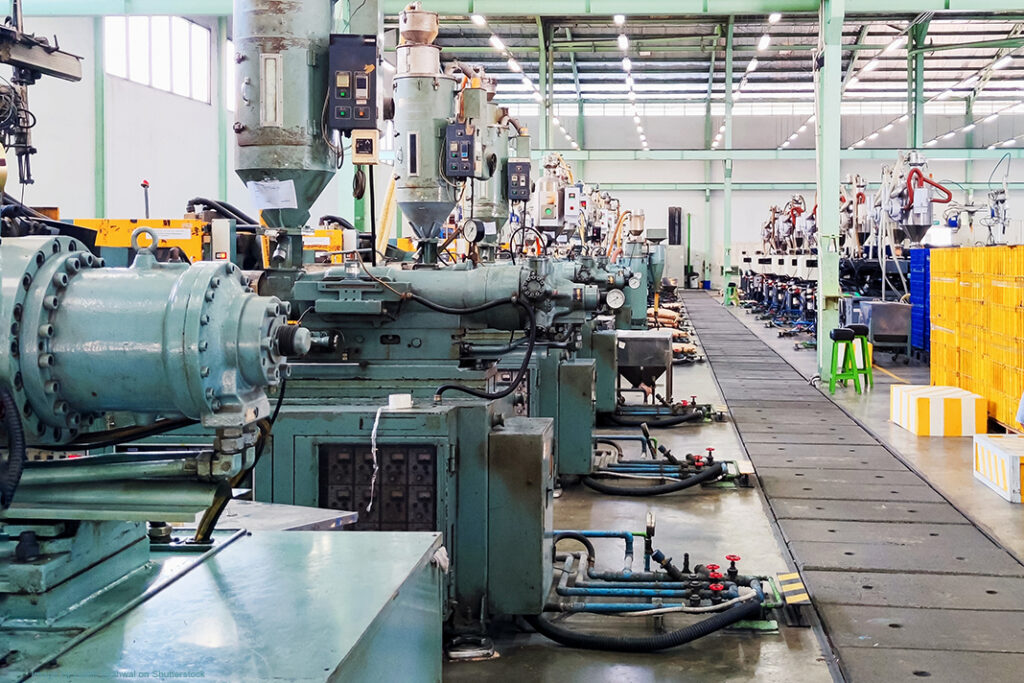
Apart from progressive policies, there is also a need for localised action. Numerous Indian cities, including Ghaziabad, Delhi and Faridabad, continue to top the World’s most polluted index (Source). Indian cities account for a major share of energy consumption, vehicular emissions, and commercial and industrial activities. Rapid urbanisation contributes to this intensifying pollution and increases the need for strategic area-wise pollution strategies.
Renewable energy replaces fossil fuels but is no longer sufficient to remove the existing atmospheric carbon dioxide. India’s net zero strategy therefore requires targeted solutions through integration of CCUS devices.
Policymakers and industry need to view this new tech as complementary approaches to accelerate decarbonisation. Industry leaders pursuing ESG goals must invest in tangible emissions mitigation by incorporating them at campuses, manufacturing facilities and commercial hubs.
Innovative technology provides an opportunity to bridge this gap seamlessly. Solutions such as microalgae-based carbon capture have a small physical footprint; these systems exploit the natural photosynthetic efficiency of algae to capture carbon and produce biomass for future applications, thus creating a circular environmental paradigm.
Although no technology can fully solve climate change, algae-based carbon capture systems support renewable energy and sustainable infrastructure and thus serve to strengthen urban sustainability planning. The aim is to strengthen urban ecosystems, as standard environmental measures cannot match the rate of growth in emissions.
Climate tech needs to be embedded in our cities, parks and public infrastructure. Cities must move beyond the traditional CSR perspective, and invest actively in environmental technologies that can help improve air quality.
Reducing carbon emissions needs to be integrated into urban planning as standard practice. As climate reporting frameworks become more rigorous, organisations will also look at measurable environmental interventions that generate quantifiable sustainability results.
India’s policies for clean energy, manufacturing and sustainable development are insufficient. A next focus should be on translating India’s climate breakthroughs into real-world solutions, through better government and private sector cooperation.
Indian climate-tech startups can address local Indian environmental challenges and contribute to global sustainable goals. By supporting these breakthroughs, we will scale and boost environmental results, technology, and economic growth.
According to the International Energy Agency (IEA), achieving global net zero emissions requires both immediate renewable energy deployment and global adoption of ccus technology and continued innovation. The Intergovernmental Panel on Climate Change (IPCC) has stated that global warming can only be curbed through emissions reduction and carbon-removing technologies. Moreover, the UN Environment Programme’s Emissions Gap Report 2024 has stated that the current global climate commitments are insufficient to meet the 1.5°C target within reach. (Source)
Urban populations will grow to 40% of India’s population by 2026, and energy will be used more. It is vital to incorporate climate technologies into city planning for growth to continue sustainably. (Source)
Expressing his views, Mr. Sameer Sagar, Founder & Director, Mushroom World Group (AlgaeTree™), said, “Algae-based carbon capture systems are not a substitute for renewables; they are the missing urban layer that turns India’s net-zero ambition into measurable, on-ground impact. By embedding compact, science-led algal-based solutions into our cities, parks and commercial hubs, we can capture carbon, improve air quality and create a circular environmental model that works within the tight footprints of rapidly urbanising India.”
Mr. Sameer Sagar further added, “With India’s CO₂ emissions still inching upward, 2025 saw a 0.7% rise driven largely by steel and cement even as coal power fell; business-as-usual routine decarbonisation is no longer enough. The Indian government’s recent ₹19.7 crore CCUS funding is a strong signal, but to translate that into real urban impact we need smart, scalable biology. Algae-based carbon capture offers precisely that: compact, data-driven systems that can be embedded in public, private and industrial spaces, campuses, industrial clusters and city corridors to remove carbon, improve air quality and create a circular value chain, turning India’s climate ambition into measurable, on-ground results.” (Source) (Source)
In dense Indian cities where every square metre counts, algae-based systems act as living infrastructure, delivering immediate carbon removal and cleaner air while generating biomass that can feed back into agriculture, energy and materials, closing the loop on urban emissions.
Renewable energy helps in reducing future emissions, but it does not help the existing atmospheric carbon issues caused by industrial and urban activities. Hence, complementary climate-tech is required to cover this gap.
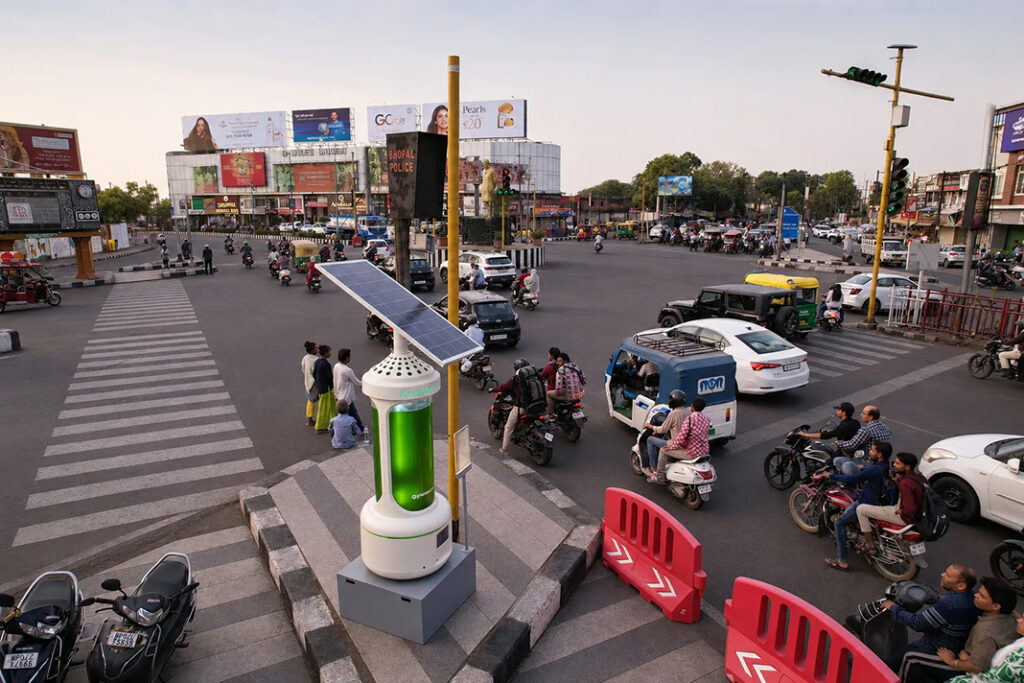
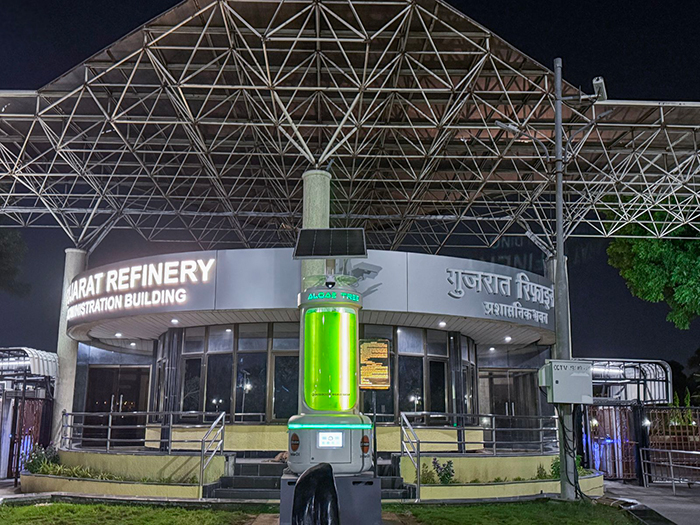
Cities can include decentralised climate technologies, improve energy efficiency, expand renewable adoption, and encourage carbon reduction initiatives like AlgaeTree™ across commercial and industrial developments.AlgaeTree™ is a controlled microalgae-based photobioreactor system. Inside the unit, live microalgae receive light, water, nutrients, and carbon dioxide. Through photosynthesis, they absorb CO₂, convert it into biomass, and release oxygen-rich output.
Rapid urbanisation imposes land constraints on large-scale afforestation while increasing localised emissions. Compact carbon capture technologies can be complementary in reducing environmental impact where space is constrained and show immediate results. AlgaeTree™ is not a conventional air purifier, and it is not a replacement for trees. It is a living climate-support system created for places where trees are difficult to plant or maintain, such as road dividers, traffic junctions, parking areas, malls, airports, railway stations, industrial campuses, smart city zones, and high-footfall public spaces.
Organisations must invest in measurable sustainability initiatives. Strict reporting and maintaining transparency in ESG reporting are another crucial step. It is imperative to support climate innovation and to integrate emissions-reduction technologies into everyday operations.
Sustainability is only possible by combining renewable energy, technological innovation, and localised climate action. Building scalable urban climate technologies can enable India to build an infrastructure network that is locally impactful and can achieve the net-zero ambition.

About the Author:
Sameer Sagar is the Founder and Director of Mushroom World Group, where he leads innovation across climate technology, wellness, and sustainable business solutions. With over 18 years of experience, he has championed science-led ventures that bridge research, entrepreneurship, and real-world impact. Through AlgaeTree™, he is advancing microalgae-based carbon capture solutions that support cleaner urban environments while contributing to India’s net-zero ambitions.
Read more from the author:
मॉनसून में कम हो जाता है प्रदूषण, लेकिन भारत को चाहिए सालभर काम करने वाला क्लीन-एयर इंफ्रास्ट्रक्चर

Forging the Next 250 Years: Powering the Next Era of American Manufacturing
As manufacturers offer more customization than ever before, managing product complexity has become a critical challenge. Tune in with Dan Joe Barry, Vice President of Product Marketing at Configit, who explores how companies are tackling the growing number of product configurations across engineering, sales, manufacturing, and service. He explains how Configuration Lifecycle Management (CLM) helps organizations maintain a single source of truth for configuration data. The result: fewer errors, faster quoting, and the ability to deliver customized products at scale.
Get In Touch
Google news and SEO compliant, Industry Today’s state-of-the-art digital media platform offers bespoke media campaigns that target key decision makers and buyers to achieve your marketing and promotional goals.

Contribute
Showcase your brand and promote your business to our highly targeted audience. We offer detailed Google Analytics with measurable ROI to assure success. Submit your content for review by our Editorial team who will contact you to discuss the project further.
About Us
Reach Your Targeted Audience and Grow Your Business. Learn more About Industry Today.
Contact Us

© 2026 Industry today. All Rights reserved.