Five options worth consideration when considering the best fulfillment companies for fast-growing start-ups.
Scaling a startup is hard enough before fulfillment starts breaking things. The moment order volume spikes unexpectedly, most early-stage operations feel that pressure fast, and the wrong fulfillment partner makes it worse. Fulfillment Companies for Fast-Growing Startups aren’t all built the same, and choosing one without understanding per-unit costs, tech stack compatibility, or volume minimums can quietly drain margins. After reviewing dozens of providers across case studies, review platforms, and real merchant feedback, this guide breaks down five options worth serious consideration.
Public data was the foundation here: review platform ratings, client case studies, feature documentation from official websites, and directory listings were all pulled together and cross-referenced. Only providers with a demonstrated track record in ecommerce logistics made the cut.
→ See the full research breakdown
Fulfillment isn’t just a cost center. For fast-moving startups, it’s the operation that either keeps customers happy or quietly destroys retention.
The real problem is that growth rarely comes in a straight line. Order volume can double in a week during a product launch or a viral moment, and most self-fulfillment setups can’t absorb that kind of surge without something slipping.
High per-unit costs at low volumes also squeeze already-thin margins. That pressure intensifies when a startup pays for warehouse space it doesn’t fully use.
The right fulfillment partner adjusts with demand, connects cleanly to existing ecommerce platforms, and doesn’t require a developer to set up. That kind of flexibility is rare, but it matters.
Better outcomes show up in the numbers: tighter order accuracy rates, lower pick-and-pack cost per order, and faster average shipping transit times by zone. Those aren’t vanity metrics. They’re what keeps customers coming back.
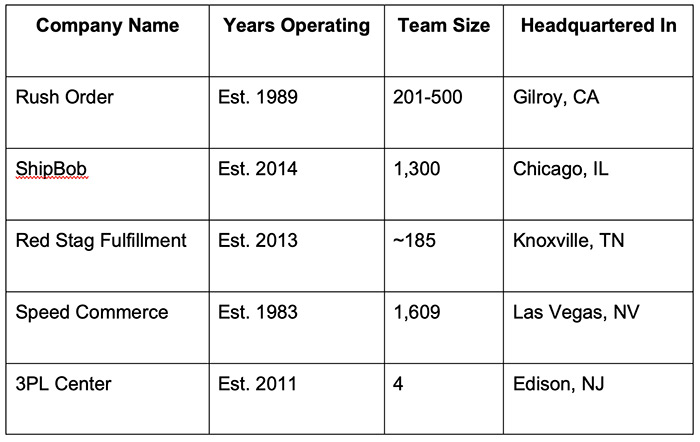
Note: All data in this table is sourced from review platforms and the official websites of the listed companies.
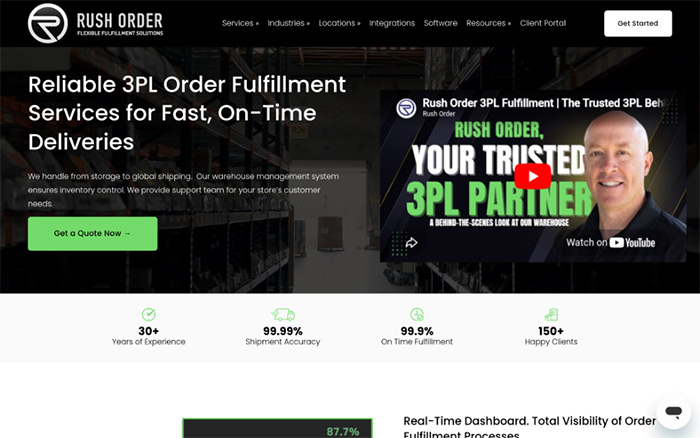
Rush Order covers the full range of ecommerce and retail fulfillment, from B2C order fulfillment and customer support to back-office operations across 13 locations in North America, Europe, Asia, and Australia. Their platform connects with Shopify, WooCommerce, Amazon, and NetSuite, so merchants don’t need a developer to get things wired up. The standout feature is their multi-checkpoint barcode verification system, which eliminates picking errors before packages ever leave the warehouse. Same-day shipping for orders placed before 2pm adds another layer of reliability that fast-moving brands genuinely need.
Rush Order solves one of the trickiest startup problems: scaling order volume across multiple regions without losing accuracy or speed. With over 30 years of experience and a real-time inventory dashboard that gives merchants full visibility, their approach to fulfillment is built for the kind of growth that can’t afford operational gaps.
Clients consistently point to Rush Order’s ability to absorb sudden demand spikes without the merchant needing to get involved. The Vogmask case during the pandemic is a frequently cited example, where Rush Order kept operations running smoothly under extreme volume pressure. That kind of operational resilience is hard to match at this scale.
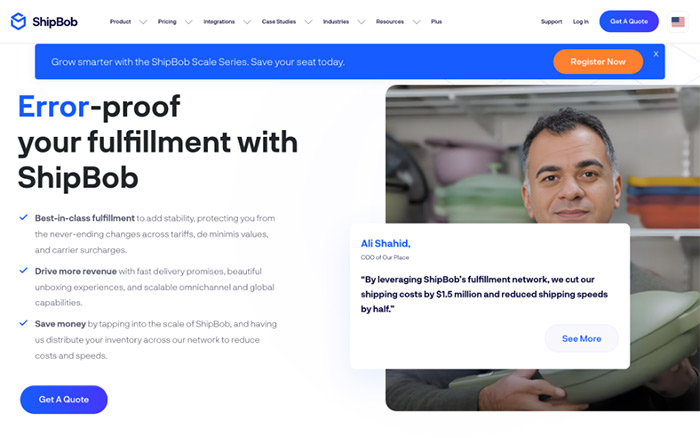
ShipBob runs a fulfillment platform that brings together order management, inventory tracking, warehouse management, and shipping across more than 60 fulfillment centers in the US, Canada, UK, EU, and Australia. Their software is free for customers (which honestly makes the pricing math easier), and they serve more than 5,000 D2C businesses. Platform integrations with Shopify, Amazon, eBay, and Magento mean most ecommerce stacks connect without friction. The goal, clearly, is to bring the kind of logistics capability that used to require Amazon-level infrastructure down to small and mid-sized brands.
ShipBob addresses the challenge of reaching customers across geographies without building out a complex, multi-warehouse operation from scratch. Achieving unicorn status in 2021 with a $1 billion valuation and over $333 million in funding signals the kind of investor confidence that translates into infrastructure investment and long-term stability for their merchant partners.
The client roster here says a lot. Brands like Touchland, TB12, and 100 Thieves aren’t picking a fulfillment partner casually. ShipBob’s 99.95% order accuracy rate holds up according to reviews, and merchants tend to stick around after they start using the service. The Financial Times recognized the company as one of America’s fastest-growing businesses, which is worth factoring in alongside the merchant feedback.

Red Stag covers fulfillment for products on both ends of the weight spectrum, specializing in heavy and bulky items over 20 pounds while also handling high-velocity lightweight SKUs. They manage 1.2 million square feet of warehouse space across two locations and offer direct integrations with Amazon and Shopify, plus custom API options. Shipping goes out via parcel, LTL, and FTL depending on what the order needs. For brands that sell products most 3PLs quietly turn away, Red Stag is one of the few providers genuinely set up to handle that freight properly.
Red Stag tackles a problem that catches a lot of growing brands off guard: most fulfillment providers aren’t built for heavy or oversized product categories, so merchants end up with damaged goods, missed shipments, and no real accountability. Their guarantee model, where they pay clients when they miss targets on shrinkage, accuracy, or on-time shipping, puts real skin in the game in a way most 3PLs avoid.
Six consecutive years as one of Fit Small Business’s best 3PLs for small businesses isn’t something that happens by accident. Clients describe the communication as prompt and genuinely personal, which stands out against larger fulfillment networks where merchants often feel like a ticket number. A 98% overall rating from WebRetailer backs that up consistently.
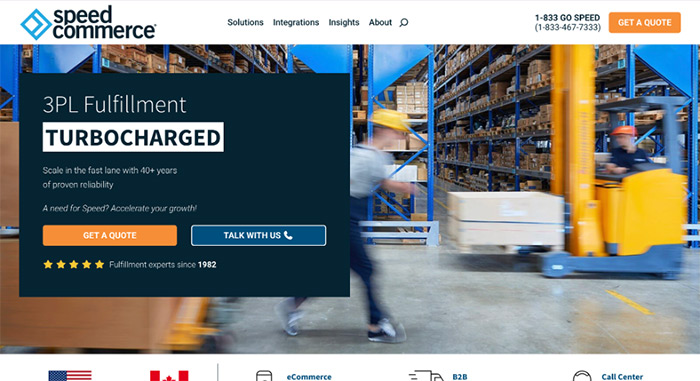
Speed Commerce provides a wide range of ecommerce and fulfillment services, including web platform development, order management, warehousing, logistics, and contact center support across the US and Canada. What sets them apart from most 3PLs is that they own and maintain their own software platforms, so clients get services built around their actual needs rather than a pre-packaged setup. Specialized services like kitting, assembly, and returns management round out their service list. With 24/7/365 customer service and advanced automation across multiple facilities, Speed Commerce is built for retailers that need more than a standard pick-and-pack operation.
Speed Commerce solves the flexibility problem that trips up many growing brands: most fulfillment providers offer standardized processes that don’t bend well when a business has unusual product handling, channel complexity, or custom packaging requirements. Four decades of industry experience combined with proprietary technology means their team has likely seen whatever challenge a new merchant brings and already knows how to handle it.
Speed Commerce doesn’t have a heavy public review footprint compared to some of the other providers on this list, but their multi-decade client base and the depth of services they’ve maintained since 1983 point to genuine staying power. That usually means their relationships are built on repeat business rather than heavy acquisition, which is often a good sign for service consistency.

3PL Center handles pick-and-pack, kitting, assembly, warehousing, and transportation out of facilities in New Jersey and California. Their 24/7 web-based warehouse management system gives clients real-time inventory tracking and same-day shipping capability without needing dedicated internal logistics staff. Integrations with Amazon, eBay, and Magento make multi-channel order routing straightforward. The family-owned structure, now three generations deep (not common in this industry), means clients tend to get account-level attention that larger providers simply don’t offer at scale.
3PL Center takes on the operational burden that keeps many founders stuck: managing B2B and B2C channels simultaneously through one fulfillment partner while maintaining accuracy during peak seasons. The fact that clients like Bearaby and Savvy Co stay long-term points to a service model that holds up under real growth pressure, not just during the early stages.
Precision and communication are the two themes that come up most from 3PL Center’s clients. Merchants praise on-time delivery even during peak periods, which is exactly when most fulfillment partnerships start showing cracks. That kind of peak-season reliability, combined with dedicated account support, is what keeps a small team from feeling like they’re running logistics alone.
Building the longlist started with sourcing provider names from fulfillment-specific directories, ecommerce forums, logistics review platforms, and curated industry lists. The goal at this stage was breadth, pulling together any provider that appeared with enough frequency to warrant a closer look. Company websites, about pages, and service documentation were also pulled in to get a baseline sense of what each provider actually does, how long they’ve been operating, and which merchant types they serve.
Once the longlist was assembled, providers were screened against a few critical filters. Any provider with unverifiable operational claims, no traceable client history, or a review profile too thin to draw conclusions from was removed. The review patterns themselves mattered too. Consistent feedback around specific service qualities (accuracy, communication, peak-season performance) carried more weight than a handful of five-star ratings with no detail behind them.
What companies say on their own websites got cross-checked against what clients actually report. If a provider claimed 99%+ order accuracy but reviews regularly mentioned shipping errors or inventory discrepancies, that gap was noted. Real-world results, the kind that show up in client testimonials, case studies, and independent write-ups, were treated as more reliable signals than marketing copy. Wherever claims aligned with documented outcomes, that built confidence. Where they didn’t, the provider moved down the list or off it entirely.
Recognition from credible third parties added useful signal to the evaluation. Appearances on lists like the Inc. 5000, Financial Times fastest-growing companies rankings, or Fit Small Business annual reviews were treated as external validation rather than proof of quality on their own. A provider that shows up consistently across multiple independent publications over several years carries different weight than one with a single award from a little-known outlet.
The strongest evidence came from providers with dedicated service pages that matched their review profile, verified case studies that named real clients and real outcomes, and merchant testimonials that described specific operational situations rather than generic praise. For the ecommerce logistics space, evidence of handling order volume surges, peak-season performance, and multi-platform integration was weighted heavily because those are the exact pressure points where fulfillment partnerships either hold or break down.
Choosing a fulfillment partner isn’t just about who has the lowest per-order rate. The right fit depends on how well a provider’s capabilities line up with where your business is now and where it’s headed in the next 12 to 18 months.
Picking the right fulfillment partner comes down to fit: the right warehouse footprint, the right platform integrations, and the right pricing model for where your business is right now. The providers on this list cover a real range, from ShipBob’s global network to Red Stag’s specialization in heavy freight. As customer expectations around delivery speed keep rising, startups that lock in strong fulfillment infrastructure early will have a meaningful operational edge as they scale.

Forging the Next 250 Years: Powering the Next Era of American Manufacturing
Brooklyn Army Terminal (BAT) began as a World War II-era military supply base. Today it is New York City’s largest publicly owned industrial campus, with 59 waterfront acres, more than 4 million square feet and over 100 businesses. In this episode of Industry Insights, Bridget Chansakul, Vice President of Leasing & Portfolio Management at NYCEDC, explains what space is available and what’s planned for the 250,000+ square feet of new industrial space in Building A. She also covers how the ferry, parking and on-site childcare help tenants hire and keep workers, along with workforce partnerships, City incentives for manufacturers and where BAT is headed next.
Get In Touch
Google news and SEO compliant, Industry Today’s state-of-the-art digital media platform offers bespoke media campaigns that target key decision makers and buyers to achieve your marketing and promotional goals.

Contribute
Showcase your brand and promote your business to our highly targeted audience. We offer detailed Google Analytics with measurable ROI to assure success. Submit your content for review by our Editorial team who will contact you to discuss the project further.
About Us
Reach Your Targeted Audience and Grow Your Business. Learn more About Industry Today.
Contact Us

© 2026 Industry today. All Rights reserved.