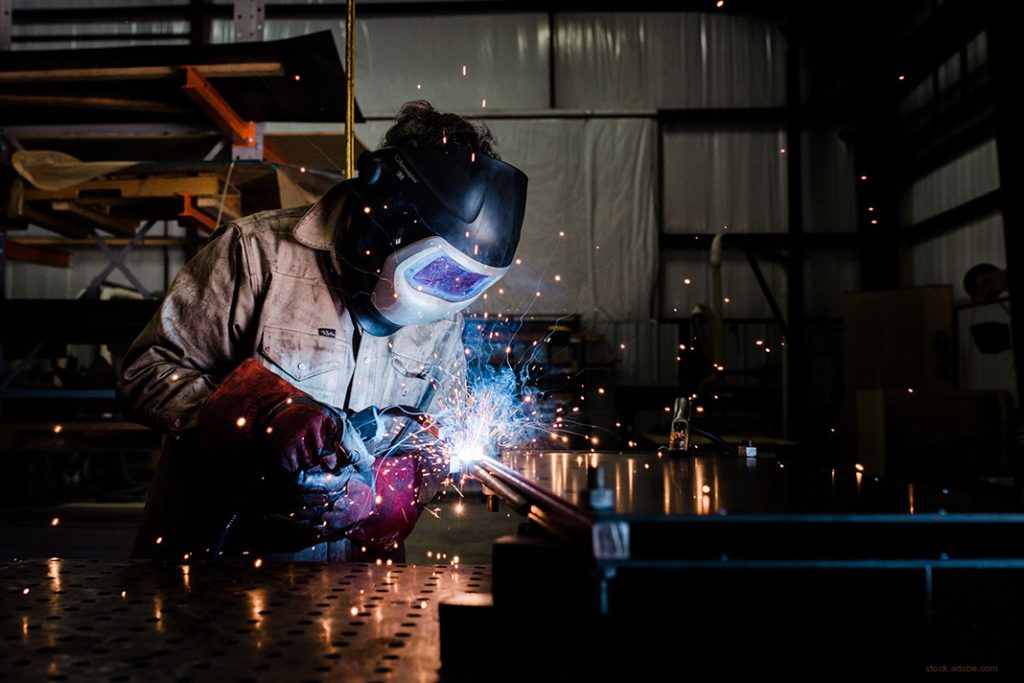
The Caldwell Group Inc. manufactures the spreader beam component of Vita Inclinata Technologies Inc.’s load navigator system.

Rockford, Illinois-based The Caldwell Group Inc. manufactures the spreader beam component of Vita Inclinata Technologies Inc.’s load navigator system.
The propulsion (fan) driven product is a remotely operated, suspended load system that allows crane operation crews to precisely (to one degree) control and orient loads without guylines or being in the critical path of the load. The system dynamically adjusts to load sizes, crane movement, and wind conditions, allowing high-precision lifts even in the most challenging environments.
The load navigator is available in five versions in 20t (7 ft. and 11 ft.) and 40t (7 ft, 11 ft., and 15 ft.) capacities. The complete system weighs 1,650 lbs., 1,900 lbs., 1,800 lbs., 2,100 lbs., and 2,400 lbs. respectively. In each instance, the centerpiece is Caldwell’s Dura-Mod modular spreader beam, a versatile, lightweight alternative to fixed and multiple point below-the-hook solutions.
Dan Mongan, senior sales engineer / project leader at Caldwell, said: “The beams are perfect for integration into such an innovative solution. Each spreader system consists of a pair of end units and drop links, and two upper and lower shackles to make the shortest possible configuration. From there it is a simple case of combining intermediate spreader sections to achieve the required span.”
The load navigator system offers direct user-controlled positioning using a wireless control pendant, and features a position hold function, that keeps the load stable in a pre-set orientation, despite wind or slewing impacts on the load. Broomfield, Colorado-based Vita Inclinata reports a 20-50% increase to productivity, depending upon load parameters.
Derek Sikora, chief technology officer at Vita Inclinata, said: “We’re combining with specialists in their respective manufacturing fields—like Caldwell—to create a safety ecosystem that ultimately results in safer, more productive operation. Companies like DPR construction have identified our solution as a game-changing technology where analog systems have been the solutions of choice for generations.”
He added: “We can point to 300% reduction to crane fatalities and 63.1% reduction to crane-related injuries when utilizing the load navigator.”
Josiah Rausch, crane tech manager at Creative Lifting Services, said: “Using the Vita load navigator meant we did not have to have riggers run through an obstacle course, making it much more efficient and safer for the crew.”
Contact for editorial inquiries: Lisa Sympson, lsympson@caldwellinc.com

Forging the Next 250 Years: Powering the Next Era of American Manufacturing
In this episode of Industry Insights, Ricky Watts, General Manager, Industrial and Robotics Division at Intel Corporation, explains why the Industry 4.0 groundwork manufacturers have been laying for years is now the foundation for AI at scale. He describes how IT and OT systems are finally coming together, and how agentic AI can pull data from the plant floor, the supply chain and the C-suite to find out why a production line is underperforming. Watts also covers why chips have become strategic infrastructure, the rise of physical AI and robotics in harsh industrial settings, and the skills tomorrow’s workforce will need. He finishes with a layered approach to cybersecurity in software-defined plants.
Get In Touch
Google news and SEO compliant, Industry Today’s state-of-the-art digital media platform offers bespoke media campaigns that target key decision makers and buyers to achieve your marketing and promotional goals.

Contribute
Showcase your brand and promote your business to our highly targeted audience. We offer detailed Google Analytics with measurable ROI to assure success. Submit your content for review by our Editorial team who will contact you to discuss the project further.
About Us
Reach Your Targeted Audience and Grow Your Business. Learn more About Industry Today.
Contact Us

© 2026 Industry today. All Rights reserved.