By Brad Whitehead, Managing Director, Site Readiness for Good Jobs Fund
Companies are investing in American manufacturing again. U.S. Census Bureau data shows private manufacturing construction spending reached $219 billion in 2025. But for communities hoping to capture that investment, it is no longer just about whether a city has available industrial land or can offer an attractive incentive package, but rather: can a company actually build and successfully start up operations there, and how quickly?
Manufacturers making large capital investments need certainty around entitlements, utilities, transportation, permitting, environmental conditions and workforce availability. Land may appear inexpensive on its own, yet years of environmental work, title and ownership questions, infrastructure gaps and permitting can quickly add up. Throw into the mix attracting, developing and retaining talent in a far-flung location and even the most promising deal can turn sour.
True site readiness has become a competitive differentiator. The communities best positioned to compete for the next generation of manufacturing investment will be those that do the difficult work long before an employer arrives: assembling land, resolving environmental issues, planning infrastructure, understanding workforce access and building community support. They will not only prepare a site, but establish the conditions for successful startup and growth.
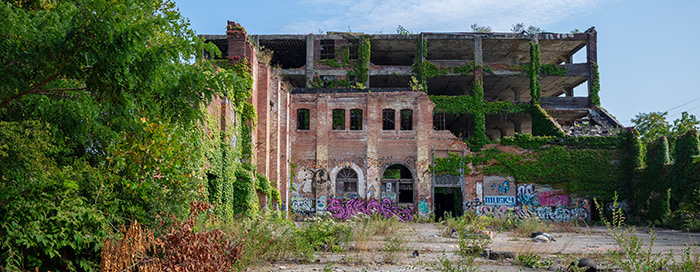
For decades, industrial cities accumulated vacant factories, fragmented parcels and contaminated land as manufacturing moved elsewhere. Often proximate to rail, roads, utilities and established neighborhoods with thousands of potential workers, these spaces look like obvious candidates to lead the nation’s manufacturing resurgence. However, availability is different from readiness.
Legacy sites often require environmental action; resolving complicated ownership and site assembly puzzles, and navigating multi-layered zoning and permitting issues.
But with preparation, urban sites can swing to having advantages over greenfield. It’s obvious that a factory located 30 minutes outside of an urban core will be easier to build. But these sites often face more difficult recruiting processes, lower employee retention and can create compounding cost burdens on employees that will eventually hurt the bottom line.
Deloitte found that nearly half of the manufacturers surveyed reported moderate to significant challenges filling production and operations management roles. The same research identified human capital as one of the areas where manufacturers see the greatest need for improvement.
For manufacturers today, workforce access is part of site readiness.
The traditional economic development process emphasizes the cost of land, tax incentives and the size of a property. Those factors still matter, but they are one part of a bigger picture.
Manufacturers need workers who can get to a facility reliably and affordably. They need access to technical training and education systems, and a regional labor market that can support hiring not only on day one, but as operations expand.
They also need transportation capable of supporting the business. A 2025 NAIOP discussion with corporate real estate leaders underscored this shift. Transportation, infrastructure and labor were identified as primary considerations in site decisions, while incentives were described as an important component but not necessarily the determining factor.
For legacy industrial cities, this changes the value proposition. Places that have spent decades building transportation networks, industrial infrastructure and dense labor markets may possess advantages that are difficult and expensive to replicate elsewhere.
Environmental remediation is typically the most significant unknown cost in industrial real estate redevelopment (along with the time value of money). Costs to remediate a brownfield site can quickly reach eight digits. For manufacturers looking to advance domestic manufacturing initiatives, that level of financial risk is impossible to model.
And as costly and risky as it is, environmental remediation is just one piece of the site readiness puzzle.
This broad scope of “readiness” is what makes the work difficult and why the private market often struggles to do it alone. A developer may be willing to take on one or two risks but taking on all of them simultaneously, before a tenant or buyer has committed, can make the economics difficult to justify. This is precisely why legacy industrial corridors sit blighted despite their prime locations and superior workforce access.
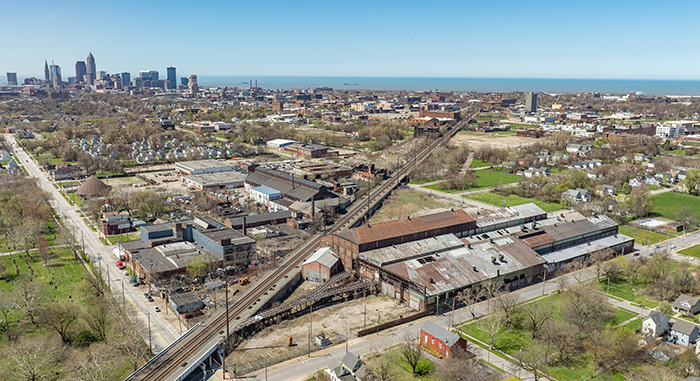
Cleveland is a legacy industrial city with 3,500 acres of vacant or underutilized industrial land, much of it burdened by environmental, ownership and redevelopment challenges. Adjacent to that land, sits a network of rail infrastructure, highways, public transportation, suppliers, institutions and neighborhoods with people left behind by America’s deindustrialization.
Recognizing the obvious site readiness challenges that have stymied any meaningful redevelopment at these sites, in 2023, the city of Cleveland launched the Site Readiness for Good Jobs Fund (SRF) with a $50 million commitment to begin addressing those barriers. It has been supplemented with another $35 million from the philanthropic community. The goal: return 1,000 acres to productive use and help create 25,000 good jobs accessible to Clevelanders. Already, SRF has site control over nearly 400 acres with 100 of them on the market now.
The model is deliberately different from traditional economic development. Instead of waiting for a company to identify a site and then scramble to make it work, SRF works to prepare industrial land in advance. The starting gun for developers isn’t fired until the site is truly ready for construction.
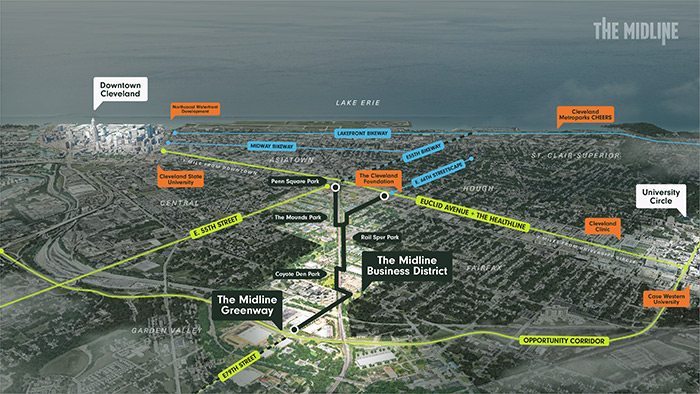
The SRF’s key initiative, dubbed The Midline, is the clearest demonstration of that approach. The 350-acre district on Cleveland’s Near East Side brings together fragmented and underutilized industrial properties along an established transportation corridor. Plans call for at least 1.5 million square feet of industrial and commercial development and more than 2,500 direct jobs, with access to public transportation and a labor pool of roughly 900,000 people within a 30-minute commute.
The biggest significance isn’t the size but that the Midline is being planned as a district rather than a single development parcel. That allows land assembly, infrastructure planning, environmental remediation, workforce connections, transportation and public space to be considered together.
It also changes the conversation with prospective employers. Instead of asking a company to take on the risks of a complicated brownfield redevelopment project, the public and nonprofit partners can address those risks in advance and present a clearer investment proposition. This is what site readiness can accomplish: not eliminating every risk but reducing enough uncertainty that private capital can move forward.
The takeaway here isn’t that the government should become a real estate developer, but that there are stages of development where public, private and philanthropic capital can create value that no individual participant can capture alone.
Government can provide land, infrastructure, policy alignment and public financing. Philanthropy and nonprofit organizations can support planning, drive community engagement, coordinate stakeholders and deliver mission-driven capital that aligns with less traditional development timelines. Private developers and manufacturers will bring their capital stacks and institutional expertise required to operate and grow.
The Cleveland Midline model reflects that division of responsibilities. It’s a model that can be replicated and shows that industrial site readiness is a shared and sequenced economic development function.
While different markets will need their own approaches, the principle is consistent: make it easier for companies to understand what they can build, where they can build and how quickly they can get there.
For communities competing for manufacturing investment, the first step may be to stop asking which companies they want to recruit and start asking whether they have sites those companies can realistically use. That means taking inventory of industrial land – not just acreage – but ownership, environmental conditions, utilities, transportation, zoning, workforce access and development timelines.
It means identifying the sites where public investment can unlock private investment and treating workforce accessibility and neighborhood investment as components of site readiness rather than separate initiatives.
The Midline’s approach recognizes a reality that economic development sometimes overlooks: a manufacturing district exists within a community. Historically, people walked to work in industrial districts like The Midline. These places were not just employment centers but were part of neighborhood life, supporting local restaurants, shops and daily routines while creating connections that extended beyond the workplace.
With that in mind, environmental remediation and infrastructure improvements are being paired with transit access, workforce connections, community engagement and a greenway intended to reconnect surrounding neighborhoods. The success of initiatives like The Midline should not solely be measured by square footage leased or capital invested, but by whether companies can hire and retain workers, residents can access said jobs, environmental conditions improve and whether private investment continues after the initial public investment is deployed.
The communities that win the next generation of investment will not necessarily be those with the cheapest land or the largest incentive package. They will be the ones that have already solved the problems that make development slow, uncertain and expensive. For legacy industrial cities, this new calculus creates a tremendous opportunity.
The land many communities once considered a liability may become an asset – if they are willing to do the work to make it ready. Site readiness is not the final step before manufacturing investment, but it is increasingly the competitive advantage that determines where that investment goes.

About the Author:
Brad Whitehead is the Managing Director of the Site Readiness for Good Jobs Fund, where he leads efforts to prepare Cleveland’s industrial land for new investment and quality jobs. A longtime leader in Cleveland’s economic development community, he previously founded and led the Fund for Our Economic Future, helping launch regional economic-development organizations. Earlier in his career, Brad was a senior partner at McKinsey & Company, advising clients across industries.
Forging the Next 250 Years: Powering the Next Era of American Manufacturing
As manufacturers offer more customization than ever before, managing product complexity has become a critical challenge. Tune in with Dan Joe Barry, Vice President of Product Marketing at Configit, who explores how companies are tackling the growing number of product configurations across engineering, sales, manufacturing, and service. He explains how Configuration Lifecycle Management (CLM) helps organizations maintain a single source of truth for configuration data. The result: fewer errors, faster quoting, and the ability to deliver customized products at scale.
Get In Touch
Google news and SEO compliant, Industry Today’s state-of-the-art digital media platform offers bespoke media campaigns that target key decision makers and buyers to achieve your marketing and promotional goals.

Contribute
Showcase your brand and promote your business to our highly targeted audience. We offer detailed Google Analytics with measurable ROI to assure success. Submit your content for review by our Editorial team who will contact you to discuss the project further.
About Us
Reach Your Targeted Audience and Grow Your Business. Learn more About Industry Today.
Contact Us

© 2026 Industry today. All Rights reserved.