Industrial AI proves its value on the frontline- why dashboards fall short, how digital twins deliver knowledge at the asset, and how to evaluate it.
By Omer Shamay, CEO, Treedis
Most industrial AI is built for people who already have screens, analysts, planners, and control-room staff. The technicians who execute maintenance, operate equipment, and carry decades of undocumented know-how rarely see any of it. Until AI reaches those workers in the field, on the asset, and in context, its impact stays trapped in reports. The frontline is where industrial AI either earns its keep or quietly fails.
“Industrial AI does not prove itself in a boardroom demo. It proves itself when a technician standing at a failed asset finds the answer faster than the veteran who retired last year.”
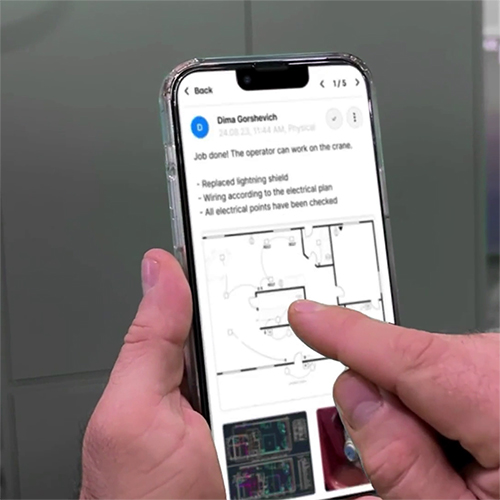
The pattern behind failed industrial AI projects is consistent: intelligence is added at the top of the organization while the work happens at the bottom. Data flows up into models and dashboards; very little insight flows back down to the person holding the tools.
Reversing that flow requires meeting three conditions. First, information must be delivered at the point of work, on a phone, tablet, or headset, not at a desk. Second, it must be spatially anchored, so the system knows which asset the worker is facing and filters accordingly. Third, the system must capture knowledge as a byproduct of work: when an experienced technician records a workaround, it should become a guided procedure the next shift can follow.
This is why the digital twin matters as an interface rather than a visualization. A 3D replica that mirrors the as-built facility gives AI a shared frame of reference with the worker. The same twin serves the control room remotely and the technician on site through augmented reality, so both are looking at the same source of truth. This bridges the gap between virtual training and actual implementation at the workplace.
At the Port of Ashdod, one of Israel’s primary cargo gateways, crane maintenance knowledge was scattered across legacy systems, paper manuals, and the memories of veteran employees nearing retirement. “When someone isn’t available, troubleshooting stalls,” says Elad Yosefi, the port’s Head of Crane and Machinery Maintenance. “Every minute a crane is down disrupts the flow and costs the port and our customers significant revenue.”
The port digitized its cranes as digital twins, linking documentation, P&IDs, and live IoT feeds to the components they describe. Technicians can now question the facility conversationally, asking what a fault code means or how a subsystem behaves, and get answers grounded in the port’s own manuals, with the source attached. The pilot cut troubleshooting time by 84% for newer technicians and 50% for veterans, and the program has since expanded to additional cranes as an operational standard.
Mekorot, Israel’s national water company, has deployed the same class of technology across operations, maintenance, engineering, and safety, with employees viewing real-time data overlays on physical infrastructure through tablets and headsets. Gil Groskopf- the company’s Vice President of Technology said, “The system connects our employees to critical real-time data, streamlines workflows, and enhances our operational, maintenance, and safety capabilities.”
Granite Construction, a major U.S. heavy-civil contractor, took the same idea into training. Preparing to onboard 300 engineers, and having found that slide decks could not convey the hazards of a live asphalt site, the company built gamified inductions inside a digital twin of its plant and embedded an AI tutor trained on its own management-system knowledge. The assistant acts as a guide, answering trainees’ questions in context as they move through the virtual site.
Whatever platform an operator considers, these five questions separate deployable systems from demos:
Why is this an essential factor? Two curves are crossing: an accelerating retirement wave in industrial workforces and the maturing of spatial computing and AI. The knowledge gap is widening at exactly the moment the tools to close it have become practical to deploy.
How should companies approach? Start with one high-cost knowledge bottleneck, a critical asset or line where troubleshooting depends on a few individuals, and run a measured pilot with clear field metrics before scaling.
Which industries are affected? Any operation where experienced workers maintain complex physical assets: manufacturing, ports and logistics, utilities, Oil & Gas energy, construction, and heavy infrastructure.
Industrial AI has spent years proving what it can predict. The next test is whether it can change what happens at the asset, in the hands of the people doing the work. Operators that judge AI by frontline outcomes, and insist on them, will capture the value everyone else is still forecasting.
About the Author:
Omer Shamay is the CEO of Treedis, a digital twin and Physical AI platform used by industrial operators including the Port of Ashdod, Mekorot, and Granite Construction to connect frontline workers with the knowledge locked in their facilities.
Read more from the author:
Partner Spotlight: How Treedis Powers the Connected Worker with a Spatially Aware Digital Twin on AWS | AWS Physical AI Blog, 13 Oct 2025
The 7 Industry 4.0 Technologies Revolutionizing Frontline Work in Manufacturing | Treedis Blog, 24 Aug 2024)

Forging the Next 250 Years: Powering the Next Era of American Manufacturing
As manufacturers offer more customization than ever before, managing product complexity has become a critical challenge. Tune in with Dan Joe Barry, Vice President of Product Marketing at Configit, who explores how companies are tackling the growing number of product configurations across engineering, sales, manufacturing, and service. He explains how Configuration Lifecycle Management (CLM) helps organizations maintain a single source of truth for configuration data. The result: fewer errors, faster quoting, and the ability to deliver customized products at scale.
Get In Touch
Google news and SEO compliant, Industry Today’s state-of-the-art digital media platform offers bespoke media campaigns that target key decision makers and buyers to achieve your marketing and promotional goals.

Contribute
Showcase your brand and promote your business to our highly targeted audience. We offer detailed Google Analytics with measurable ROI to assure success. Submit your content for review by our Editorial team who will contact you to discuss the project further.
About Us
Reach Your Targeted Audience and Grow Your Business. Learn more About Industry Today.
Contact Us

© 2026 Industry today. All Rights reserved.