57% of U.S. risk executives say turning down an opportunity feels safer than building the case for it. That’s leaving growth on the table.
By Christina Montes de Oca, CEO, Coface North America
Since liberation day, tariffs have been rewriting the math of American manufacturing. Inputs cost more, margins are thinner, and there is less ability to pass costs downstream. For many manufacturers, the growth that used to come from selling more into familiar markets now has to come from somewhere new. This might look like using a new distributor in Poland, selling to a new buyer in Vietnam, or expanding into an entirely new customer segment.
But when it comes to taking a risk on the new growth opportunities that could help a manufacturer’s bottom line, most finance and risk leaders default to no. According to a recent Coface survey, when U.S. leaders weigh a new market, only 17% begin by looking for a way in. Nearly twice as many, 31%, begin with what could go wrong. And 57% of U.S. finance and risk executives admit that turning an opportunity down feels safer than building the case for it.
New market opportunities haven’t closed for manufacturers. It’s just that a lot of companies are writing off opportunities before they even consider the possibility, and that is ultimately hurting growth.
It’s understandable why working with a new customer in a new market isn’t a straightforward decision for leadership. It involves shipping product to a buyer you have never worked with, on new payment terms, governed by unfamiliar law, in a country where checking who pays their bills is not straightforward. Every instinct says the potential risk of nonpayment isn’t worth the effort.
In fact, just 33% of U.S. executives say they are comfortable moving forward without a complete view of the risks. That sounds prudent until you notice that a first order from a new market never comes with a complete view of the risks. As a result, the deal is often rejected because no one wanted to sign off on the uncertainty.
That instinct is understandable, but there’s a cost to standing still too. Tariffs change every few months, trade agreements get renegotiated, and shipping routes shift with them. A manufacturer selling into only one or two markets feels each of those changes at once. Diversifying into new markets and customers spreads that exposure out. When one route or region gets disrupted, a company with relationships already established elsewhere has more options for sustaining sales and adapting its growth strategy.

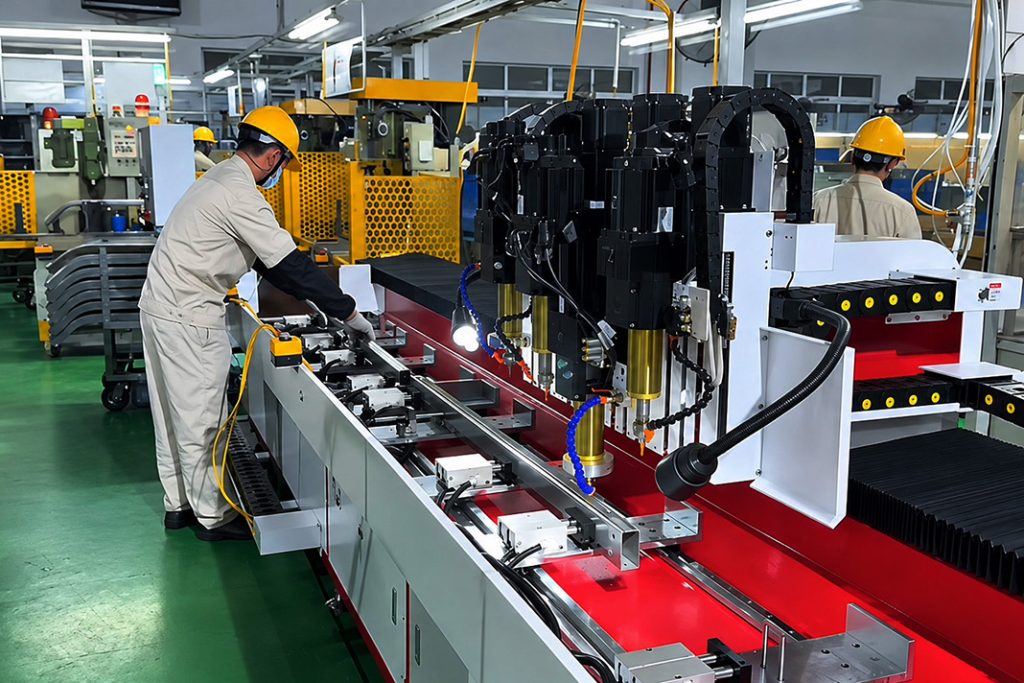
Gorodenkoff/Shutterstock.com
Many manufacturers understand they need to take risks to drive growth, and are betting technology will close that confidence gap. In the survey, 80% of leaders named AI-driven insights and early warning signals a top priority. AI can scan more markets and more buyers than any team could manually, and that’s value, but it only works if the data underneath it does too.
Only 31% of executives say data quality is consistent enough across markets to compare opportunities and take action. Most manufacturers are mostly running these tools on their own internal records, past shipments, some trade references, whatever sales data the team plugged in, which have limited visibility. That dataset is thinnest where the growth is, because a market the company hasn’t sold into yet has no internal history to draw on. For example, if a manufacturer has never sold into Southeast Asia, its internal records have nothing to say about buyers there, so the model is essentially running on a blank.
Asking a model to assess an unfamiliar market from a company’s own limited records amounts to asking it to guess. The data that would actually help, verified payment behavior and financial standing across thousands of buyers, usually doesn’t live in a single company’s own books. It comes from risk intelligence firms that track it across borders. Give AI good outside data and a senior leader accountable for the call, and it can make that decision faster. But turning that scan into a decision still takes someone who knows the business well enough to judge when the model’s confidence is actually warranted. It can’t replace either one.
Most companies decide whether to enter a market by judging the whole country, and walk away if that country looks risky. While country risk remains an important part of the decision, it’s not a substitute for evaluating an individual buyer. Risk doesn’t work that way. Every risky country still has buyers who pay reliably, and every safe country has buyers who don’t. Consider a hypothetical manufacturer who has avoided Brazil for years over country-risk concerns might find a Sao Paulo-based distributor with a decade of clean payment history and stronger financials than buyers it already ships to in Western Europe.
In practice, that means examining a specific buyer’s payment history, financial statements and industry standing, not just the risk rating assigned to the country where it operates. A manufacturer that takes this view may find the buyer in a market it’s avoided for years pays every invoice on time, exactly the customer a country rating would have screened out.
Even a well-vetted buyer might still not pay, and that’s where trade credit insurance comes in. It covers the invoice if the buyer defaults, so the manufacturer isn’t betting the whole order on trust. That’s a much easier decision for a finance team to sign off on than a bet with no backup plan.
This kind of coverage also helps separate two questions that usually get lumped together, whether a market is worth entering, and whether a specific buyer will actually pay. Most companies answer both at once with a single yes or no, and that’s a big reason growth stalls before it starts.
Risk management works best when it’s in the room from the start, helping decide which opportunities are worth chasing in the first place. The growth that manufacturers are leaving on the table is sitting in markets and with buyers nobody took the time to look at closely. The companies willing to look, buyer by buyer, are the ones who will find it.

About the Author:
Christina Montes de Oca is CEO of Coface North America, leading the company’s trade credit insurance and risk management operations across the U.S., Canada, and Mexico. She brings more than two decades of experience in the trade credit industry.

Forging the Next 250 Years: Powering the Next Era of American Manufacturing
As manufacturers offer more customization than ever before, managing product complexity has become a critical challenge. Tune in with Dan Joe Barry, Vice President of Product Marketing at Configit, who explores how companies are tackling the growing number of product configurations across engineering, sales, manufacturing, and service. He explains how Configuration Lifecycle Management (CLM) helps organizations maintain a single source of truth for configuration data. The result: fewer errors, faster quoting, and the ability to deliver customized products at scale.
Get In Touch
Google news and SEO compliant, Industry Today’s state-of-the-art digital media platform offers bespoke media campaigns that target key decision makers and buyers to achieve your marketing and promotional goals.

Contribute
Showcase your brand and promote your business to our highly targeted audience. We offer detailed Google Analytics with measurable ROI to assure success. Submit your content for review by our Editorial team who will contact you to discuss the project further.
About Us
Reach Your Targeted Audience and Grow Your Business. Learn more About Industry Today.
Contact Us

© 2026 Industry today. All Rights reserved.