How AI and high-fidelity virtual prototyping extend shift-left engineering into thermal, electromagnetic, and structural design.
By Tom De Muer, Fellow at Keysight Technologies
Moving testing and validation earlier in the development process has been a long-standing goal, and simulation has steadily improved toward that end with the exception of one critical area: cross-domain validation. These complex interactions, spanning thermal, electromagnetic (EM), and structural elements, have historically been too difficult to model with sufficient fidelity. Because pre-build simulations of these cases could not be trusted, cross-domain decisions necessitated physical testing even as shift-left advanced elsewhere. This is changing as AI and high-fidelity virtual simulation are making early-stage decisions trustworthy in the multiphysics, cross-domain environments where shift-left has historically broken down.
In today’s tightly integrated, densely packed electronic systems, changes to thermal, EM, or mechanical elements in one layer can negatively impact performance and reliability in another, often in ways that are hard to predict. The industry has long recognized the need to test these interactions earlier, but a decision is only as good as the information behind it. Because early-stage data was not trustworthy enough, shift-left initiatives faltered in complex, multiphysics cases.
Recent advances in virtual prototyping are starting to revolutionize shift-left by making earlier validation much more accurate and scalable. Central to this approach is the use of digital twins and simulation-led methodologies to model and validate multiphysics interactions in a virtual environment.
This enables engineers to move beyond siloed approaches and assess system-level performance holistically, rather than optimizing individual domains in isolation or waiting until after the initial physical build. As a result, decisions that have traditionally been deferred due to cost, time, or resource constraints can instead be made much earlier during development, when flexibility is highest, the cost of change is lowest, and the potential impact on the final design is greatest. This integrated approach leads to more informed design choices, fewer late-stage surprises, and improved overall performance at a significantly reduced cost.
As more design validation and iteration occur in the virtual domain, the economics of innovation fundamentally shift, reducing the need for expensive build-and-break cycles. Particularly for complex, high-cost systems where physical prototyping is expensive or impractical, virtual prototyping is the logical choice. For example, the automotive sector is reaping efficiency and bottom-line benefits by virtually validating autonomous driving, industrial manufacturers optimize assembly and tooling workflows through digital twins. In the semiconductor industry, designers can virtually validate performance, power delivery, thermal behavior, and mechanical reliability before tape-out and avoid costly silicon respins.

Innovations in AI and machine learning (ML) are further extending shift-left. By enabling faster analysis of large datasets and more efficient simulation of complex multiphysics systems, the technologies allow engineers to identify risks, constraints, and optimization opportunities earlier in the development cycle. AI and ML models can also detect patterns and anomalies that might suggest downstream performance or reliability issues before they are visible through traditional simulation or testing, providing an early warning during design.
Specific areas in which AI is transforming shift-left include:
Agentic AI can overhaul simulation workflows, automating model configuration, parameter sweeps, and result interpretation. They can also dynamically adapt as outcomes change, improving coverage without manual intervention. This reduces engineering effort and also supports more comprehensive exploration of complex scenarios. ML-based surrogate models can also be used to simulate behavior at a fraction of the computational cost, while maintaining acceptable fidelity, whether as fast replacements for high-fidelity simulation to screen out less promising design areas, or as offline-built models that shift the computational cost earlier so results are available in real time when it counts. Both uses shorten simulation cycles.
AI’s adaptive algorithms are also advancing optimization. With approaches like reinforcement learning, the process becomes learning-driven with the system incrementally improving based on previous iterations. This can be further accelerated by bootstrapping from pre-trained models or prior knowledge, reducing the need to start from scratch. This is often achieved through the model learning to navigate the design space more efficiently based on experience with similar problems, resulting in faster convergence in new but related scenarios.
Historically, optimization has been largely human-driven, with engineers manually evaluating trade-offs and guiding each step of the process. AI is shifting this approach to a “human-on-the-loop” model, where engineers increasingly specify intent, the what, rather than procedure, the how, and supervise AI-driven workflows rather than directly controlling every decision. Domain expertise is still critical but is increasingly embedded into AI systems through training data and feedback mechanisms. This allows AI to assume additional autonomous decision-making, freeing engineers to focus on more strategic tasks.
Design exploration has traditionally combined mathematical optimization techniques with human intuition to navigate complex design spaces. However, encoding expert knowledge into these formal models is often difficult and requires specialized skills, which limits how much intuition can be used at scale. AI lowers this barrier, providing new ways to incorporate domain insights without requiring explicit mathematical formalization. As a result, AI agents can autonomously explore design spaces more effectively and evaluate a broader set of alternatives before a human engineer re-engages for final validation and decision-making.
As shift-left accelerates, traditional reliance on physical prototypes gives way to more virtual design loops. It’s important to recognize that the progression is not automatic but rather relies on underlying model accuracy and the availability of scalable compute.
Another key change is the evolution from sequential engineering to concurrent workflows. With AI, disciplines spanning RF, hardware, software, and system validation can operate in parallel against a shared, dynamically updated design context. For example, a package engineer can evaluate thermal impact while an RF colleague simultaneously validates signal integrity against the same evolving design, before a physical prototype is built.
Shift-left also means that engineers can consider manufacturability, system integration, and other downstream concerns earlier. Multiphysics interactions and interoperability challenges can now be modeled and root-caused before a design is finalized, rather than discovered during late-stage testing.
The structural payoff is significant. Shift-left’s future lies in how early in the process trustworthy decisions become possible. AI is driving this evolution by increasing both the fidelity and interpretability of virtual prototyping outputs for cross-domain interactions.
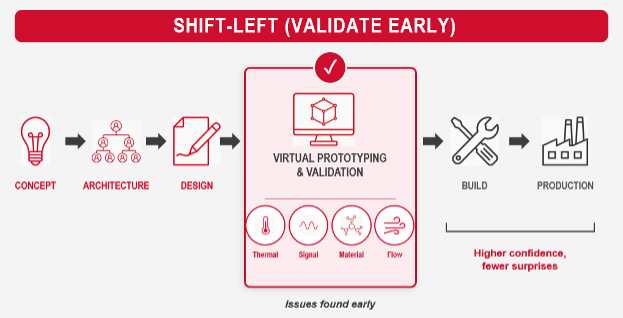
AI and virtual prototyping are overcoming legacy upstream trust concerns. The most complex multiphysics cases, once considered shift-left’s frontier, can now be validated at early design stages. This growing trust extends to the agents themselves. Generic AI progress alone is not sufficient, as it lacks the context needed to act reliably and repeatably within an engineering workflow. It is the emergence of domain-specific agentic AI, purpose-built with that context, that makes it possible to extend real autonomy to these agents with confidence. As this transformation continues, leading companies will be distinguished not by who can simulate faster, but by who can decide sooner, with confidence, at full system complexity.

About the Author:
Tom De Muer, PhD, is a Fellow at Keysight Technologies, where he helps shape the future of AI-driven engineering, simulation, and virtual prototyping. With two decades of experience in electronic design automation (EDA), electromagnetic simulation, and engineering software, he has been instrumental in advancing technologies that enable engineers to design, validate, and optimize increasingly complex products in the virtual domain.
Tom’s work focuses on the convergence of multiphysics simulation, digital engineering, and artificial intelligence, helping organizations accelerate innovation, improve product quality, and bring solutions to market faster. He is a recognized thought leader in simulation-driven design and frequently engages with customers, industry partners, and engineering teams on emerging trends in AI, virtual prototyping, and next-generation product development.

Forging the Next 250 Years: Powering the Next Era of American Manufacturing
As manufacturers offer more customization than ever before, managing product complexity has become a critical challenge. Tune in with Dan Joe Barry, Vice President of Product Marketing at Configit, who explores how companies are tackling the growing number of product configurations across engineering, sales, manufacturing, and service. He explains how Configuration Lifecycle Management (CLM) helps organizations maintain a single source of truth for configuration data. The result: fewer errors, faster quoting, and the ability to deliver customized products at scale.
Get In Touch
Google news and SEO compliant, Industry Today’s state-of-the-art digital media platform offers bespoke media campaigns that target key decision makers and buyers to achieve your marketing and promotional goals.

Contribute
Showcase your brand and promote your business to our highly targeted audience. We offer detailed Google Analytics with measurable ROI to assure success. Submit your content for review by our Editorial team who will contact you to discuss the project further.
About Us
Reach Your Targeted Audience and Grow Your Business. Learn more About Industry Today.
Contact Us

© 2026 Industry today. All Rights reserved.