Volume 29 | Issue 1
By Spencer Pederson, Senior Vice President of Public Affairs at the National Electrical Manufacturers Association (NEMA).
Click here to read the complete illustrated article or continue below to read the text article.
The numbers are hard to argue with. The National Electrical Manufacturers Association (NEMA) anticipates that U.S. electricity demand will increase as much as 55% by 2050 thanks to the advent of AI data centers, an acceleration of advanced manufacturing, reshoring, electrification – and economic growth. Underneath all of it sits a grid not only built for a different era, but one whose fleets of critical electrical equipment are rapidly approaching the end of their planned lifecycles, being taken offline by natural disasters, and otherwise being pushed to their functional limits.
This is the central challenge of the American electroindustry in 2026: meeting a demand surge of historic proportions while supply chains, permitting processes, and workforces are increasingly insufficient. At NEMA, an organization representing more than 300 manufacturers of electrical equipment that powers, lights, and connects our modern world, we are engaged in every dimension of this challenge. We are advocating for federal legislation to strengthen U.S. manufacturing, accelerate infrastructure deployment, and power the next era of American energy dominance and economic growth. And through our industry-leading, federally- recognized Make It American™ certification program, we are proving that American industry is ready to rise to the occasion and build the infrastructure for the future.
At the root of this power demand surge is the rapidly developing data center and AI-driven economy, whose energy consumption NEMA anticipates will increase by as much as 300% over the next 10 years. To meet this challenge, industry leaders expect electric generation, transmission, and distribution providers will need to invest eye-watering sums in the coming years.
But investment commitments alone don’t generate or move electrons. The physical hardware needed to expand and upgrade the grid is in increasingly high demand. In fact, lead times for distribution and large power transformers and switchgear have extended to as long as two years in some cases.
To address this, electrical manufacturers have invested nearly $200 billion in domestic production capacity since 2018, and reduced dependence on Chinese-sourced materials by more than 32% over that same period. That represents approximately half of recent manufacturing sector growth, as well as a genuine commitment to building the domestic supply chain this moment demands.
But investment takes time to come online. And the nation cannot afford to wait. That is why NEMA is making its case in Washington.
A major obstacle to grid expansion is not a lack of investment interest or intent. It is the time it takes to site, permit, and build new power generation and delivery infrastructure. Wait times for interconnection to the high-voltage transmission system are measured not in weeks or months – but years. Meanwhile, as much as 2,300 gigawatts of power generation and storage capacity are sitting in interconnection queues, which has the added effect of disrupting project development and energization timelines for AI data centers and other economy-driving infrastructure.
NEMA is actively supporting a bipartisan solution. In March 2026, U.S. Senators Dave McCormick (R-PA) and Peter Welch (D-VT) introduced the Reconductoring Existing Wires for Infrastructure Reliability and Expansion (REWIRE) Act – which NEMA endorsed immediately.
The legislation takes a practical approach. In addition to streamlining the infrastructure permitting process, it focuses on maximizing the capacity of infrastructure already deployed with grid-enhancing technologies (GETs). This is a targeted, commonsense policy change that can add meaningful capacity in the near term while longer-term infrastructure comes online, aligning with the slate of recommendations that NEMA and allied organizations have recently proposed to Congress and the Trump Administration.
The current tariff landscape presents a dilemma. America’s electrical manufacturers support the Trump Administration’s goal of strengthening American manufacturing through reshoring supply chains. But some of the electrical equipment and materials the grid needs most urgently simply cannot be manufactured domestically at the volumes the market demands today. Imposing tariffs on critical equipment for the grid, for data centers, and for advanced manufacturing facilities without an earned relief mechanism doesn’t protect American manufacturing so much as it slows the construction of economy-driving infrastructure.
As a result, NEMA has developed a Tariff Incentive Proposal, backed by a coalition of manufacturing, energy, and infrastructure associations, that provides a practical framework for leveraging tariffs toward accelerated domestic manufacturing. The proposal calls for targeted, time-limited tariff offset incentives on critical electrical equipment and materials not yet available in sufficient domestic supply. Critically, these incentives would be earned – tied to verified domestic investment commitments and production practices. Manufacturers who invest in building domestic capacity would be eligible for relief on the inputs needed to bridge the supply gap in the interim.
The stakes are substantial. Every month of delay in substation construction, transformer delivery, or transmission line deployment translates directly into slower data center builds, deferred manufacturing reshoring, and greater grid reliability and resilience risks.
Even the best-designed legislation and most generous incentives will fail if the industry cannot find the workers it needs to active potential. For perspective, NEMA estimates that the total transformer workforce is approximately 30,700, with a present-day shortage of approximately 13,400 workers, assuming no binding constraints from materials, equipment, or capital investment. To translate, that comes out to a labor shortfall of roughly 30%.
That isn’t sustainable. It demands new pathways into the industry.
One of the most promising pathways runs through America’s veteran community. More than 200,000 service members transition out of military service each year, bringing with them technical training, operational discipline, and a mission orientation that, in many cases, maps directly onto the needs of grid modernization and electrical manufacturing.
NEMA has been advocating alongside a host of other industry associations and veteran community organizations to bring the bipartisan Veterans Energy Transition (VET) Act to fruition. Introduced by Representatives Jen Kiggans (R-VA) and Chrissy Houlahan (D-PA), the bill makes it easier for electroindustry employers to hire and train transitioning U.S. service members, existing veterans, and military spouses in civilian energy and advanced manufacturing sector roles.
Today, the electroindustry directly employs more than 580,000 people, generating nearly $200 billion in labor income across the country. Ensuring those numbers grow is central to our mission.
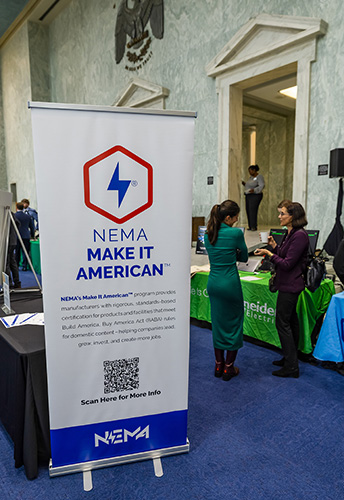
Federal action matters enormously, and NEMA will continue fighting for it. But the electroindustry is not standing by while the policy process unfolds. NEMA’s Make It American™ certification program is the most visible demonstration that American manufacturers are building the future domestic supply chain.
The program was created to help manufacturers of electrical equipment and other products not only navigate the Build America, Buy America (BABA) Act domestic content requirements embedded in the 2021 Bipartisan Infrastructure Law, but help consumers of products subject to these requirements more easily identify BABA-aligned goods in the marketplace.
The program’s credibility received significant validation in October 2025 when the U.S. Federal Highway Administration (FHWA) officially listed Make It American as a recognized industry resource for manufacturers, contractors, and state departments of transportation seeking to meet domestic preference requirements. That recognition reflects the rigor of the program’s methodology and its real-world utility for the procurement ecosystem.
It equips manufacturers with a deeper, structured understanding of BABA’s requirements and a documented framework for evaluating their own supply chains — replacing uncertainty with an auditable, repeatable process.
For contractors and government purchasers, that certainly has real value.
NEMA celebrates 100 years of industry leadership in 2026. Over that century, our members have helped electrify the nation, rebuild the grid after disasters, and power the technologies that have defined each era of economic growth. What faces the industry today is definitive.
The convergence of AI infrastructure demand, manufacturing reshoring, and electrification is already showing up in load forecasts, interconnection queues, and equipment order books. The question is not whether the grid will need to grow dramatically – it is whether America’s electrical manufacturers, policymakers, and workers will capture that opportunity or cede it.
What we’re asking of policymakers is simpler: remove the barriers, align the incentives, and trust that American manufacturers will do what they have always done.
We will build what the country needs.

About the Author
Spencer Pederson is the Senior Vice President of Public Affairs at the National Electrical Manufacturers Association (NEMA).
About NEMA
The National Electrical Manufacturers Association (NEMA) represents over 300 electrical equipment manufacturers that make safe, reliable, and efficient products and technologies that power, connect, and light our world. Together, our members contribute a full 1% of U.S. GDP and directly provide over 580,000 American jobs, adding more than $330 billion to the U.S. economy. Learn more at makeitelectric.org.

Forging the Next 250 Years: Powering the Next Era of American Manufacturing
As manufacturers offer more customization than ever before, managing product complexity has become a critical challenge. Tune in with Dan Joe Barry, Vice President of Product Marketing at Configit, who explores how companies are tackling the growing number of product configurations across engineering, sales, manufacturing, and service. He explains how Configuration Lifecycle Management (CLM) helps organizations maintain a single source of truth for configuration data. The result: fewer errors, faster quoting, and the ability to deliver customized products at scale.
Get In Touch
Google news and SEO compliant, Industry Today’s state-of-the-art digital media platform offers bespoke media campaigns that target key decision makers and buyers to achieve your marketing and promotional goals.

Contribute
Showcase your brand and promote your business to our highly targeted audience. We offer detailed Google Analytics with measurable ROI to assure success. Submit your content for review by our Editorial team who will contact you to discuss the project further.
About Us
Reach Your Targeted Audience and Grow Your Business. Learn more About Industry Today.
Contact Us

© 2026 Industry today. All Rights reserved.