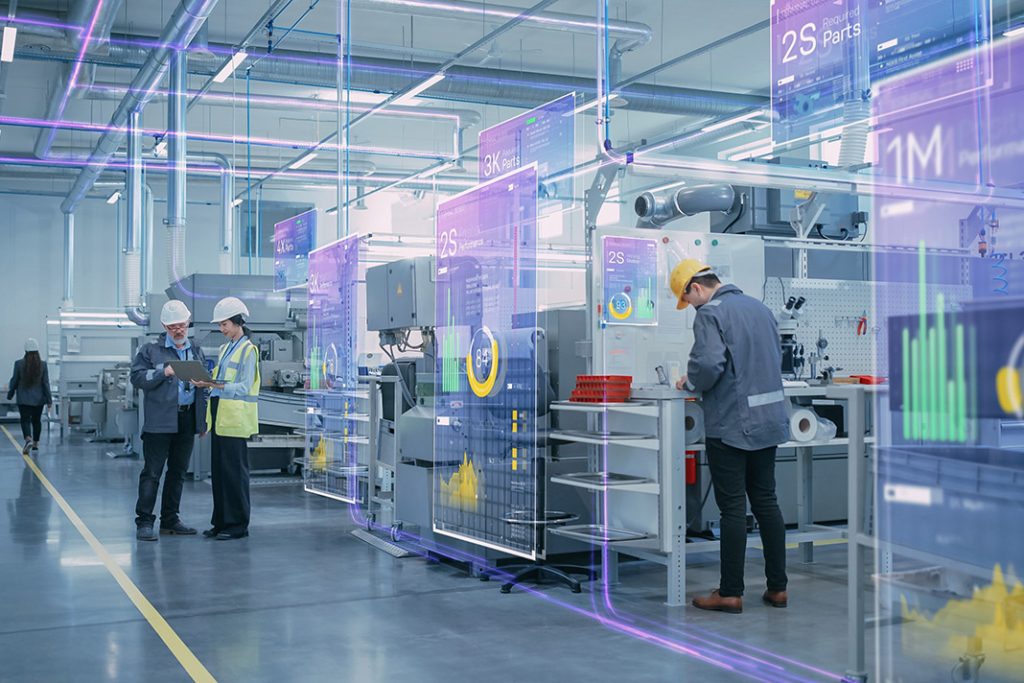
Engineering AI is redefining product development by enabling teams to explore three times more design variants than conventional workflows.
By Jon Wilde, Vice President of Product
One year ago, engineering AI was more promise than reality. In a 2025 survey of senior engineering leaders, nearly one-third anticipated very high gains from AI, but only 3% actually reported achieving them.
Today, the landscape is changing rapidly as engineering AI enters a new phase. AI-enabled workflows are redefining how organizations, especially those in manufacturing and engineering spaces, are approaching nearly every facet of design and product development. As those workflows continue to mature, organizations are beginning to see measurable results.
AI is unlocking benefits ranging from faster engineering response times to deeper design exploration. A recent global survey of senior engineering leaders by simulation platform SimScale found that organizations using AI-enabled workflows evaluated more than three times as many design variants per program as those relying on conventional processes. That is not a marginal efficiency gain. It represents a fundamentally different approach to product development, one where teams can test more ideas, catch problems earlier, and arrive at better designs within the same development window.
The strategic urgency is not lost on engineering leaders. Every respondent in the SimScale survey rated AI as important for their engineering teams, with more than a third calling it extremely important. The question is no longer whether to adopt AI, but how quickly can organizations move from siloed experimentation to broad operational execution.
This points to an overarching truth that no engineering team, regardless of industry, can ignore. The speed created by AI-enabled workflows is about much more than efficiency. It is quickly becoming a competitive differentiator in the marketplace.
Let’s take a closer look at how engineering AI is ushering in new value and redefining industries.
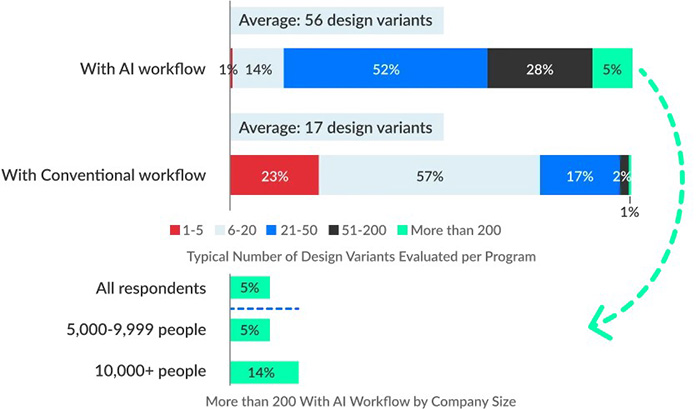
Testing more designs doesn’t just deliver efficiency gains. Exploring more designs significantly changes how engineering teams think about product development entirely. When simulation is fast enough to keep pace with design, teams are no longer forced to commit early to a single direction. They can explore a broader range of possibilities, pressure-test more assumptions, and arrive at more optimized outcomes before anything gets built.
The numbers reflect this shift. AI-enabled workflows are reducing simulation turnaround times from an average of 17 hours down to as little as six, nearly three times faster than conventional methods, while enabling engineers to iterate far more frequently. That recovered time is not going into schedule compression. It is going back into the design process itself, earlier insights, more options explored, and better decisions made before capital is committed.
The importance of embracing AI-native simulations tools can’t be overstated. For example, A manufacturer specializing in metal casting used AI-enabled simulation to optimize mold performance earlier in development, identifying design improvements that traditional workflows would have caught much later in the process, at significantly higher cost.
So, what should organizations take away from these AI-powered accelerations? Speed matters, and the productivity gains are real. The deeper value of integrating AI into design and simulation workflows is what that speed unlocks. Teams can explore more variations earlier, take on higher-risk options more freely, and treat simulation as an active input to design rather than a final check before production.
To this point, we have focused heavily on the simulation and design implications of AI-enabled workflows. Those gains, though, do not exist in isolation. SimScale’s survey shows a clear link between moving faster, exploring more designs, and becoming more competitive in the market. In fact, 95% of simulation requests handled with AI-enabled workflows are resolved in less than half a day, and organizations using those workflows are achieving up to three times faster RFQ and technical bid turnaround times compared to conventional processes.
For manufacturing and engineering organizations, this creates immediate commercial impact. Faster response times allow teams to pursue more opportunities while improving the quality of each submission.
Velocity, in other words, is not just an operational metric. Organizations that can move faster, respond more effectively, and deliver stronger solutions within the same window are better positioned to win. And as a result, the gap between those organizations and their competitors is widening.
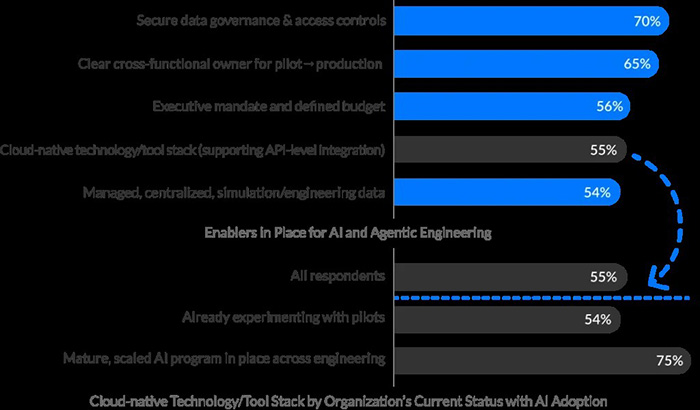
The benefits of AI in engineering workflows are becoming measurable. But realizing them at scale requires more than good intentions. SimScale’s research found that 75% of organizations with mature AI programs cited cloud-native infrastructure as a key enabler, alongside secure data governance (70%) and clear ownership for moving pilots into production (65%). Yet only 9% of organizations say they have a mature, scaled AI program in place, while 80% remain in pilot and experimentation stages.
For many organizations, the perceived barrier is data. Seventy-four percent of respondents cited data preparation and availability as a primary obstacle. That concern is real, but the data tells a more nuanced story. Organizations with mature AI programs were nearly 50% less likely to cite data as a significant blocker. Data matters, but it is not what is holding most programs back.
What separates organizations that scale successfully from those stuck in pilots is infrastructure readiness and organizational alignment, not perfect data.
The industry is moving from experimentation to execution. The next phase will carry that momentum across entire enterprises, but only if organizations build the right foundation now. Cloud-native infrastructure, secure data governance, and clear ownership for moving pilots into production are not just enablers. These are what determine whether an AI program matures into a competitive advantage or stays permanently in pilot mode.

About the Author:
Jon Wilde is VP of Product Management at SimScale, where he connects customer insight with product and AI-driven innovation. With a background in mechanical engineering and fluid mechanics, Jon began his career at Thales Aerospace before moving into simulation software with Blue Ridge Numerics and Autodesk. Over the past decade, he has scaled advanced simulation technologies across industries.
At SimScale, Jon works at the intersection of AI, cloud engineering, and customer strategy—leveraging data from millions of simulations to shape product direction and drive measurable customer impact.
Forging the Next 250 Years: Powering the Next Era of American Manufacturing
As manufacturers offer more customization than ever before, managing product complexity has become a critical challenge. Tune in with Dan Joe Barry, Vice President of Product Marketing at Configit, who explores how companies are tackling the growing number of product configurations across engineering, sales, manufacturing, and service. He explains how Configuration Lifecycle Management (CLM) helps organizations maintain a single source of truth for configuration data. The result: fewer errors, faster quoting, and the ability to deliver customized products at scale.
Get In Touch
Google news and SEO compliant, Industry Today’s state-of-the-art digital media platform offers bespoke media campaigns that target key decision makers and buyers to achieve your marketing and promotional goals.

Contribute
Showcase your brand and promote your business to our highly targeted audience. We offer detailed Google Analytics with measurable ROI to assure success. Submit your content for review by our Editorial team who will contact you to discuss the project further.
About Us
Reach Your Targeted Audience and Grow Your Business. Learn more About Industry Today.
Contact Us

© 2026 Industry today. All Rights reserved.