As AI digitizes expert knowledge on the factory floor, manufacturers must redefine their human capital strategy around the Software-Defined Technician.
By Dijam Panigrahi, Co-founder & COO, GridRaster
The manufacturing industry spent the last year racing to capture the knowledge of retiring experts. Now a more urgent question has arrived: once that knowledge is digitized, what exactly do the remaining specialists do? The answer is not less work. It is fundamentally different work, centered on orchestrating AI rather than performing manual observation. The workers who master this transition will define competitive advantage in industrial operations for the next decade.
“The manufacturers who win the next decade will not be those with the most advanced AI. They will be those who most clearly define what their people do now that AI exists.”
— Dijam Panigrahi, GridRaster COO
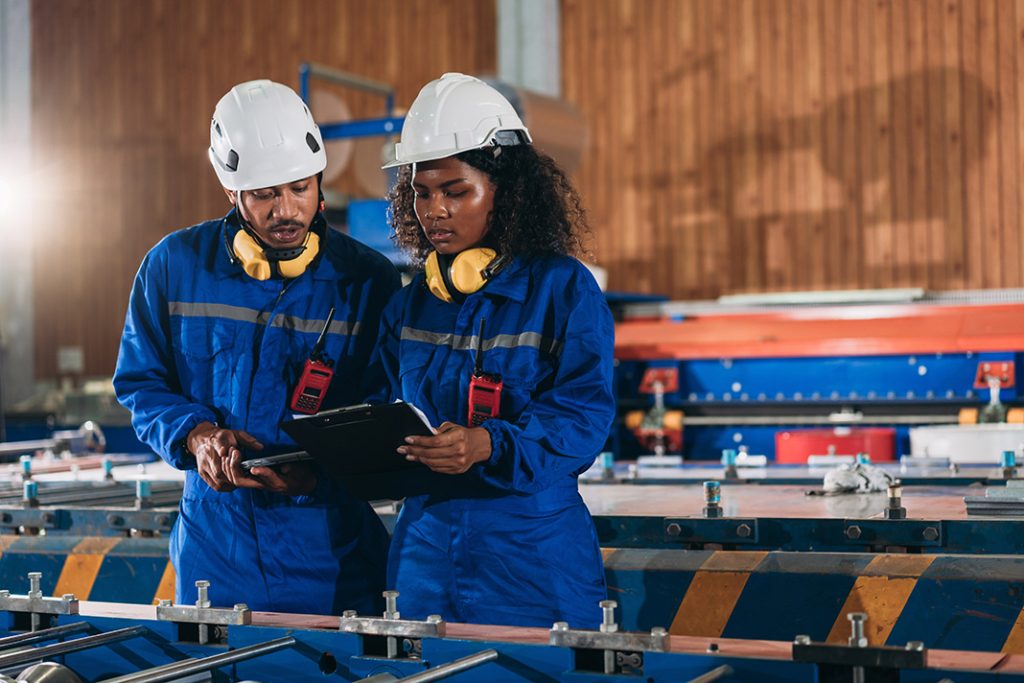
For decades, the senior quality inspector’s job was fundamentally observational. Their mental model, built over years of hands-on experience, was the detection system. Vision Language Models now perform that baseline detection faster, more consistently, and at a scale no human team can match. But what VLMs cannot do is apply metallurgical reasoning or understand why a surface anomaly that looks identical to yesterday’s benign variation might represent a critical failure mode today because the incoming raw material lot changed.
That contextual, causal reasoning is precisely where human expertise migrates in the software-defined factory. The veteran inspector’s role does not disappear. It evolves from primary observer to primary teacher, the person responsible for instructing the model on what an anomaly means, not just what it looks like.
The talent implications extend further. Deep manufacturing expertise has always been concentrated in individuals who can only be in one place at one time. Spatial AI changes that constraint. A specialist monitoring 3D point cloud representations of ten machining cells simultaneously is doing something that was structurally impossible five years ago. The effective supervisory span of a single expert expands without adding headcount.
The brittleness problem is equally important. A production line calibrated for one grade of steel becomes unreliable when the supplier delivers a slightly different alloy. Traditional rule-based automation requires manual recalibration every time inputs shift. A software-defined workforce, where specialists orchestrate adaptive AI, handles that variability through generalization rather than recalibration.
Statistics
The Manufacturing Institute has consistently documented a widening skills gap in manufacturing, with workforce readiness research highlighting that the next wave of shortfalls will be cognitive and analytical rather than purely technical or trade-based.
Expert Analysis
Analysis from McKinsey’s manufacturing practice indicates that advanced digital twin deployments can increase the effective supervisory span of skilled workers by significant multiples, making the case that workforce strategy must be redesigned in parallel with technology investment, not after it.
Real-World Example
Aerospace and defense manufacturers deploying spatial computing platforms are already encountering this dynamic in their quality organizations. A single senior inspector, equipped with a 3D point cloud monitoring interface, can maintain oversight of multiple assembly stations simultaneously, intervening only when the system surfaces an anomaly requiring human contextual judgment. What previously required a team is now managed by one specialist with significantly higher consistency.
The inflection point is the maturation of Vision Language Models capable of reliable visual inspection at industrial scale. When AI can perform the observation layer, the human role naturally shifts to the reasoning and orchestration layer. This transition is happening in 2025 and 2026 as VLM deployment in manufacturing moves from pilot to production.
Three steps are most urgent. First, identify which existing specialists have the strongest capacity for semantic reasoning and metalinguistic description of their own expertise. Second, create explicit job descriptions and training pathways for the AI Orchestrator role before the need becomes critical. Third, audit existing digital twin and spatial computing investments to ensure workflow design reflects human-AI collaboration, not human replacement or parallel operation.
Quality inspection, predictive maintenance, and process engineering are the immediate impact zones. Aerospace, automotive, precision manufacturing, and defense suppliers with high regulatory and tolerance requirements feel this shift earliest. Any operation that has invested in digital twin technology or spatial computing infrastructure is already at the threshold of needing to answer this question.
Previous automation waves replaced physical tasks. This wav7e restructures cognitive tasks. The difference matters for workforce planning because the workers best suited to the Software-Defined Technician role are domain experts with decades of experience, not entry-level employees. The transition requires retaining and retraining senior talent, not replacing it.
The knowledge transfer problem was necessary and urgent. But it was also the easier half of the challenge. The harder question, what do specialists actually do once their expertise is inside the machine, is the one that will determine whether manufacturing organizations extract real value from their AI investments or simply digitize the past. The Software-Defined Technician is not a distant future role. It is the job that needs to be defined, trained for, and hired toward today.

About the Author:
Dijam Panigrahi is Co-founder and COO of GridRaster, a spatial computing platform purpose-built for industrial enterprises deploying AI-powered quality, maintenance, and process applications. He writes on the intersection of spatial AI, human capital strategy, and the future of manufacturing operations.
Read more from the author:
2026: The Rise of Agentic Smart Factories | Industry Today, January 2026
3D AI with AR and VR Technology | Industry Today, February 2021

Forging the Next 250 Years: Powering the Next Era of American Manufacturing
As manufacturers offer more customization than ever before, managing product complexity has become a critical challenge. Tune in with Dan Joe Barry, Vice President of Product Marketing at Configit, who explores how companies are tackling the growing number of product configurations across engineering, sales, manufacturing, and service. He explains how Configuration Lifecycle Management (CLM) helps organizations maintain a single source of truth for configuration data. The result: fewer errors, faster quoting, and the ability to deliver customized products at scale.
Get In Touch
Google news and SEO compliant, Industry Today’s state-of-the-art digital media platform offers bespoke media campaigns that target key decision makers and buyers to achieve your marketing and promotional goals.

Contribute
Showcase your brand and promote your business to our highly targeted audience. We offer detailed Google Analytics with measurable ROI to assure success. Submit your content for review by our Editorial team who will contact you to discuss the project further.
About Us
Reach Your Targeted Audience and Grow Your Business. Learn more About Industry Today.
Contact Us

© 2026 Industry today. All Rights reserved.