Construction projects produce data, on the ground and in the office. Digital site management puts the data to work with an AI-enabled edge.
By Elwyn McLachlan, Sector Vice President, Civil Solutions, Trimble
Construction is one of the most data-intensive industries on the planet. A single large project generates millions of data points daily—equipment positions, inspection logs, material deliveries, labor hours, progress photos, and countless field decisions.
Yet turning that data into timely, actionable insight across every team member remains one of construction’s greatest challenges. The tools have evolved over the decades, but the fundamental disconnect persists on job sites of every kind, from highway corridors and high-rise towers to water treatment facilities and data center campuses. In many cases, the visibility in the office and the reality on the ground remain stubbornly out of sync, updated in batches or reconciled weeks or even months later.
Digital site management is designed to close that gap by connecting office and field in a continuous, two-way flow of information that gives every project contributor the right data at the right time, with artificial intelligence (AI), specifically physical AI, now becoming the force multiplier that is making both possible at scale.
Every construction project begins in the digital realm with schedules, budgets, site layouts, 3D models, and specifications developed before a single shovel breaks ground. Those plans are handed off to the physical world, where project teams interpret, adapt, and execute against ever-changing conditions: soil variability, weather, equipment availability, and the decisions that get made in the field every day. The flow does not stop there. As work progresses, data from the job site—progress tracking, inspections, as-built conditions—must be captured and pushed back into the digital model.
The return loop is where digital site management delivers some of its greatest value. Equipment utilization is tracked in one platform. RFIs and submittals are managed in another. Data arrives in different formats, used once and filed away, and, too often, none of that data connects in real time.
Digital site management binds these streams together, creating a continuous flow of information from planning through construction and into the operational life of the finished asset. Norway’s Randselva Bridge remains one of the most cited examples in digital construction delivery. Constructed without a single 2D drawing, it relied on a common data environment that kept every member of the project team working from the same live model, a clear demonstration of what becomes possible when the digital-to-physical-to-digital continuum is fully realized.
More recently, South Carolina-based Landmark Construction began work on a manufacturing campus. The contractor deployed more than 150 pieces of equipment across a 1,600-acre site, every dozer and grader equipped with grade control technology. A common data environment controlled the entire project; updates pushed to every machine simultaneously. On their best days, crews moved 60,000 to 70,000 cubic yards of material, a pace made possible only by keeping data moving freely between field and office.
In another example, Lancaster Development, a highway and civil construction firm in Richmondville, New York, views digital site management as a way to reduce rework, one of construction’s most persistent sources of waste. The firm is targeting an 80% reduction in administrative workload—not by adding headcount, but by establishing a single source of truth across estimating, field tracking, scheduling, and financial management. As company president Mark Galasso puts it, being slow and being chaotic are the two most dangerous things for any business, and both trace back to the same root cause: not having accurate data when you need it.
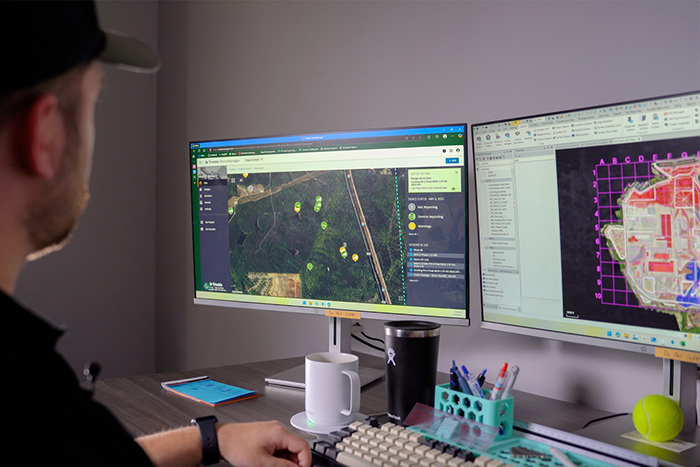
Digital site management does not require AI to deliver value. But AI is increasingly making it significantly more powerful. A modern construction site generates information in a staggering variety of formats: sensor feeds, mobile field logs, equipment telematics, inspection reports, progress photos. Even with strong digital tools in place, that volume and variety makes it nearly impossible for any one team to maintain a complete picture of what is happening on site.
AI helps in two important ways. First, it standardizes data from different sources into a consistent framework so that patterns begin to emerge, such as budget overruns, rework, or equipment sitting idle.
Second, it acts. Algorithms flag potential clashes before they become costly. Deep learning tools extract features from massive point cloud data sets in minutes rather than hours. AI-assisted estimating and contract review tools are turning days of administrative work into hours.
AI is emerging in other ways to further drive productivity and safety.
A newer category of AI, physical AI is a real-time feedback loop that assists operators in making optimal decisions in the field, turning heavy equipment into an active contributor to how work gets planned and executed on site, extending the same connected intelligence that flows between office and field down to the machine itself. Physical AI is not a future state — it is already embedded in tools that help surveyors verify precision and machine operators validate field activities in real time. What makes it possible, and difficult to replicate, is the precise geospatial data underneath it, the layer that tells the machine not just what to do, but exactly where it is in the world.
Skilled dozer operators think like chess masters, planning several moves ahead. Getting the earthwork sequence wrong means moving dirt twice, burning fuel, and slowing every trade that follows. That expertise takes years to develop and is increasingly hard to find given the skilled workforce shortage.
Physical AI bridges that gap through augmentation, not replacement. By tracking machine position and movement patterns continuously, these systems assess whether an operator is working efficiently toward the task goal and suggesting adjustments when a better method exists, putting the equivalent of a seasoned operator’s instincts within reach of every crew on every job site. Looking ahead, that same connected intelligence could detect an incoming weather event, warn a site foreman, and automatically generate the retention pond design, machine assignments, and operator instructions—with the human role shifting toward supervision, choosing from pre-analyzed options rather than building solutions from scratch.
The contractors making the greatest gains in the field and in the office share a common trait: they have stopped treating field data and office data as separate streams and started managing them as one.
When a project manager has access to a live digital model rather than weekly progress reports, decision latency drops and small variances get addressed before they become costly change orders. When AI standardizes and acts on the data flowing through that model, the gains multiply. The construction industry has spent decades building the physical world. It is now building a reliable digital picture of itself to match—and the pace of that transformation is accelerating.
The tools are here. The data exists. What is emerging now is the intelligence to finally use it, and the connected ecosystem to put it to work across every team, every machine, and every decision on the job site.

About the Author:
Elwyn McLachlan is vice president of civil solutions at Trimble. In this role, she is responsible for global product development and strategy for the company’s technology solutions for the civil construction sector, which includes Trimble’s machine control, construction surveying and site management solutions.
McLachlan joined Trimble in 1995. She has held various roles in product development, strategy and business management across the Geospatial, Transportation and Construction sectors.
She holds a bachelor’s degree from the University of Canterbury in Christchurch, New Zealand, and a master’s of business administration from the University of Edinburgh in the United Kingdom. She currently lives in Colorado and is based out of Trimble’s Westminster, Colorado office.
Trimble is a global technology company that connects the physical and digital worlds, transforming the ways work gets done.
Read more from the author:
Trimble to explore real-world technology integration at ConExpo-Con/Agg 2026 | Heavy Equipment Guide, January 16, 2026
Four Benefits of Construction Technology Subscriptions | ForConstructionPros, August 2, 2024

Forging the Next 250 Years: Powering the Next Era of American Manufacturing
As manufacturers offer more customization than ever before, managing product complexity has become a critical challenge. Tune in with Dan Joe Barry, Vice President of Product Marketing at Configit, who explores how companies are tackling the growing number of product configurations across engineering, sales, manufacturing, and service. He explains how Configuration Lifecycle Management (CLM) helps organizations maintain a single source of truth for configuration data. The result: fewer errors, faster quoting, and the ability to deliver customized products at scale.
Get In Touch
Google news and SEO compliant, Industry Today’s state-of-the-art digital media platform offers bespoke media campaigns that target key decision makers and buyers to achieve your marketing and promotional goals.

Contribute
Showcase your brand and promote your business to our highly targeted audience. We offer detailed Google Analytics with measurable ROI to assure success. Submit your content for review by our Editorial team who will contact you to discuss the project further.
About Us
Reach Your Targeted Audience and Grow Your Business. Learn more About Industry Today.
Contact Us

© 2026 Industry today. All Rights reserved.