2.3M audits reveal why most LPA programs miss benchmarks – and why leadership matters most.
In high-performing audit programs, leaders do their audits on time. The message to everyone else: plant floor checks matter, and they are everyone’s job
Over the course of a year, manufacturers using the EASE platform conducted more than 2.3 million layered process audits (LPAs) across 2,200+ sites in over a dozen industries. Our Layered Process Audit Benchmark Report, the first of its kind to analyze LPAs at scale, sheds light on how manufacturers are actually running these programs.
LPAs are quick checks of critical process inputs, completed daily by multiple levels of the organization from frontline supervisors to senior leaders. Required by major automotive OEMs, they’re becoming common wherever companies face strict requirements or set a higher bar for quality.
The report data shows both progress and risk, and puts numbers behind one inescapable truth: the most powerful lever for quality improvement starts at the top.
The average organization in our analysis completed 8,702 audits in a year, closing out nearly 1,500 findings. Those numbers have an undeniable impact. Every finding caught is a problem that didn’t become a defect, a complaint, or worse. And that’s the whole point of layered audits: getting more eyes on the process to prevent problems, instead of having to spend all your time on fire drills.
These numbers prove that LPAs work, but most companies still fall short when it comes to disciplined execution and follow-up. For example, only 27% of organizations hit best-practice benchmarks for on-time audit completion, while just 28% of plants close more than 60% of their findings on time.
Late audits and late corrective actions add up to less visibility into quality issues and slower improvement, increasing costs in plants already struggling with margin pressure and economic uncertainty.
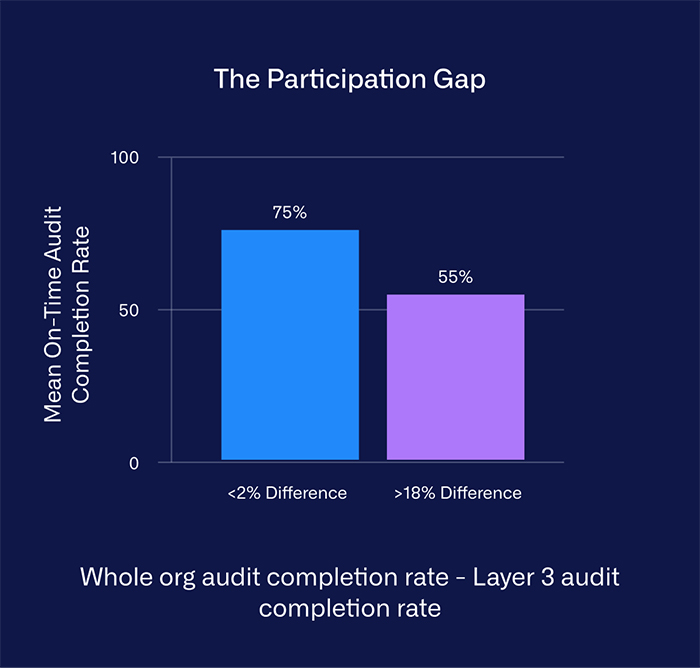
Organizations with the smallest gap between leadership and organization-wide audit participation achieve a 75% on-time audit completion rate. Those with the widest gap only reach 55%. That 20-point swing is statistically significant (P<0.0001), meaning the chance it’s just a coincidence is vanishingly small.
What it means is that leadership participation is strongly associated with the entire organization’s performance, for better or worse.
If you’re a consistent presence on the plant floor, completing your own checks on time and holding your team accountable to the metrics, people notice. If you constantly let other priorities rule the day, people notice that as well, and it sends the message that LPAs aren’t that important.
The implication is clear. Leaders can’t expect the frontline to take an active role in quality when they’re not willing to do it themselves.
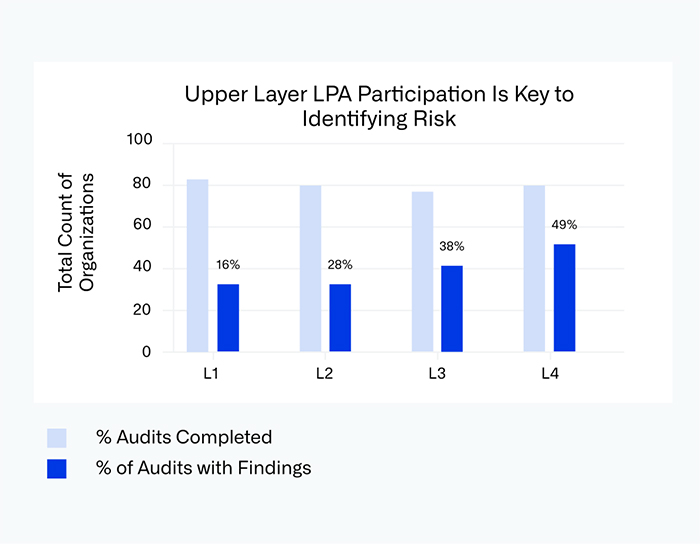
One of the most surprising insights from the report is that frontline supervisors doing the majority of checks identify findings in just 16% of audits. Senior leaders, meanwhile, find issues in nearly half of their checks.
This evidence of widespread pencil-whipping represents a reality check for any leader running structured quality or safety checks in their plants. Either frontline auditors don’t notice nonconformances, or they don’t log them as findings them when they do.
Audit length is one contributing factor, with the data showing that 44% of audits run too long. When audit fatigue sets in, people stop paying attention.
On a fundamental level, however, this check-the-box attitude exists because the frontline doesn’t understand why audits matter. That’s leadership’s responsibility to fix, and if the frontline doesn’t get it, then leaders haven’t done their job.
The report benchmarks LPA performance across three dimensions: on-time audit completion, on-time findings closure, and audit engagement. Most organizations are still in the earliest maturity stage for on-time completion and findings closure while showing more progress on engagement, where companies break roughly evenly across all stages.
Does a digital audit platform make a difference? Organizations running digital LPAs for two or more years do show consistently higher audit completion rates overall, with fewer low performers. But software alone isn’t enough to move up the maturity scale.
This is where it’s important to understand the People-Process-Tools framework: committed people and stable processes must be in place before tools can have meaningful impact.
If you’re not seeing results from your LPA program like lower scrap costs and fewer complaints, start by asking whether leaders are modeling the behaviors you want to see. Performance reflects leadership. If the program isn’t working, that’s where you need to look first.
Download the full Layered Process Audit Benchmark Report for the complete maturity model, detailed findings, and practical steps for every stage of the journey.
Leaders must take an active role by:
Establish clear closure timelines and escalation paths for overdue findings. Discuss audit metrics in leadership meetings and help identify roadblocks in the process. Educate your team on problem-solving tools like 8D, 5Y and Fishbone diagrams.
About 10 minutes. Keep checklists focused on high-risk questions that are clear and quick to answer.
About the Author:
Josh Santo is Senior Director of Industry Strategy & Solutions at EASE.io, where he helps manufacturers deploy digital technologies across their frontline operations. A manufacturing industry voice for more than a decade, he’s also the host of The Shop Floor, Top Floor Talk Show, a podcast featuring real conversations with manufacturing pros on operational leadership and continuous improvement.
Read more from the author:
How to Ensure Your Corrective Actions Work, and Keep Working | Manufacturing Tomorrow, May 26, 2025

Forging the Next 250 Years: Powering the Next Era of American Manufacturing
As manufacturers offer more customization than ever before, managing product complexity has become a critical challenge. Tune in with Dan Joe Barry, Vice President of Product Marketing at Configit, who explores how companies are tackling the growing number of product configurations across engineering, sales, manufacturing, and service. He explains how Configuration Lifecycle Management (CLM) helps organizations maintain a single source of truth for configuration data. The result: fewer errors, faster quoting, and the ability to deliver customized products at scale.
Get In Touch
Google news and SEO compliant, Industry Today’s state-of-the-art digital media platform offers bespoke media campaigns that target key decision makers and buyers to achieve your marketing and promotional goals.

Contribute
Showcase your brand and promote your business to our highly targeted audience. We offer detailed Google Analytics with measurable ROI to assure success. Submit your content for review by our Editorial team who will contact you to discuss the project further.
About Us
Reach Your Targeted Audience and Grow Your Business. Learn more About Industry Today.
Contact Us

© 2026 Industry today. All Rights reserved.