AI can accelerate manufacturing decisions, but only when product data and configuration rules are aligned.
When manufacturers apply AI to disconnected product data, they risk moving the errors within that data through the business faster. AI is only effective if it’s grounded in shared configuration logic that reflects what can actually be sold, built and delivered.
According to a new global survey of manufacturing leaders, 79% are now actively investing in or exploring AI, up from 64% in 2025. The share who are already heavily investing has nearly doubled in a single year, from 16% to 28%. Manufacturers are moving quickly and the industry is all-in, barreling toward its AI-enabled future.
Manufacturers are managing more product complexity than ever, responding to more requests for custom configurations, and facing more pressure to quote accurately and deliver reliably. AI can help, but its ability to do so depends on the quality of the data and logic it works from. For most manufacturers, that foundation is fragmented. In complex manufacturing, inconsistent data produces bad quotes, invalid configurations, inaccurate delivery commitments and margin erosion that often goes untraced back to its source.
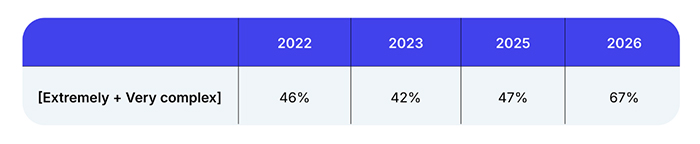
The same survey found that 67% of manufacturers describe their products as very or extremely complex, a jump of 20 percentage points in a single year.
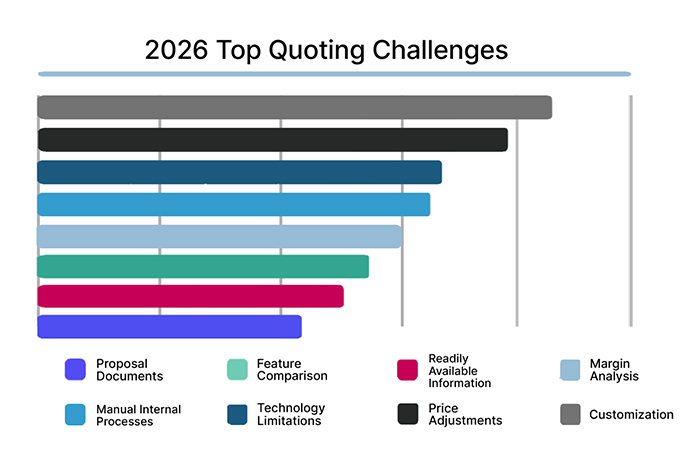
Customers feel that complexity early, especially when they are trying to navigate product options. Thirty-nine percent of manufacturers say the size of their product portfolio makes selection overwhelming for buyers, while 43% cite customization as their top quoting challenge. And 93% of engineering teams spend moderate to very high effort just maintaining configuration rules across their systems.
Every team across the organization should be working from the same version of product reality, but that’s rarely the case. Sales needs accurate information about what can actually be sold, engineering needs to know what was promised, and production needs to know what it’s being asked to build.
When each of those teams carries a slightly different interpretation of the product, pulled from different systems, updated at different times, and governed by different rules, the gaps between the customer promise and the reality on the floor grow with every order. That’s the environment into which many manufacturers are now introducing AI, which serves as a natural accelerant for whatever data foundation already exists.
Those gaps become especially visible at the moment of quote, when product complexity turns into a customer commitment.
A quote in complex manufacturing is a price, a technical commitment and a delivery promise all wrapped into one. It defines what can be configured, what can be built and when it can be delivered.
According to the same survey, 46% of manufacturers are now using third-party CPQ software, up 19 percentage points since 2022. Customization remains the top quoting challenge, and it continues to rise.
When a quote goes out without validated configuration logic behind it, the problems get handed off downstream. Engineering inherits the exceptions. Production absorbs the corrections. Delivery commitments made before parts availability has been confirmed or engineering constraints have been checked become the starting point for rework, change orders and delays.
Forty percent of manufacturers in the survey say they are not fully confident in the delivery commitments they make at the time of quote. AI can help at this stage. It can steer buyers toward valid configurations earlier, catch constraint violations before they propagate and help compress response times on complex RFQs. Only 15% of manufacturers currently respond to RFQs in under 24 hours, even as most handle hundreds per month.
If the configuration logic behind the quote is inconsistent or incomplete, the guidance will be too. That just means more mistakes at higher velocity, moving the same errors through the business faster.
According to the survey, only 7% of manufacturers define configuration rules once and reuse them across the full lifecycle. For the other 93%, the rules governing what can be sold, built and delivered exist in multiple places, maintained separately, and not guaranteed to agree with each other.
CPQ holds one version. Engineering systems hold another. ERP has its own. Each team works from the system closest to them, and the gaps between those systems show up as errors, rework and missed commitments.
Only 23% automatically generate valid manufacturing bills of materials from sales quotes, which means most organizations still have to translate what was sold into what production needs to build. Each manual translation creates another place for assumptions to change, errors to enter and costs to drift from the original quote.
Teams relying on separate systems report significant or critical margin issues at nearly twice the rate of teams using a single shared system (23% compared with 12%). And 62% of manufacturers report moderate to severe margin erosion between quote and delivery. That risk can begin much earlier, when a quote is built on configuration assumptions that were never fully verified.
AI inherits those same assumptions. It reasons from the information it receives. Conflicting product definitions lead to conflicting outputs, and a fast answer built on incomplete logic is still an incomplete answer.
AI needs a governed set of configuration rules that travels consistently from sales through engineering into production, reflecting what has been approved, what can be built and what the supply chain can realistically support.
AI investment should continue with discipline and a clear view of the foundation it requires. Manufacturers already investing heavily in AI show significantly stronger visibility into product and configuration performance at 80%, compared to 56% for those still in the exploration stage.
When the rules governing what can be sold and built are defined once and flow consistently across sales, engineering and production, AI can help organizations move faster, catch errors before they compound and give customers more reliable answers earlier in the buying process.
Manufacturing has always required precision in design, production, and delivery. The same standard applies to the data that AI runs on. Connecting sales, engineering, production, and fulfillment around a shared configuration truth is what gives AI the accuracy it needs to be genuinely useful and manufacturers the confidence to stand behind their commitments.

About the Author:
Klaus Andersen is CEO of Tacton, which provides CPQ buyer engagement software for manufacturers of complex products. He has led global technology companies through transformation, growth, and scale.

Forging the Next 250 Years: Powering the Next Era of American Manufacturing
As manufacturers offer more customization than ever before, managing product complexity has become a critical challenge. Tune in with Dan Joe Barry, Vice President of Product Marketing at Configit, who explores how companies are tackling the growing number of product configurations across engineering, sales, manufacturing, and service. He explains how Configuration Lifecycle Management (CLM) helps organizations maintain a single source of truth for configuration data. The result: fewer errors, faster quoting, and the ability to deliver customized products at scale.
Get In Touch
Google news and SEO compliant, Industry Today’s state-of-the-art digital media platform offers bespoke media campaigns that target key decision makers and buyers to achieve your marketing and promotional goals.

Contribute
Showcase your brand and promote your business to our highly targeted audience. We offer detailed Google Analytics with measurable ROI to assure success. Submit your content for review by our Editorial team who will contact you to discuss the project further.
About Us
Reach Your Targeted Audience and Grow Your Business. Learn more About Industry Today.
Contact Us

© 2026 Industry today. All Rights reserved.