How can CPG finance leaders model rapid trade policy shifts and protect profit margins before costs hit the shelf?
By Matej Trbara, Co-Founder at Farseer
Amid shifting global trade policies, consumer packaged goods (CPG) companies face a quiet crisis. Changing tariff rates can move faster than traditional annual budgeting, impacting packaging, ingredient, and sourcing costs before finance teams can evaluate the profit & loss (P&L) impact. Organizations relying on manual spreadsheets are trapped in a reactive loop, explaining historical losses rather than preparing for future shocks. To survive real-time trade volatility, CPG finance leaders must transition to unified, real-time FP&A platforms that connect tariff exposure directly to operational business drivers.
For consumer packaged goods (CPG) organizations, volatile tariff rates are immediate operational disruptions. A single tariff adjustment can trigger a chain reaction, increasing packaging, ingredient, and supplier costs before finance departments can evaluate the full profit and loss impact.
When cost assumptions shift overnight, traditional budgeting models typically fail to keep pace. Waiting weeks for a consolidated view of actuals and forecast scenarios is a major risk that few teams can afford. If a finance team cannot calculate the direct impact of tariff changes in minutes, commercial teams will deploy promotions and discounts that systematically erode gross profits.
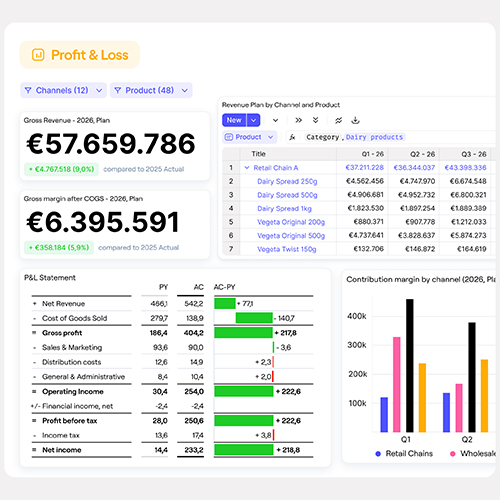
Despite investments in ERP, the month-end close and rolling forecasts at most CPG firms are still held together by manual spreadsheets. Analysts spend most of their time acting as “data janitors” – manually extracting data, stitching files, and fixing broken formulas. This patchwork “spreadsheet glue” is error-prone and inevitably leads to version-control chaos.
When tariff rates shift, a team using Excel must manually update every product line and customer rebate. By the time these spreadsheets are compiled, the data is already stale, forcing commercial teams to make decisions in the dark. This spreadsheet dependency turns trade volatility into enterprise risk, while also accelerating talent burnout as finance teams grow exhausted from unnecessary manual work
To protect profitability, CPG companies must transition to a unified financial operating system that unifies the data warehouse (DWH), business intelligence (BI), and enterprise performance management (EPM) in a single platform. Rather than performing manual exports, finance must establish bidirectional synchronization with core ERP systems to keep transaction ledger data continuously aligned with live planning models.
A recent Gartner survey showed that 73% of finance functions prefer a tightly governed source for data while only 3% of companies actually have aligned strategic, operational, and financial planning processes. Finance leaders who adopt a unified foundation are enabled to build driver-based models, linking results to operational metrics like sales volumes, ingredient weights, shipping routes, and customer rebates.
In this scenario, when a tariff changes, the recalculation propagates instantly across P&Ls, cash flows, and balance sheets simultaneously. This can be powered by in-memory engines like Farseer’s proprietary Rama calculation engine, which processes millions of cells in seconds. Not only aligning the data faster, but also connecting it to other key metrics to better inform decision-making.
The operational benefits of real-time, driver-based margin planning are demonstrated by leading consumer distribution and manufacturing companies that have abandoned spreadsheet-based workflows:
“Most finance teams are still working across fragmented systems, spreadsheets, and manual processes. Farseer takes a different approach: the governed model does the math, the AI does the reasoning, and every answer points back to the definitions finance teams have already agreed upon.”
— Matej Trbara, Co-Founder, Farseer
CPG companies operate in low-margin, high-volume environments where overreacting to short-term changes is as damaging as underreacting. Raising prices too aggressively in response to temporary supply chain congestion risks losing market share, while absorbing structural tariff increases collapses EBITDA margins.
CFOs need the ability to stress-test models and evaluate downside risk using Cost-Volume-Profit analysis and flexible budget variance, reconciled dynamically across all operational tables. By running instant “what-if” simulations on a single platform, finance professionals can check margin safety ranges and evaluate supplier alternatives before making critical commercial moves.
By running instant “what-if” simulations on a single platform, finance professionals can check margin safety ranges and evaluate supplier alternatives before making critical commercial moves. Transitioning to a unified, real-time FP&A system is no longer a luxury; it is the ultimate operational shield against trade volatility.
Traditional annual budgeting assumes static twelve-month conditions. Overnight tariff changes make static budgets obsolete quickly, forcing teams into endless spreadsheet re-forecasting cycles.
Real-time models link financial statements directly to operational drivers. Adjusting a cost or tariff driver instantly displays the margin-level impact across all SKUs, allowing proactive pricing and target adjustments.
Yes. No-code platforms like Farseer use plain-English formulas and an Excel-like interface, allowing finance teams to own and modify models without IT help or consultants.
Unifying DWH, BI, and planning (EPM) into one system ensures that all reports draw from a single source of truth and identical definitions, eliminating spreadsheet-based conflicts.

About the Author:
Matej Trbara is a co-founder at Farseer, a rapidly growing SaaS company dedicated to optimizing business modeling, planning, and analysis. Drawing on deep expertise in financial strategy and operational forecasting, he specializes in helping CFOs and enterprise finance teams transition from manual spreadsheet models to automated, driver-based planning systems. Matej previously served as an Engineering Manager at DeepAR.ai and ShopAR, where he led core development teams building 3D and Augmented Reality (AR) face-tracking SDKs. He holds a Master’s degree in Computer Software Engineering from the University of Zagreb and specializes in transitioning complex data frameworks into automated enterprise solutions.
Read more from the author:
Moving beyond the spreadsheet to continuous forecasting | Accounting Today, 6/18/26
Tech news: Deloitte announces unified agentic intelligence network | Accounting Today, 6/26/26

Forging the Next 250 Years: Powering the Next Era of American Manufacturing
As manufacturers offer more customization than ever before, managing product complexity has become a critical challenge. Tune in with Dan Joe Barry, Vice President of Product Marketing at Configit, who explores how companies are tackling the growing number of product configurations across engineering, sales, manufacturing, and service. He explains how Configuration Lifecycle Management (CLM) helps organizations maintain a single source of truth for configuration data. The result: fewer errors, faster quoting, and the ability to deliver customized products at scale.
Get In Touch
Google news and SEO compliant, Industry Today’s state-of-the-art digital media platform offers bespoke media campaigns that target key decision makers and buyers to achieve your marketing and promotional goals.

Contribute
Showcase your brand and promote your business to our highly targeted audience. We offer detailed Google Analytics with measurable ROI to assure success. Submit your content for review by our Editorial team who will contact you to discuss the project further.
About Us
Reach Your Targeted Audience and Grow Your Business. Learn more About Industry Today.
Contact Us

© 2026 Industry today. All Rights reserved.