Why continuous gas analysis matters.
In industry, hydrogen is used as a feedstock, a reducing agent, a protective atmosphere and a cooling medium. In each of these applications, what matters is not only its share of the gas stream but also the impurities it contains. Oxygen in electrolytic hydrogen creates the risk of a flammable mixture. Carbon monoxide poisons catalysts. Inert gases in a recycle loop reduce the hydrogen partial pressure in the reactor. Even a small deviation in quality can affect plant operation before a laboratory analysis reveals it.
For this reason, hydrogen quality is increasingly monitored not only through periodic sampling but also continuously, directly in the process. For continuous measurement of hydrogen concentration in process streams, a hydrogen gas analyzer installed inline or in a bypass can be used. Individual impurities are monitored with dedicated analyzers, while full verification against a specification remains a task for the laboratory.
This article explains what hydrogen quality consists of, how it depends on the production route and the application, why periodic sampling is often not enough and how a continuous monitoring system is set up.
Hydrogen quality is described by three groups of parameters. Which of them matters most depends on the process.
The strictest requirements apply to hydrogen used as fuel for proton exchange membrane fuel cell vehicles. ISO 14687 (in Europe, EN 17124 sets equivalent requirements) specifies a minimum purity of 99.97 % for this application, together with separate limits for each impurity. Carbon monoxide, for example, is limited to 0.2 µmol/mol, and total sulphur compounds to 0.004 µmol/mol. Even trace amounts of such impurities reduce the activity of the fuel cell catalyst, either partially or irreversibly.
The impurity profile is determined by how the hydrogen is produced. The list of parameters to monitor therefore starts with the source.
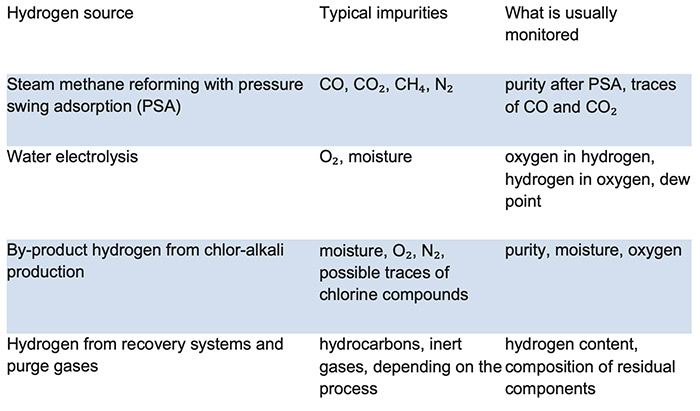
With electrolysis, product purity depends on the electrolyser technology and on the drying and purification stages. The characteristic components to monitor are oxygen and moisture. With steam reforming, the PSA unit remains the critical point: if the cycle is disrupted or the adsorbent becomes saturated, CO and CO₂ break through.
The same impurity can have very different significance in different processes. Typical relationships are shown below.
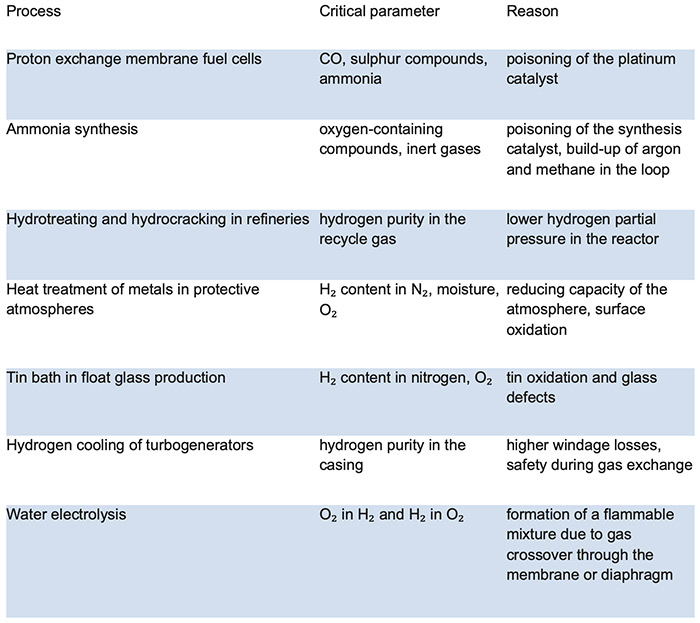
The last item concerns safety. At atmospheric pressure and room temperature, the lower flammability limit of hydrogen in oxygen is about 4 vol.%; under other conditions it may differ. At partial load, the proportion of hydrogen crossing over to the oxygen side of an electrolyser can increase. The hydrogen content of the oxygen is therefore monitored continuously, and the operating alarm and shutdown thresholds are set by the electrolyser manufacturer with the necessary safety margin.
Laboratory analysis gives the most complete picture of composition, but it reflects the state of the gas only at the moment the sample is taken. Hours, and sometimes entire shifts, pass between samples. In addition, time is needed for transport, preparation and analysis before a result is available.
Hydrogen quality changes more often than samples are taken. Typical causes of short-term deviations include:
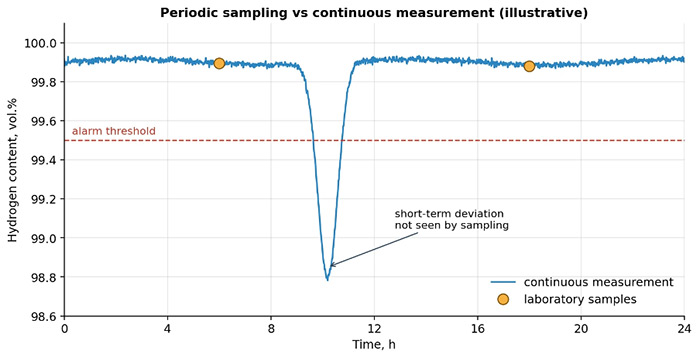
If a deviation appears and disappears between two samples, the laboratory will not see it, yet products or equipment have already received gas of inadequate quality. Continuous analysis closes this gap. It does not replace the laboratory but complements it: the laboratory confirms compliance with the specification, while the inline analyzer shows what happens between samples.
The continuous signal from an analyzer serves several purposes.
Measuring points are distributed along the chain from hydrogen production to the consumer. Different parameters are monitored at each stage.
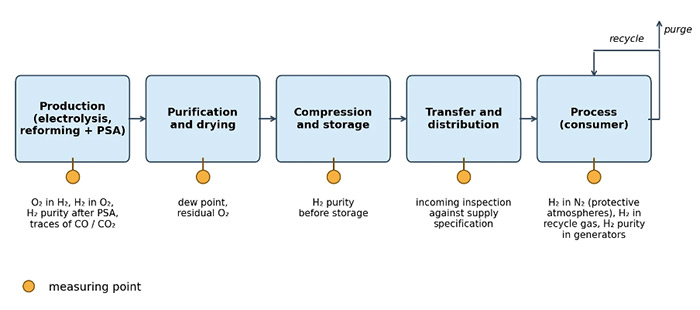
At the production unit outlet. Downstream of an electrolyser, oxygen in hydrogen and hydrogen in oxygen are measured. Downstream of a PSA unit, hydrogen purity and traces of CO and CO₂ are measured.
After purification and drying. Dew point and residual oxygen are monitored to confirm that dryers and catalytic deoxidisers are working. Hydrogen purity is verified before compression and storage so that gas of inadequate quality does not enter the storage vessels.
At receipt and transfer. When hydrogen is delivered by trailer, by pipeline or from a third-party producer, incoming inspection confirms that the gas meets the contractual specification.
At the consumer. In protective atmospheres, the hydrogen content in nitrogen is measured; in recycle loops, the hydrogen content of the recycle gas; in turbogenerators, the hydrogen purity in the casing.
Filling and emptying turbogenerators is a separate task. To prevent hydrogen and air from forming a flammable mixture, the casing is first purged with carbon dioxide. During purging, the hydrogen content in CO₂ and the air content in CO₂ are measured; in normal operation, the hydrogen purity is monitored.
Continuous monitoring of hydrogen quality usually combines several analyzers, each responsible for its own parameter.
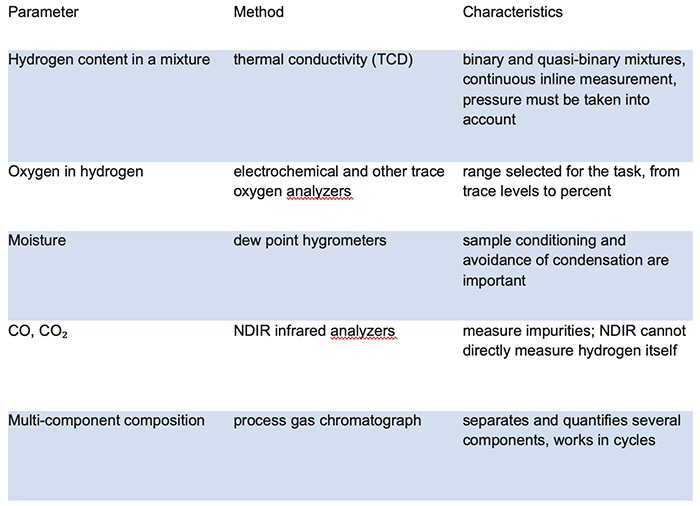
The thermal conductivity method holds a special place here. The thermal conductivity of hydrogen is considerably higher than that of most other gases, so even a small change in its content noticeably changes the heat removed from a heated sensing element. The method requires no reaction with the gas and is suitable for continuous measurement. Depending on the sensor design, gas pair and calibration, TCD analyzers cover tasks from low hydrogen concentrations up to 100 vol.%.
The limitation of the method must be considered when selecting a measuring point. Thermal conductivity characterises the mixture as a whole, so the method is designed for binary and quasi-binary mixtures: hydrogen in nitrogen, hydrogen in argon, hydrogen in CO₂. In refinery recycle gas, the background composition may vary; accurate determination of the hydrogen content then requires either a stable background or a chromatograph. The result is affected by the pressure at the measuring point, which is either stabilised or compensated using readings from a pressure sensor.
Before selecting analyzers, it helps to answer the following questions.
No. Confirming compliance of fuel cell hydrogen with the specification requires the determination of many impurities at very low levels, which is done with laboratory methods. Continuous analyzers monitor selected parameters between laboratory analyses.
Purity shows the total proportion of impurities but not their composition. For fuel cells, 0.2 µmol/mol of CO is more critical than a much larger amount of nitrogen. Critical impurities are therefore monitored separately.
Water vapour changes the thermal conductivity of the mixture and acts as a third component. If the moisture content of the gas fluctuates, the sample is dried or its influence is taken into account when setting up the measurement.
Hydrogen can pass through the membrane or diaphragm to the oxygen side. Monitoring its content in the oxygen is necessary to prevent the formation of a flammable mixture, especially at partial load.
The interval is specified by the manufacturer. It depends on the method, the range, the operating conditions and the accuracy requirements.
Hydrogen quality comprises purity, the content of individual impurities and the stability of process mixture composition. The requirements are determined by the process, and the set of monitored parameters by the hydrogen source. Laboratory analysis confirms compliance with the specification but does not capture changes between samples. Continuous inline analysis closes this gap: it makes it possible to raise alarms in time, control the process and document quality. For the hydrogen content of a mixture, the thermal conductivity method is particularly well suited, provided the mixture is binary or quasi-binary and the influence of pressure is taken into account. For individual impurities and multi-component composition, it is complemented by oxygen and moisture analyzers, infrared analyzers and process chromatography.

Forging the Next 250 Years: Powering the Next Era of American Manufacturing
As manufacturers offer more customization than ever before, managing product complexity has become a critical challenge. Tune in with Dan Joe Barry, Vice President of Product Marketing at Configit, who explores how companies are tackling the growing number of product configurations across engineering, sales, manufacturing, and service. He explains how Configuration Lifecycle Management (CLM) helps organizations maintain a single source of truth for configuration data. The result: fewer errors, faster quoting, and the ability to deliver customized products at scale.
Get In Touch
Google news and SEO compliant, Industry Today’s state-of-the-art digital media platform offers bespoke media campaigns that target key decision makers and buyers to achieve your marketing and promotional goals.

Contribute
Showcase your brand and promote your business to our highly targeted audience. We offer detailed Google Analytics with measurable ROI to assure success. Submit your content for review by our Editorial team who will contact you to discuss the project further.
About Us
Reach Your Targeted Audience and Grow Your Business. Learn more About Industry Today.
Contact Us

© 2026 Industry today. All Rights reserved.