Manufacturers can lay the groundwork for more reliable AI by preserving the knowledge behind product and engineering decisions.

By Rob McAveney, CTO, Aras
How can manufacturers prepare AI to support trustworthy engineering decisions?
The future value of AI in manufacturing will depend less on the sophistication of AI models than on the engineering context organizations make available to them. Every design decision, workflow, approval, and product change can contribute to a richer understanding of not only what happened, but why. Manufacturers that strengthen their digital thread today are doing more than improving traceability. They are building the organizational memory that AI can operate against today and that increasingly capable agents can learn from tomorrow.
For years, manufacturers have viewed the digital thread primarily as a way to connect product data across the lifecycle. The emphasis has been on improving traceability, eliminating data silos, and ensuring teams work from a consistent source of product data. Those goals remain important, but the role of the digital thread is expanding.
Nearly 80% of manufacturers plan to increase spending on AI tools in the next 12 to 24 months. Making those investments count will require more than adding AI to existing processes. AI can summarize documents, search specifications, analyze large datasets, or automate repetitive work. But engineering decisions depend on context. Why was a requirement changed? Which alternatives were considered? What supplier, manufacturing, cost, regulatory, or quality constraint influenced the outcome? What happened downstream as a result? If that context disappears after the decision is made, AI cannot reliably reconstruct it later.
This changes how manufacturers must think about the digital thread. Connecting product data remains the foundation. The next step is preserving the context around how that data came to be.
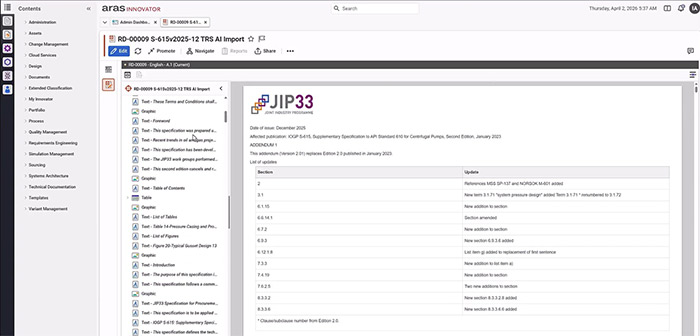
Engineering organizations generate enormous amounts of knowledge every day, but much of it is difficult to reuse. Final designs are always preserved, but the reasoning that produced them often is not.
Teams know which requirement changed or which engineering change was approved, but the assumptions, alternatives, tradeoffs, and constraints behind those decisions may remain scattered across meetings, emails, documents, spreadsheets, and individual experience.
For engineering teams, that creates a coordination problem. Engineers spend time reconstructing previous decisions. New employees must rediscover context. Teams repeat analysis that has already been done.
For AI, the gap is even more fundamental. A model can identify patterns across large volumes of data, but it cannot recover decision rationale that was never captured.
This is where the digital thread begins to take on a new role. In addition to connecting requirements, product structures, changes, manufacturing processes, quality data, and service records, it can preserve the context surrounding the decisions that connect them.
Over time, those decision traces create organizational memory: a record not simply of what the product became, but how and why it became that way.
“The organizations that derive the greatest value from AI will not necessarily have the most data; they will have the most complete understanding of why engineering decisions were made.”
— Rob McAveney, CTO, Aras
That memory has immediate value for engineers trying to understand prior work. It also creates richer context for AI to use as intelligent capabilities become more deeply embedded in engineering workflows.
Connected, trusted product data is the foundation for AI, but it is not the entire picture. The decisions made around that data provide another layer of context: why something changed, what alternatives were considered, and which constraints shaped the outcome.
Consider an engineering change order. A traditional record may tell us which components changed, who approved the change, and when the revision took effect. That is essential for configuration management, traceability, and compliance, but it does not necessarily tell us why the change happened. Was there a supplier constraint? A manufacturing problem? Did the team reject another option because it created unacceptable cost or schedule risk? Those relationships matter because engineering decisions rarely exist in isolation. Every change can create downstream effects across requirements, manufacturing, quality, procurement, suppliers, compliance, and service.
Capturing the decision trace gives both people and AI more context for understanding those relationships. Instead of seeing only the final state of the data, they can understand the path that produced it.
That distinction will become increasingly important as AI moves beyond search and summarization toward analysis, recommendations, and more autonomous tasks. An agent evaluating a new engineering change must be able to distinguish trusted data from inference, understand relevant dependencies, and recognize where human judgment is required.
The digital thread built today provides that operational context. The decisions captured through those workflows can also become valuable inputs for developing and improving future agents.
Manufacturers are not simply accumulating more data. They are creating a history of how work gets done.
As AI takes on more work across engineering workflows, organizations must be able to trust how that work gets done. That requires governance, observability, and explainability.
Governance establishes clear operating rules, traceable decisions, and controlled authority. Organizations must define what data an agent can access, what actions it can take, and where human approval is required.
Observability provides visibility into agent behavior and resource consumption. Organizations must be able to see what an agent is doing, which resources it is using, and how it operates within the workflow. Patterns will emerge across the agentic ecosystem that will provide opportunities for optimization.
Explainability provides the “why” behind recommendations and actions. Engineers must be able to understand the rationale behind an outcome so they can evaluate it in context.
A team might initially allow an agent to analyze a large dataset and recommend an action while a human validates every result. As confidence grows, the agent may take on more of the workflow while humans focus on exceptions, tradeoffs, and higher-value decisions. Trust must be earned at each stage.
Engineering accountability does not disappear as AI becomes more capable. Humans still provide judgment, creativity, oversight, and responsibility for decisions that affect product quality, safety, compliance, and business outcomes.
The goal is not to remove engineers from the process. It is to make sure their attention is applied where human judgment creates the most value.

Manufacturers do not need to wait for a massive AI transformation to begin building this foundation. Start with one workflow. Look for work that consumes significant time because teams must gather data, reconcile it, identify relationships, or repeatedly reconstruct context before they can make a decision. Requirements ingestion, engineering change analysis, supplier data review, issue triage, and compliance checks are all examples.
Then ask a different set of questions. What work can AI perform well? Where is human judgment required? What context must be captured? How will the outcome be validated? And how will the organization know why a recommendation or action occurred? The answers define how work can be delegated to AI without giving up human judgment and accountability.
An agent might handle the volume of data, identify relationships, or surface anomalies. The engineer validates the result and applies judgment. The interaction and resulting decision become part of the digital thread. Then move to the next workflow.
This incremental approach creates value now while building richer decision traces over time. Better workflows produce better context. Better context enables more capable AI. And as trust grows, organizations can responsibly delegate more work.
AI readiness is not a destination or a one-time technology project. It is a capability that develops every time an organization makes its engineering data more connected, its decisions more traceable, and its workflows more observable.
As AI capabilities advance, their value will depend on the context organizations have built around them. Manufacturers that build that foundation now can delegate more work to AI without sacrificing human judgment and accountability.
AI models can process enormous amounts of data, but recommendations are more useful when they include the engineering and business context surrounding a decision. Capturing design intent, tradeoffs, approvals, and change history gives AI the context needed to understand relationships rather than simply recognize patterns.
No. Most manufacturers can make meaningful progress by connecting existing data, improving governance, capturing richer workflow context, and modernizing key engineering processes incrementally. The objective is not to replace every application. It is to preserve context as work moves across them.
A mature digital thread provides the connected, trusted, and contextual data AI needs to support engineering decisions across the product lifecycle. As organizations also preserve decision traces and rationale, the digital thread becomes a form of organizational memory that can provide context for AI today and help make future agents more capable.

About the Author:
Rob McAveney brings a lifelong passion for technology to the CTO role at Aras. For the past 20 years, he has focused that passion on building rich software platforms that solve difficult business problems for major industrial companies. Rob acts as Aras’ technology visionary and provides design oversight for future PLM technology, while remaining grounded in the realities of configuration management, systems integration, and the many other challenges of delivering enterprise software. Prior to Aras, Rob led technical sales engagements for Eigner, an early entrant in the PLM market. He began his career at Boeing, where he gained a broad understanding of engineering and manufacturing systems and processes.
More from the author:
Driving Business Growth Through a Downturn | Industry Today, May 2023

Forging the Next 250 Years: Powering the Next Era of American Manufacturing
As manufacturers offer more customization than ever before, managing product complexity has become a critical challenge. Tune in with Dan Joe Barry, Vice President of Product Marketing at Configit, who explores how companies are tackling the growing number of product configurations across engineering, sales, manufacturing, and service. He explains how Configuration Lifecycle Management (CLM) helps organizations maintain a single source of truth for configuration data. The result: fewer errors, faster quoting, and the ability to deliver customized products at scale.
Get In Touch
Google news and SEO compliant, Industry Today’s state-of-the-art digital media platform offers bespoke media campaigns that target key decision makers and buyers to achieve your marketing and promotional goals.

Contribute
Showcase your brand and promote your business to our highly targeted audience. We offer detailed Google Analytics with measurable ROI to assure success. Submit your content for review by our Editorial team who will contact you to discuss the project further.
About Us
Reach Your Targeted Audience and Grow Your Business. Learn more About Industry Today.
Contact Us

© 2026 Industry today. All Rights reserved.