AI is reshaping how manufacturers are discovered and evaluated, making clear, credible digital content increasingly important.
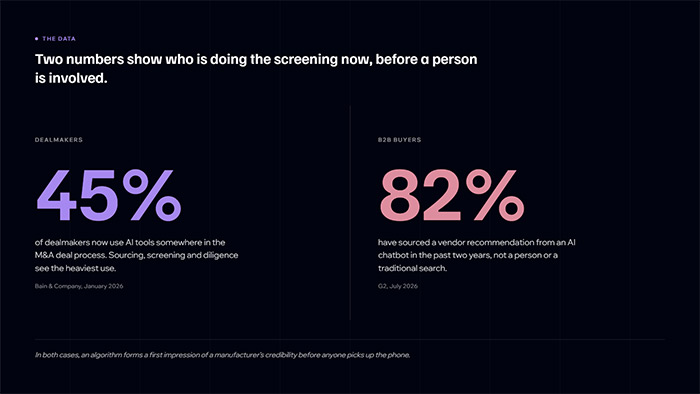
Increasingly, yes. In M&A, 45% of dealmakers now use AI tools somewhere in the deal process, and sourcing, screening and diligence are the heaviest areas of use (Bain & Company, January 2026). On the buying side, 82% of B2B buyers have sourced a vendor recommendation from an AI chatbot in the past two years rather than through a person or a traditional search (G2, July 2026). In both cases, an algorithm is forming a first impression of a manufacturer’s credibility before anyone picks up the phone.
Traditional M&A due diligence still runs on financials, contracts and legal exposure once a deal process formally opens. But the earlier phase, deciding which targets are worth approaching at all, is now substantially AI-assisted. Deloitte’s October 2025 survey of 1,000 corporate and PE leaders found generative AI adoption across M&A workflows at 86%, concentrated most heavily (40% of adopters) in strategy and market assessment – the stage where a longlist of targets gets narrowed before anyone makes contact.
The same pattern is showing up further upstream, in ordinary buying decisions. G2’s July 2026 research, based on more than 1,000 B2B software buyers and over 50 interviews with sales and marketing leaders, found 82% had sourced a vendor or software recommendation from an AI chatbot such as ChatGPT or Google AI Mode within the past two years. Whether the reader is a corporate development analyst scanning acquisition targets or a procurement manager shortlisting suppliers, a growing share of that first-pass judgement is now formed by a model reading a company’s public content, not a person reading it directly.
Working with engineering and manufacturing clients on positioning through Nebula, the practical gap is consistent and still widely missed: most manufacturers’ websites are written for a person to skim, not for a model to extract facts from. Case studies sit as PDFs behind a contact form, capability statements stay vague (“a wide range of solutions”), and the concrete proof – certifications, named clients with permission, project scale, sector experience – is scattered across the site or missing entirely. Asked to summarise that company for a dealmaker or a buyer, an AI system has very little accurate material to draw on, and will either under-represent the business or leave it out of the answer altogether.
“A manufacturer no longer gets to make its first impression on a person. Increasingly, it makes that impression on an AI system summarising its website to someone else, and it never finds out whether that summary was accurate.”
— Anna Soboleva, Nebula
Bain’s January 2026 report includes a concrete example of the mechanism at work: a corporate development team used AI tools to scrape public sources, including LinkedIn, to model a target company’s workforce structure and cost base to within 90% of the real figures – entirely before any direct approach to the company. That is what being evaluated by AI before a human looks like in practice, and it depends entirely on how much accurate, specific information about the company exists publicly for a model to work from.

No. The same AI-assisted screening now happens whenever a new customer, JV partner or lender is evaluating an unfamiliar supplier, not only during formal M&A.
Specific, structured facts: named capabilities, real project examples, certifications and a plain description of who the company serves, rather than broad claims a model has nothing concrete to extract.
No. It shifts where the earliest screening happens; the formal financial, legal and technical review still follows.
Publishing two or three detailed, named case studies, with client permission, and a plainly worded capability summary usually does more for how a company gets represented than any other single change.
As AI tools take on more of the earliest screening work in both dealmaking and ordinary buying decisions, the companies that get represented accurately, and found at all, will increasingly be the ones whose public content gives a model something concrete to work with.

About the Author:
Anna Soboleva is the founder of Nebula, a marketing consultancy helping engineering and technical B2B companies build a stronger, more credible presence online. Find out more at nebulas.uk.
Read more from the author:
“What electronics buyers check before they ever get in touch”, Electronic Specifier, 4 September 2026
Sources
Bain & Company, “M&A Capability for a New Era: Five Ways AI Is Creating More Value in M&A Right Now”, 27 January 2026 – bain.com/insights/capability-for-a-new-era-m-and-a-report-2026
Deloitte, GenAI in M&A survey of 1,000 corporate and PE leaders, 9 October 2025 – deloitte.com/us/en/about/press-room/deloitte-survey-genai-in-mna
G2, 2026 Buyer Behavior Report, 22 July 2026 – company.g2.com/news/buyer-behavior-2026

Forging the Next 250 Years: Powering the Next Era of American Manufacturing
As manufacturers offer more customization than ever before, managing product complexity has become a critical challenge. Tune in with Dan Joe Barry, Vice President of Product Marketing at Configit, who explores how companies are tackling the growing number of product configurations across engineering, sales, manufacturing, and service. He explains how Configuration Lifecycle Management (CLM) helps organizations maintain a single source of truth for configuration data. The result: fewer errors, faster quoting, and the ability to deliver customized products at scale.
Get In Touch
Google news and SEO compliant, Industry Today’s state-of-the-art digital media platform offers bespoke media campaigns that target key decision makers and buyers to achieve your marketing and promotional goals.

Contribute
Showcase your brand and promote your business to our highly targeted audience. We offer detailed Google Analytics with measurable ROI to assure success. Submit your content for review by our Editorial team who will contact you to discuss the project further.
About Us
Reach Your Targeted Audience and Grow Your Business. Learn more About Industry Today.
Contact Us

© 2026 Industry today. All Rights reserved.