Circular-material startups can reduce scale-up risk by validating feedstocks, production requirements and customer demand before committing capital.

By Joshua W.J. Brown
Circular-material startups should treat dedicated manufacturing capacity as a late-stage decision, not proof that the material works. The early job is to establish source authority, material composition, process transferability, industrial machinability, finished-part performance and a buyer specification. A factory should answer demonstrated demand; it should not be the experiment used to discover what the market or the feedstock actually requires.
“The cheapest factory is the one you discover you do not need to build.”
— Joshua W.J. Brown
The conventional startup sequence can encourage a dangerous inversion. A team develops promising laboratory material, converts that promise into equipment requirements, raises money for a pilot or small plant, and only later discovers the exact conditions under which a converter, packaging buyer or procurement team will accept the output.
That sequence can convert uncertainty into fixed assets before the uncertainty has been resolved.
The alternative is qualification-first manufacturing. Instead of asking, “What machine should we buy?”, the first questions become: What is the source? What varies? What process step creates the useful property? Can an existing industrial process handle it? What would make a buyer reject it? What result would justify spending the next dollar?
A 2024 paper in Bioresource Technology Reports by Senghor and colleagues demonstrated that Typha domingensis and Phragmites australis could be processed into paper sheets and rigid packaging under the study conditions. The paper is important because it moves beyond a generic “biomass valorization” argument into physical paper and tray formation. It is not, however, proof that a different regional feedstock will run commercially on standard equipment.
In direct correspondence about transferring that work to a new source, co-author Professor Joseph D. N. Bassama identified cellulose content, lignin content and cellulose-extraction yield as the first variables to establish. He also cautioned that the study’s pulp-production step used sodium hydroxide and that a materially different source would require the extraction process to be revisited rather than assumed transferable. He advised keeping paper properties separate from tray properties and choosing one application lane before spending on the other.
That is a useful manufacturing rule: reproduce the mechanism before optimizing the business around it.
The laboratory can establish whether a fibre can be processed. Industry asks whether it can be supplied, run and sold.
Nicola Galaffu, a co-author of the same paper with packaging-industry experience, reduced that translation boundary to six practical issues: cost, contaminant levels, raw-material availability, raw-material accessibility, machinability in standard mills, and the mechanical properties of the finished material.
Those six gates are more useful to an early manufacturer than a long list of speculative product applications.
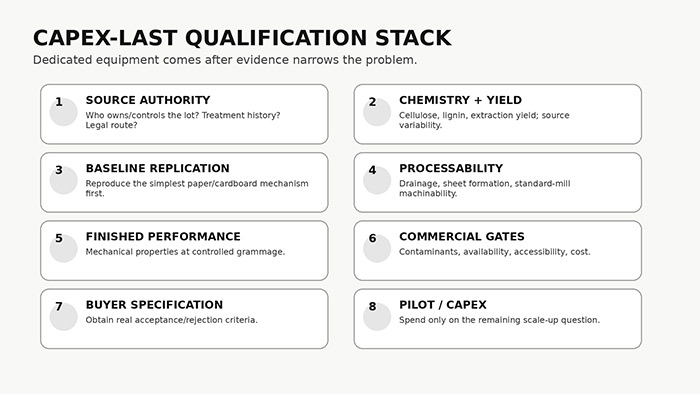
For an alternative-fibre project, a defensible evidence sequence is therefore:
The source problem becomes more important when the input is an invasive plant rather than a conventional agricultural residue.
Ontario lists invasive Phragmites, Phragmites australis subsp. australis, as a restricted invasive species. Provincial guidance warns against accidentally spreading it through root fragments or seeds, tells people to clean equipment when leaving infested areas, and says invasive Phragmites should not be composted. Ontario’s legal framework also distinguishes restricted species from prohibited species and provides specific exceptions and conditions for control, management, commercial, agricultural and maintenance activities.
That means a serious manufacturing project cannot reduce compliance to the phrase “render it non-viable.” It needs a source-by-source record of authority, location, treatment history, handling conditions, transport route and intended disposition. Material qualification begins only after that source record is coherent.
This is one reason I have narrowed the current XENOCRAFT × Chromaverse Naturals work rather than presenting it as a mature manufacturing company. The venture remains pre-incorporation, pre-revenue and pre-commercial-prototype. The immediate objective is not to build a Phragmites factory. It is to determine whether one bounded, legally sourced alternative-fibre route survives the evidence gates that would make later manufacturing rational.
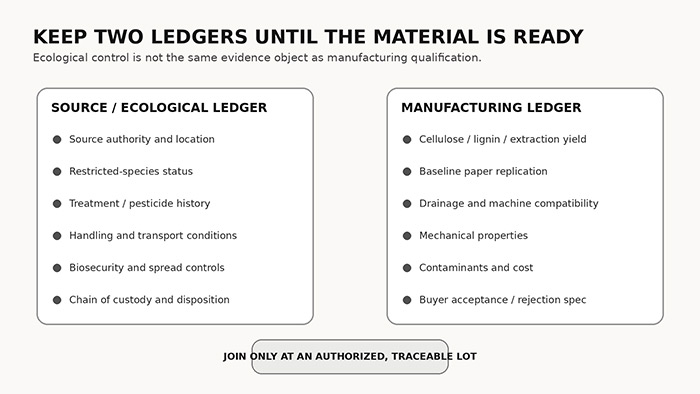
Service-first does not mean pretending that field-service revenue already exists. It is a sequencing rule.
Where there is legitimate demand for ecological field work, source documentation, controlled biomass handling, procurement support or other bounded services, those activities can be evaluated as businesses in their own right. A separate material-development lane can then use authorized and traceable lots for R&D without making the manufacturing business dependent on winning the ecological work.
The two ledgers should meet only when the material is lawfully available and technically qualified.
This separation also creates an ecological stop rule. If management succeeds and the invasive source declines, the manufacturing architecture should accept a substitute feedstock that meets the same functional specification or retire the source-specific route. A circular business should not need the environmental problem to continue in order to protect its factory utilization.
A pilot can be justified when it answers a defined scale-up question that bench methods and existing equipment cannot answer. It is premature when the source chemistry, processability, buyer specification or legal route is still undefined.
No. It can establish a mechanism or performance within the tested method and material. Transfer to a different source, geography, process line or product specification requires new evidence.
Measurement and access before dedicated production capacity: characterization, controlled replication, processability testing, external equipment access and buyer-defined acceptance criteria.
Manufacturing discipline begins before manufacturing. Source authority, composition, process transfer, equipment compatibility, finished-material performance and buyer rejection criteria should narrow the problem until capital has a specific job to do. The result may be a factory, a contract-manufacturing route, a different feedstock—or a documented decision not to build.

About the Author:
Joshua W.J. Brown is a Toronto-based independent researcher, writer and systems architect developing XENOCRAFT × Chromaverse Naturals as an early-stage materials and ecological-services venture. His work focuses on evidence control, manufacturing qualification, institutional systems and commercialization.
Read more from the author:
Digital Accessibility Must Preserve the State of Our Work | Disabled World, 28 August 2026.
Sources
Senghor et al., “Typha domingensis and Phragmites australis as alternative and sustainable pulp materials for primary paper based packaging,” Bioresource Technology Reports 25 (2024), 101712. https://doi.org/10.1016/j.biteb.2023.101712
Ontario, “Phragmites fact sheet,” “Invasive Phragmites best management practices,” Invasive Species Act, 2015, and O. Reg. 354/16.
Expert input: Joseph D. N. Bassama, correspondence, 17 September 2026; Nicola Galaffu, correspondence, 16 September 2026.
Forging the Next 250 Years: Powering the Next Era of American Manufacturing
As manufacturers offer more customization than ever before, managing product complexity has become a critical challenge. Tune in with Dan Joe Barry, Vice President of Product Marketing at Configit, who explores how companies are tackling the growing number of product configurations across engineering, sales, manufacturing, and service. He explains how Configuration Lifecycle Management (CLM) helps organizations maintain a single source of truth for configuration data. The result: fewer errors, faster quoting, and the ability to deliver customized products at scale.
Get In Touch
Google news and SEO compliant, Industry Today’s state-of-the-art digital media platform offers bespoke media campaigns that target key decision makers and buyers to achieve your marketing and promotional goals.

Contribute
Showcase your brand and promote your business to our highly targeted audience. We offer detailed Google Analytics with measurable ROI to assure success. Submit your content for review by our Editorial team who will contact you to discuss the project further.
About Us
Reach Your Targeted Audience and Grow Your Business. Learn more About Industry Today.
Contact Us

© 2026 Industry today. All Rights reserved.